Why people are flocking to experience the Titanic disaster

 FKP Scorpio Entertainment
Immersive shows recreating the ocean liner's fateful voyage are attracting audiences globally. But are they valuable historical experiences, or cynically turning tragedy into entertainment?
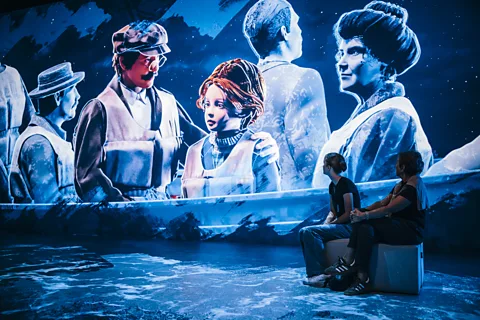
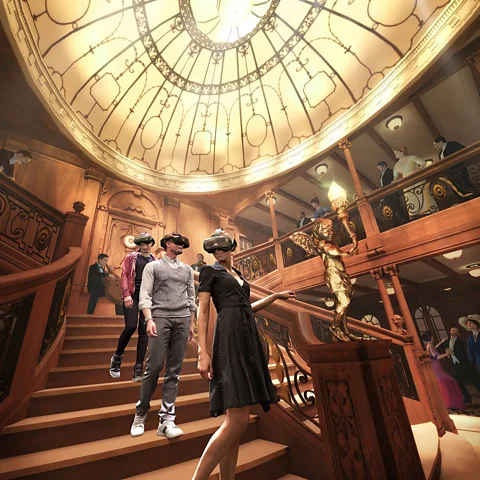
The grand interior rooms of the Titanic are slowly filling up with water. Videos projected on to the floor, ceiling and walls of a warehouse in south London show fixtures and fittings disappearing beneath the waves. This is one of the centrepieces of The Legend of the Titanic: The Immersive Exhibition, which has been designed to make ticketholders feel as if they are aboard the fated ocean liner, using a mix of video projections and virtual reality (VR) sections, where visitors put on a headset.
In the exhibition's gift shop, there are souvenir whistles to attract attention, and postcards of the ship sinking surrounded by icebergs. Couples queue to pose against a green screen so they can recreate the famous Leonardo DiCaprio and Kate Winslet pose from the 1997 James Cameron film at the bow of the ship. Others play "avoid the iceberg" computer games on a computer in which you have to steer the ship between icy obstacles, or drink prosecco in the bar. The multiple VR segments, which allow you to stride along the deck in the sunshine and wander through the boat's opulent interiors, as well as venture in a submersible to the wreck, are genuinely transportative. But the aforementioned part of the experience in which you are surrounded by 360-degree video projections of the ship filling up with water, feels distasteful, and more voyeuristic than educational or emotional.
 FKP Scorpio Entertainment
The exhibition has a pretty positive 4.2 score on TripAdvisor, with ticketholders complimenting the VR technology, information boards and storylines. Visitor Julie Akhtar from Virginia Water in Surrey, England, says she felt transported "from the moment we walked through the doors" and the VR element made her "feel part" of life aboard the ship. Her only criticism was that the tickets were expensive and "the opportunity to have a photo posing as Kate Winslet and Leonard DiCaprio for me was a little commercial". Sarah Mattock from Brighton, was equally impressed. "It was a good effort," she says. "I went in knowing it's a little crass, but have always been intrigued by Titanic since I was young."
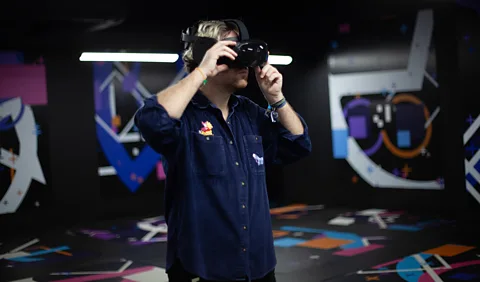
This is one of at least threeimmersive Titanic experiences going on in the UK at the moment. At Titanic: Echoes from the Past, another one of these in the north London borough of Camden, guests witness the boat hitting the iceberg. Unlike The Legend of the Titanic exhibition, it is a purely VR experience. Wearing the headset, I get up close to senior crew members, and later I'm striding towards the bow when the storyline takes me to that fateful night. Orchestral music crescendos as the ship inches closer to the iceberg, and then workers are thrown to the floor when the impact hits. The crew say "come on, come on, we're going to make it" but then you hear the ice scraping along the side.
The rise of immersive experiences
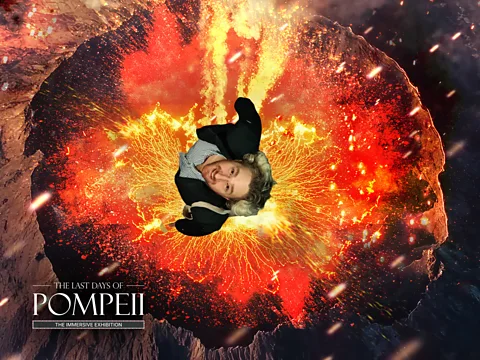
The story of the Titanic is one of dozens of historical moments that can now be relived as an immersive experience. Another new attraction in the UK capital centres on one of the most destructive ever volcanic eruptions. The Last Days of Pompeii experience in east London recreates the annihilation of the Roman city by the activity of Mount Vesuvius in 79 AD: eight-metre-high projection walls show the city burning, making visitors feel as if they are surrounded by burning ash and cinder. Meanwhile one VR segment sees audiences take a chariot ride through an arena filled with thousands of spectators, and another allows guests to walk around a family's house on the evening of the disaster. I was also asked to stand and look at a camera installed into the ceiling to pose for a photo, available for me to buy, of me superimposed against a background of molten lava, making it appear as if I was shooting out of the top of Mount Vesuvius.
 BBC/ Javier Hirschfeld
These new immersive attractions are booming. The global market for so-called immersive entertainment was estimated to be worth more than $114 bn (£85.3 bn) in 2025, with projections suggesting that figure could reach $412 bn (£308 bn) by 2030. UK searches for "immersive experience" on the events platform Eventbrite have increased by 83% over the past year, a spokesperson tells the BBC. According to to the Evolving Immersive: The 2025 Immersive Entertainment & Culture Industry Report, co-published by the Gensler Research Institute and the Immersive Experience Institute, "traditional, passive forms of media and live performance are largely stagnant or declining," while "forms of experience that centre participant engagement and interactivity continue to grow".
With Titanic immersive experiences also running in LA, Cincinnati, Hamburg, Singapore, Copenhagen and many other cities around the world, the fated ship has proved one of the most universally popular subjects for this type of attraction. A couple of factors make it particularly fascinating. The vast ocean liner was supposed to be unsinkable, and the fact that its fated voyage put some of the wealthiest people in danger – the sorts of people who never normally experience hardship – is interesting in itself. "It is one of the ultimate tragedies, a symbol of the weakness of humanity against the awesome power of nature," says Titanic historian Tim Maltin. "One of the quotes in [Echoes of the Past] is 'we're all passengers on the Titanic', and there is an extent to which that's true. It does speak to the human condition itself."
There's certainly a big audience wanting to set sail: more than 45,000 people have donned a headset to experience Echoes of the Past since it opened in February, organisers tell the BBC. But some say these immersive experiences specifically centred on disasters are exploitative because they turn real-life historical tragedy into entertainment.
 Eclipso
Such criticisms are not new: in the past they have been levelled at everything from films like Titanic itself to video games like the Call of Duty series, which allows players to fight in different historical conflicts. But the truly immersive nature of these new experiences perhaps heightens the question around their appropriateness.
The questions around recreating historical events
In her two-star review of The Legend of the Titanic exhibition, Anna Moloney from London's City AM newspaper took particular issue with the show's ethics. She tells the BBC: "As an 'immersive exhibition', The Legend of the Titanic markets itself somewhere between education and entertainment, though from dodge-the-iceberg games to grin-for-the-camera photo ops, it's clear which one it privileges. No exhibition on a tragedy should feel fun, while walking past a sombre stone that displays the names of all those who lost their lives to the tragedy before being ushered into a gift shop selling souvenir emergency whistles borders on grotesque."
The Legend of the Titanic creators were unavailable to speak to the BBC, but Karl Blake Garcia, Venue Director for Titanic: Echoes from the Past, acknowledges that there are serious considerations when it comes to how stories about real-life tragedies are told. "I'm not here to talk down any other experience," he says, "but I can definitely call out quality when I see it… [Echoes from the Past is] not about gimmicks or sensationalising a tragedy. We do get the occasional customer asking 'Oh I wish I saw the ship sink', but we found [the idea of that] a bit tasteless. You can experience the impact of the iceberg but we're not going to show you the ship going down and hundreds of people losing their lives. It's just not what we want to do."
The academic Adam Heardman, who wrote an article entitled 'against immersion' for Art Monthly, is sceptical about the value of immersive experiences full stop, telling the BBC that their rise is "a sinister development in the urban cultural landscape". For him, these shows are more about "aggressive money-making" than offering a valuable cultural experience. As for the Titanic experiences specifically, he says that "it's not hard to see why taking the tragic death of over a thousand people at sea and turning it into a blockbuster tourist diversion might be a little exploitative".
But not all critics feel the same. Time Out's theatre editor Andrzej Lukowski says that, for him, The Legend of the Titanic exhibition is a successful show that's "just big and loud and techy, and concerning a subject people have been fascinated with for a century".
And there is the argument that people have always been grimly captivated by tragedy: psychologist Coltan Scrivner's recent book Morbidly Curious argues that technology has merely thrown up new ways to satisfy this fascination. "We can create compelling, immersive simulations of disasters that will draw millions of people,” he tells the BBC. "This doesn't mean people are more interested in the macabre today; rather, it is just more accessible. My research suggests that morbid curiosity is a perfectly normal trait that is common and variable among people like any other personality trait." From that perspective, his view is that immersive disaster experiences are "not unethical".
 Scorpio/ Go Photo
Another issue entirely is accuracy. Information displayed on banners at The Legend of the Titanic exhibition features numerous typos and spacing errors, as well as "facts" that seem dubious, such as the information board which declares that "for the younger and also for the single passengers, the major amusement on board the Titanic, and on all ocean liners, was flirting". Users on social media have also been calling out inaccuracies. Promotional material for The Legend of the Titanic shows the boat hitting the iceberg on its port side, and on a cloudy night with fairly choppy water. "Call me a pedant," wrote one user on Facebook, "but Titanic grazed the berg on her starboard side, not the port side as depicted in your artwork. Oh, yes, and it was dark and the sky was clear." Representatives for the exhibition did not return BBC Culture's request for comment on these matters of accuracy.
More like this:
Richard Parry, CEO at Experience UK, the UK trade body tasked with growing the "experience economy" for visitor experiences and attractions, isn't aware of anyone drawing up ethical guidelines for producers of historical immersive shows, as exist for museums, whether regarding their quality or their appropriateness. He believes that the market will ultimately "self-censor" as to what is and isn't suitable source material.
Amid questions over these experiences' merit, one thing is fairly certain: they will continue to become more and more part of the cultural landscape. As Parry says: "There's no limit to what can be reproduced if demand is there."
--
If you liked this story, sign up for The Essential List newsletter – a handpicked selection of features, videos and can't-miss news, delivered to your inbox twice a week.
