Celebrating town's replica of the Bayeux Tapestry

 BBC
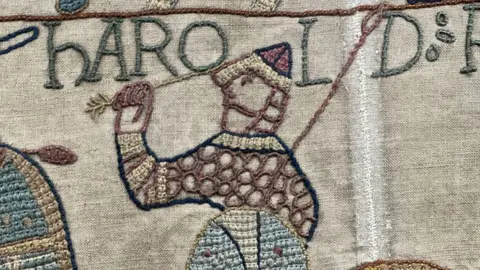
BBCReading's copy of the Bayeux Tapestry has become part of the town's DNA nearly 140 years on from its production, an expert has said.
Both tapestries depict the Norman conquest of England and the original will be loaned to the British Museum from September and insured for about £800m.
The replica, finished by about 40 women, mostly from Leek in Staffordshire by mid-1886, was bought by a Reading alderman Arthur Hill for the town in the 1890s after it had toured the world.
"I think it's become part of Reading. It's part of our DNA. Even though it's a replica, Reading took off during the Norman conquest," the manager of the town's museum, Matthew Williams, said.
"We've got Reading Abbey. It was built by the youngest son of William the Conqueror, Henry I. So to have this here to tell the story of the Norman conquest puts Reading in context."
Last year, debate raged amongst experts about the number of penises included on the original tapestry.
But the replica does not include them all because they were given censored etchings, engravings and photos of the original to work from.
"There are borders in the tapestry that show figures and mythical beasts and things but there's actually a little man who's quite famous because he's the man in pants," Williams said.
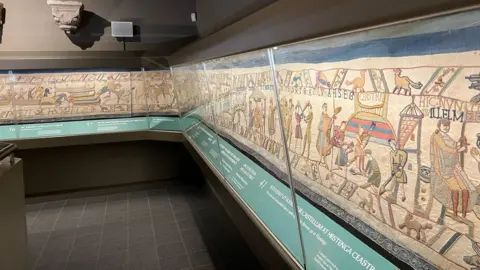
"On the original, he's not wearing pants and for years [people] blamed the Victorian women [who embroidered the replica], saying: 'Look they were being prudish, they put pants on him. He should be naked.'.
"But in fact it was the male curator at the [Victoria and Albert Museum] who had doctored the photos that they had then traced so they probably just traced these pants off those photos."
Williams added: "I think that what's lovely is almost 1,000 years ago there were women who made the tapestry… we celebrate the 140th anniversary of the tapestry and we can celebrate women and the real women on the tapestry.
"If you look at the tapestry, it's mostly men. It's a very male-dominated story and of course women would have been part of that story and it's quite nice to put women back into the story, of both the Norman conquest and the replica."
David Musgrove, from the History Extra magazine and author of The Story of the Bayeux Tapestry, said: "This is an amazing part of the long story of the Bayeux Tapestry, which is the most famous document in English history, I would argue."
He added: "I am wildly excited about the original tapestry coming to the UK. It's been a long time coming."
"None of them [previous visits] came of for various reasons, but now it's happening, partly because politics have aligned and we want to have a closer relationship with Europe, so it seems."
