Pluribus review: This new sci-fi from Breaking Bad's creator is 'one of 2025's smartest shows'

 Apple TV+
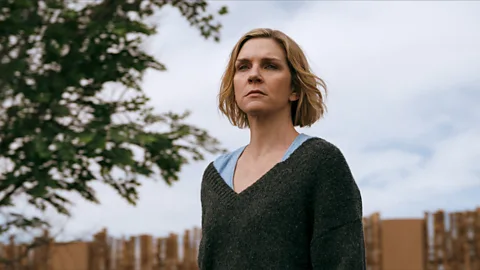
This intriguing series from Vince Gilligan stars Better Call Saul's Rhea Seehorn as a cynical woman living in a world where people are suddenly happy all the time. The result is George Orwell meets Invasion of the Body Snatchers.
If a mystery man talks directly to you by name through your television, and you're not dreaming or hallucinating, it's safe to assume the world has shifted. How and why is the question that winds through Breaking Bad and Better Call Saul creator Vince Gilligan's delightful new series. Pluribus plays like George Orwell meets Invasion of the Body Snatchers, but it still has Gilligan's distinctive voice, blending the real and the outlandish. After all, how preposterous was it for a high-school science teacher to become a drug lord, as Walter White did in Breaking Bad, or for a slimeball lawyer like Saul Goodman to be the hero we root for? Here Gilligan wraps timely social commentary in sci-fi tropes – and centres the story around a prickly but sympathetically down-to-earth heroine – to create one of the smartest, most entertaining shows of the year.
That heroine, Carol Sturka, is played by Rhea Seehorn – Kim from Better Call Saul, without Kim's distinctively unstylish ponytail – and she is perfectly in sync with Gilligan's mix of genuine emotions and wild plot turns. A cataclysmic event occurs which leaves Carol surrounded by people who are happy all the time. She was already one of the least cheerful people on the planet, and seems immune to whatever's going on around her. A best-selling romance novelist, she privately says her readers are "a bunch of dummies" for gobbling up her books, which have titles like Bloodsong of Wycaro. She is cynical and acerbic, and her droll scepticism is a great, refreshing quality in this world of people who might as well be walking, talking smiley-faces. "Nobody sane is that happy," she insists. The series puts us in Carol's place, and Seehorn's empathetic performance is both dramatic and witty, grounding the sci-fi plot in her visceral, fearful, determined reactions.
Although the show's premise plants it in the Twilight Zone, one of the many genre classics the show evokes along with Body Snatchers (Gilligan has said both are inspirations), Carol is quite precisely located. She lives in a large house in an upscale cul-de-sac in Albuquerque, New Mexico, the city where Breaking Bad and Better Call Saul take place. Those shows don't overlap with Pluribus, but the location allows Gilligan to hide some Easter eggs. The sci-fi aspect takes him back to his early days as a writer for The X-Files. But here he uses genre tropes in a knowing, meta way. "We've all seen this movie and we know it does not end well," Carol says. And the sci-fi never overwhelms her human story. Her sardonic wit and Seehorn's ever-sharp delivery make the show very funny. At times it brings to mind the comedy The Good Place. At other times it recalls the eeriness of HBO drama The Leftovers, but throughout it shifts easily from one tone to the other.
More like this:
The happy-face concept is only the start of the story, which takes many turns that are too spoilery to reveal. But Apple's trailer itself depicts the Orwellian world Carol finds herself in. A half-dozen people in her driveway greet her in creepy unison, saying "Hey, Carol". The man on her television is apparently speaking from the White House and his soothing tone is as ominous as Orwell's Big Brother. "Rest assured, Carol, we will figure out what makes you different," he says, "so you can join us." There is even a hint of what's happening in the typeface of the show's title, with the numeral 1 in place of the letter i in Plur1bus, a Latin word from the phrase E Pluribus Unum, One Out of Many.
Although Carol is often isolated in her new life, as the series goes on it travels to locations around the globe. Other significant characters include Helen (Miriam Shor), Carol's manager and beloved life partner, and Zosia (Karolina Wydra), a stranger assigned to cater to her every whim in order to try and nudge her into happiness. What would be so bad about that? Carol definitely finds out.
The credits for each episode end with the disclaimer: "This show was made by humans." The line is both a troll of the concept that artificial intelligence can create content, and an apt slogan for a series that is both a plea for humanity and freedom of thought – and that is extremely fun to watch.
★★★★★
--
If you liked this story, sign up for The Essential List newsletter – a handpicked selection of features, videos and can't-miss news, delivered to your inbox twice a week.
