Eight of the UK's cosiest thatched cottages

 Getty Images
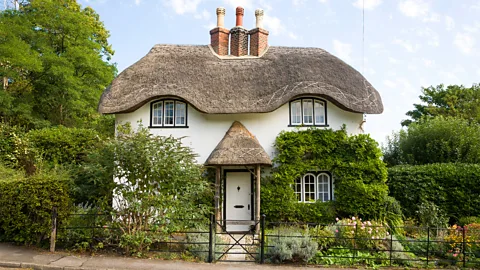
Where better to hunker down in the autumn than the ultimate snug home? The thatched cottage is romantic, sustainable, has a long, proud tradition – and is now enjoying a revival.
As the nights draw in and winter in the northern hemisphere approaches, the idea of a cosy, picturesque cottage in the countryside is a classic fantasy. On social media, the cottagecore aesthetic shows no sign of abating, and has spawned the similarly popular hashtag "cosycore". Images abound of quaint, quintessentially British cottages, their roofs often blanketed by thick thatch, with rambling roses prettily framing their front doors.
On TikTok, the idealised thatched cottage is now a compelling signifier of comfort, security, authenticity and simplicity, racking up millions of views. Cosy-culture-themed video clips sell a chocolate-box idyll of bucolic country living as cameras pan lovingly past cottage gardens with grazing roe deer, then venture indoors, revealing snug, welcoming havens of steaming mugs of tea, low ceilings, wooden beams and Willow-pattern china arranged artfully on vintage Welsh dressers.
Most thatched cottages in the UK are based in East Anglia, Dorset, Devon, Wiltshire, and the Cotswolds, as well as in rural regions of Scotland, Wales and Northern Ireland. They are also found in the Republic of Ireland, Germany, the Netherlands, Denmark, Sicily, Belgium and France. Historical precedents of this vernacular architectural tradition include thatched cottages in the pastoral hamlet built for Marie Antoinette on theVersailles estate – her escape from formal court life – along with the thatched cottages painted by artists as disparate as Van Gogh in France to Kate Greenaway in Britain.
 Getty Images
In 2006, the British cottage was celebrated in Nancy Meyers' romcom The Holiday. Rosehill Cottage, with its uneven roofline dusted with snow, was the heartwarming setting for the dalliance between the characters played by Jude Law and Cameron Diaz. Although fictitious (it was built for the film), the love nest was convincingly modelled on the real Honeysuckle Cottage in Holmbury St Mary, Surrey.
In England, thatch – usually made of such natural materials as straw, water reed or heather – remained the only roofing material available to most of the population in rural towns and villages until the late 1800s. Yet the number of thatched cottages has declined steadily since the Industrial Revolution.
This year, UK charity Heritage Crafts added Welsh and Irish vernacular thatching to its red list of endangered crafts. The specialist skills required for thatching aren't being passed down the generations as they traditionally were, so the number of skilled practitioners is falling. Thatched roofs need to be regularly rethatched, too, making thatched cottages expensive to maintain.
More like this:
"It's now believed there are around 50 to 60,000 thatched properties in the UK. About 75% of these are listed," Andrew Raffle, Secretary of the National Society of Master Thatchers, tells the BBC. "We also think there are around 800 thatchers in Britain who passionately service these buildings."
That said, thatched roofs are being revived in contemporary architecture. One prominent example in the UK is the roof of the Enterprise Centre at the University of East Anglia. And architects practice Sanei Hopkins and Richard Parr Architects have designed thatched homes in recognition of their romantic appeal and sustainability.
"The thatching renaissance comes, we think, from a wider search for natural, low-impact materials that connect buildings to place," Abigail Hopkins of Sanei Hopkins tells the BBC; her partner is co-founder Amir Sanei. "We recently chose thatch for our family home in Suffolk as it's very site-specific: there's a long tradition of thatching in Suffolk. Water reed grows nearby, making our use of it contextual and sustainable."
Here are eight examples of thatched homes in Britain.
 Getty Images
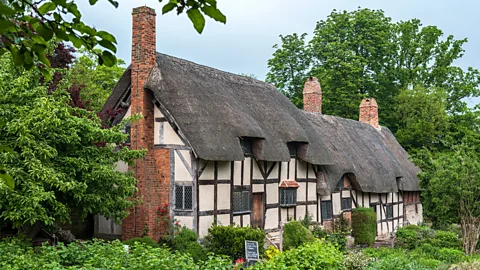
Anne Hathaway's Cottage, Shottery, near Stratford-upon-Avon, Warwickshire
"Thatched cottages trigger all sorts of signification, drawn from myth and literature," Matt Carey-Williams, founder of his eponymous London art gallery, who owns a thatched cottage in Wiltshire, tells the BBC. "They appear in Little Red Riding Hood and JRR Tolkien's the Shire [in The Hobbit and The Lord of the Rings]." Also fitting this description is Anne Hathaway's Cottage, a half-timbered building. Its construction began in 1463. William Shakespeare, who would later become her husband, is said to have courted Hathaway here. "For me, a thatched cottage needs to be set in a cottage garden that's a bit frantic but unapologetically beautiful," adds Carey-Williams. Hollyhocks and delphiniums bloom in the garden at Stratford-upon-Avon, many of whose plants are mentioned in Shakespeare plays.
 Alamy
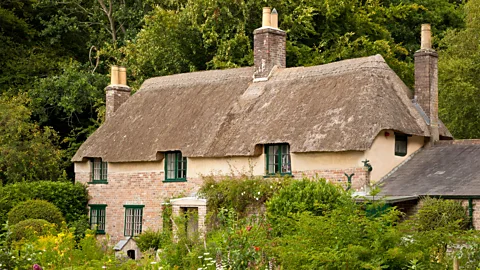
AlamyThomas Hardy's Cottage, Higher Bockhampton, Dorset
Poet and novelist Hardy was born in this cottage, built by his great-grandfather in 1800 out of cob (a mix of unburned clay and straw) and thatch. "Thatch goes well with any building materials which makes it so versatile," says Raffle. Hardy wrote his novel Far from the Madding Crowd in the cottage, and lived there until the age of 34. "Traditional thatched roofs appeal for their rounded contours," says Carey-Williams. "Their curvilinearity and the way they are so predominant (like a large spring bonnet) nourishes a sense of comfort or cheer in the viewer. They look organic and scream 'homely'." These cottages' homeliness perhaps satisfies the taste many have for shabby chic in an accessible way – without carrying anyconnotations of grand, draughty country houses.
 Matt Carey-Williams
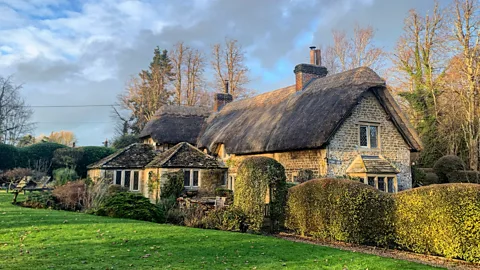
Cottage in Sandy Lane, Wiltshire, owned by Matt Carey-Williams
Carey-Williams and his husband, Donnie Roark, say they fell in love with their 18th-Century cottage in a hamlet called Sandy Lane at first sight. "We believe it's an amalgamation of cottages built as living quarters for staff at nearby Georgian pile Bowood House," says Carey-Williams. "The main reason for our architectural swoon was the roof." Their cottage is testimony to the fact that cottages today needn't have traditional interiors. "We wanted to mix both old and new here. We have low ceilings, wooden beams, creaking floorboards and George III antiques, but no patterned walls to provide a neutral backdrop for our contemporary art."
 Alamy
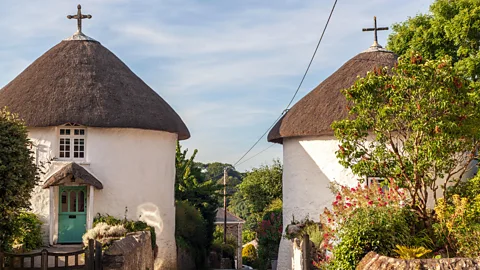
AlamyWhimsical cottages with round walls
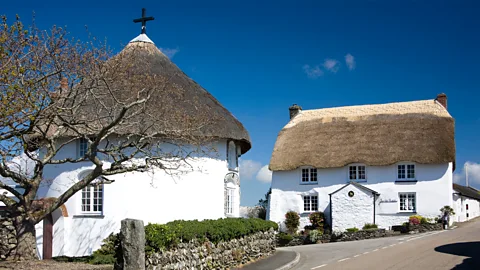
The versatility of thatched cottages is such that they can take any form, including round-walled buildings. Shown here is an example in Veryan, Cornwall, a particularly picturesque village on the Roseland Peninsula. Similar ones can be found at Winterton-on-Sea in Norfolk.
 Alamy
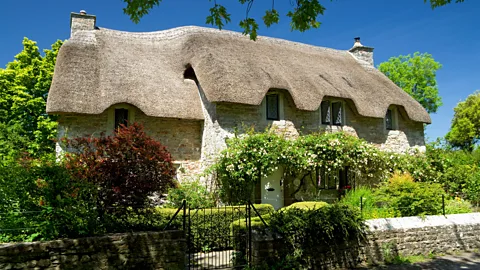
AlamyA traditional Welsh thatched cottage
There are lots of thatched cottages in Wales and Scotland boasting their own versions of cosy culture – called cwtch in Welsh and coorie in Scots. In the 18th and 19th Centuries, thatching was the most common roof covering in Wales, where it's typically steeply pitched to shed rainwater effectively. By the mid-20th Century, more durable, available and low-maintenance materials – such as slate and corrugated iron – led to a sharp decline in thatching. Today, few thatched cottages remain in Wales, but some craftspeople continue to preserve this distinctive element of Welsh vernacular architecture.
 Alamy
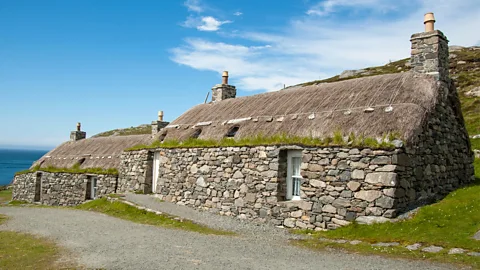
AlamyBlackhouse thatched cottage in the Hebrides, Scotland
Many thatched cottages in the Hebrides are simple, single-storey structures called blackhouses or taigh-dubh (their name in Gaelic). The term blackhouse probably derives from the fact that these cottages originally had no windows. This type of cottage has 3ft-to-6ft (1m-to-2m) stone walls to help it withstand severe Atlantic storms. Wood here is in short supply and only used for roof timbers. The buildings' roofs normally have a turf base covered with thatch. These layers are traditionally stripped off in June and used as manure to cover local crops.
 Peter Landers Photography
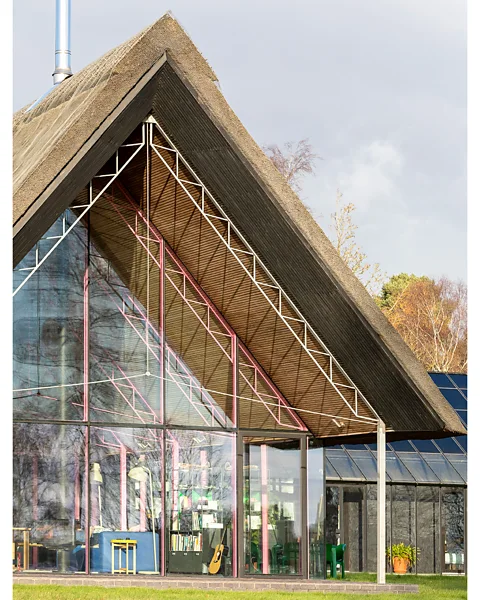
Thatched building at Abigail Hopkins and Amir Sanei's home in Suffolk
Architects Hopkins and Sanei designed their contemporary family home, Housestead, as a set of separate structures, each serving an individual function. The living room, housed in one, has a clean-lined thatched roof and boasts bubblegum-pink steel columns, adding a bold, playful touch. The building that houses their living room "captures the spirit of cosy culture as I see it", says Hopkins. "I think cosy culture resonates so widely because it speaks to a universal need for warmth, comfort and togetherness in contrast to the uncertainties of the world today. Whether found in Wales, Scotland or Norway, where it's called koselig, this tradition captures the same instinct to create protective yet inviting spaces that celebrate simple pleasures.
"In an increasingly fast-paced, digital world, this idea of sanctuary and shared experience feels rooted and enduring. Our living area is a warm, light-filled place that feels both sheltered and open, allowing you to watch winter rain lash against the glass while you remain cocooned in comfort yet immersed in nature."
 Gilbert McCarragher
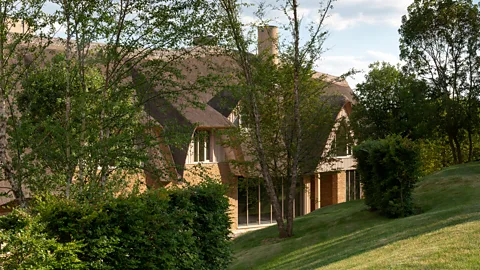
Oxfordshire thatched house by Richard Parr Associates
This is another example of a contemporary treatment of a thatched home. Made using materials such as English oak, stone and thatch, it was designed to complement its rural setting. British thatched roofs often have very ornate ridges but, in this case, Parr has designed one with sharp, modern lines. He sees thatching as malleable and flexible, and likens it to hair that can be cut in any number of styles. "In our buildings we use thatch as a contemporary roofing solution," he says. "While we might face planning restrictions, we're using this material in exciting ways that also go beyond superficial aesthetics. So far we have received no resistance from planning authorities. There is a freedom to innovate with the material."
--
If you liked this story, sign up for The Essential List newsletter – a handpicked selection of features, videos and can't-miss news, delivered to your inbox twice a week.
