Hull street with links to Carry On and 'England's fattest man'

 BBC
BBCTucked away in the middle of Hull is an unassuming street with a colourful past.
Over the past two centuries, it has been home to a World War One spy, the director of the Carry On films and the founder of one of the UK's most influential theatre companies – not to mention that it takes its name from the family of England's "fattest vicar".
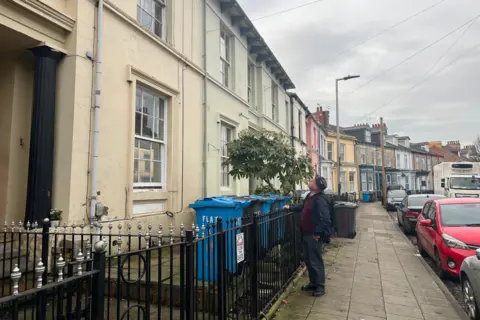
At first glance, Coltman Street – with its hodgepodge of once-grand Victorian townhouses and bland modern properties – looks nothing to write home about.
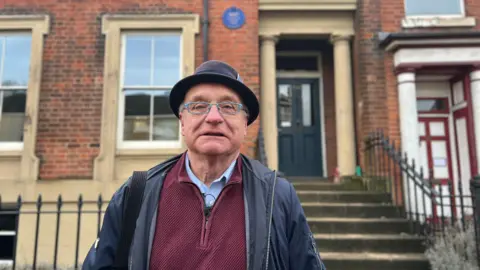
But as local historian and tour guide Paul Schofield tells the Hidden East Yorkshire podcast, behind the high doors and the big bay windows hides a fascinating history that reflects Hull's rise as a prosperous port city.
Coltman Street was laid out in about 1840, at the beginning of the booming Victorian era, on a former pasture known as Myton Carr, about a mile to the west of the city centre.
 Duggleby Stephenson of York
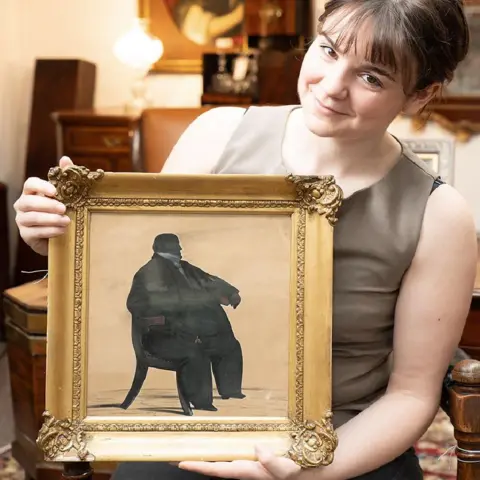
The land had been owned by the Rev Joseph Coltman, the larger-than-life vicar of Beverley Minster.
He is said to have been England's fattest man, weighing 43st (about 270kg) at his heaviest.
When Coltman died in 1837, his brother took the land on and realised the potential of building houses there.
"Much of this area was field and ditches and drains," Paul says.
"You had quite well-to-do people moving into Hull, who wanted high-quality houses, tree-lined streets.
"They had these wonderful houses built in order to live close to the city centre, but far enough away to have their own elegant street where they could live and enjoy life."
Field boundaries influenced the shape of the street, including a distinctive elbow bend, and the semi-rural estate became a desirable location for prosperous trawler owners and middle‑class families seeking space away from the crowded city centre.
"These were proper town houses. Some of them have got very long and deep gardens behind the frontages," Paul says.
"There were carriage entries, so you see these gaps between the houses, just wide enough to fit a carriage through.
"We're talking about the 1840s-1860s, before motor cars or anything, so a form of transport was the horse and carriage."
Paul says the grand street was "trying to mimic what was going on in London".
"If you didn't know you were in Hull, if you were plonked here and walking along, you'd think you were in a street in London – the brick houses, cellars in some of the houses, railings – and [it was a] gentrified area when it developed."
So what does the development of Coltman Street say about the wider story of Hull?
"Looking at maps, you can see how a city like Hull developed from the core, from the Old Town and the city centre," Paul says.
"The was a massive population boom in Victorian times onwards. The quality of housing indicates that very well-to-do people were making money."
It was not just those doing well in business who lived here. Among notable residents were the marine artist Henry Redmore and the philanthropist Christopher Pickering, who founded Hull's best-loved green spaces.
"He was a big philanthropist, a trawler owner, and took a real interest in the fishing community of Hull, and he donated the site for Pickering Park, which carries his name."
 Getty Images
By the turn of the 20th Century, the area was built up and surrounded by working‑class terraces, but it continued to be considered a good address during the first half of the century.
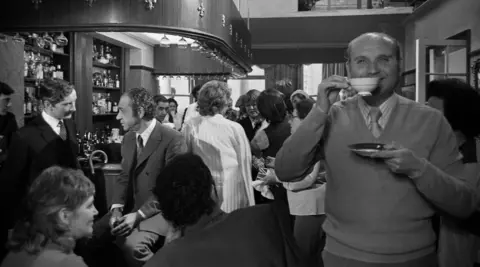
It was home to composer Dr Alfred Hollins, World War One spy Max Schultz and the future film directors Ralph and Gerald Thomas.
Gerald directed the Carry On films while Ralph was known for the post-World War Two Doctor series of comedies, such as Doctor in the House.
"The street beyond here was Bean Street, which was the most densely populated street in the city just about, and that's very much a working class street, and this was very different. This was for the rising middle classes, really," Paul explains.
Coltman Street was bombed during both World War One, when a Zeppelin dropped an incendiary bomb on No 153, and World War Two, with houses between No 20 and No 37 suffering the worst damage.
 Hull Truck Theatre
In the decades following World War Two, the area went into decline. By the 1960s and 1970s, it had a reputation as a trouble spot.
But it was still home to plenty of influential people.
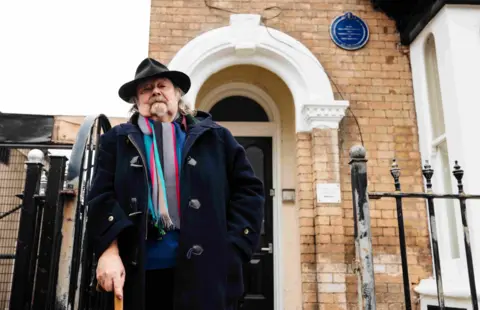
In 1971, Hull Truck Theatre was founded in one of the run-down homes by the actor Mike Bradwell, a story later immortalised in a Richard Bean play.
The "Headscarf Revolutionary", Lillian Bilocca, who campaigned for better safety on trawlers, also lived there until the early 1980s.
While Paul acknowledges there were "a few problems" in the street, he points out that these days there is "a lot of community pride you pick up on when you're walking down here".
Since the 1980s, work has been going on to restore the street – which has eight listed properties – and its historical features.
Perhaps the most prominent example is Pickering's Grade II listed home, one of the grandest in the street, which had been derelict but has been restored into a family home.
Today, the beautiful frontage of the house reflects "that impression of the wealth and grandeur" it had when it was built at the height of the Victorian boom.
Listen to highlights fromHull and East Yorkshire on BBC Sounds, watch the latest episode of Look Northor tell us about a story you think we should be coveringhere.
Download the BBC News app from the App Storefor iPhone and iPad orGoogle Play for Android devices
