Beyond the Gurlitt hoard: Finding what the Nazis stole


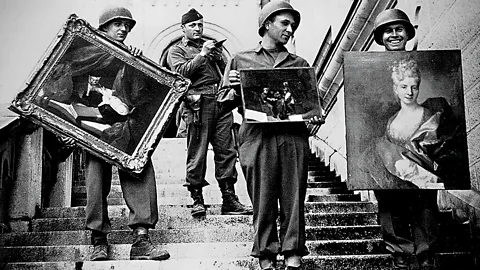
As a Swiss museum decides whether to accept Cornelius Gurlitt’s infamous art hoard, Georgina Adam reports on the effort to retrieve works looted by the Third Reich.
It might be thought that, almost 70 years since World War II ended, problems of art looted during the conflict had been resolved. Far from it. The issue remains extremely complex, with thousands of Nazi-looted works still hanging on museum walls or hidden in private collections. But who is to blame if someone finds a looted work in a collection? The original collectors are generally deceased, and the works may have been legitimately traded a number of times since WWII – so who is at fault? How can claimants prove they were war loot anyway? And is it legitimate for ‘art detectives’ to charge fees, sometimes in the millions of pounds, to track down and return such works of art to their rightful owners?
These questions were thrown into sharp focus by the uproar surrounding the discovery of over 1,400 art works in the modest Munich home of Cornelius Gurlitt, who died in May 2014 at the age of 81. His father Hildebrand had been an art dealer to the Nazis, and at least some of the works he had in his two homes were looted from Jewish families. Investigators have been sifting through the works, which included million-dollar paintings by Matisse, Picasso, Renoir and Chagall, after seizing them in 2012 during a tax enquiry.
Gurlitt’s death has done nothing to resolve the problems swirling around the cache. He left the lot to the Kunstmuseum in Bern, putting the Swiss museum in a quandary: should it accept the hot potato, with all its associated legal and ethical problems? It has put off a decision until June, while it grapples with the full implications of accepting the bequest.
Millions of art works were looted during WWII, but it was only after the 1990s that recovery of missing pieces accelerated, particularly as the collapse of communism made archives that could identify the original owners more accessible.
For the art market, war plunder is a major issue. The slightest whiff of a shadowy provenance during the war years will ensure that a work of art will become unsaleable – so the leading auction houses have dedicated restitution departments to ensure they are not handling such pieces. It is often thought that Van Gogh’s Portrait of Dr Gachet, 1890, which sold for $82.5m in 1990, has never reappeared publicly on the market since then because Christine Koenigs, granddaughter of its original owner Franz, has been pressing a claim to the work.
On the other hand, once a work of art has been restituted, it becomes highly marketable, because no question remains over its past. Earlier this year an impressionist painting by Camille Pissarro sold at Sotheby’s for £19.9m ($33.6m), almost five times the artist’s previous record and twice its estimate. Boulevard Montmartre, Matinée de Printemps, 1897, had belonged to a Jewish art collector forced to sell his paintings by the Nazis – but had ended up in an Israeli museum before heirs of the owner decided to sell at auction.
Art sleuths
A number of investigators and lawyers are tracking down looted works of art, with one of the highest profile – some say notorious - being the German Clemens Toussaint. “Some see him as a David helping beleaguered families to reclaim what is rightfully theirs, but to others he is a profiteering Goliath, using slash-and-burn tactics to strip art from innocent buyers and public museums for his own financial gain,” wrote journalist Marc Spiegler about him in 2003: “Particularly galling to some is his practice of charging a contingency fee that often equals half the value of the recovered work.”
Toussaint’s most famous case was that of the Dutch art dealer Jacques Goudstikker, who fled Amsterdam in 1940. Many of the 1,400 paintings in Goudstikker’s gallery stock were snapped up by Hermann Goering, and after 1945 many ended up in Dutch museums. Goudstikker’s heirs waged a long and costly battle to reclaim them, paying so much to lawyers and Toussaint that they had to sell recovered works at auction. This story is not finished, incidentally, as the heirs are still going after Cranach’s Adam and Evefrom about 1530, now in the Norton Simon Museum in Pasadena, California, and worth an estimated $25m. After a five-year battle the museum won the case that it owned it legitimately, but an appeal is pending.
As time passes and family links to art become lengthened, some claims have been seen as opportunistic. Andrew Lloyd Webber, the British musicals composer, tried to sell Picasso’s Portrait of Angel Fernandez de Soto (The Absinthe Drinker)1902, from the artist’s Blue Period, at Christie’s in New York in 2006 at an estimate of $40m-$60m. But in a last-minute challenge the heirs of a Jewish banker went to court contesting Lloyd Webber’s title, saying it was rightfully theirs. The work was hurriedly withdrawn from auction and only reappeared in 2010 at Christie’s London, where it sold for £34.7m ($58.5m) – falling short of hopes it could make up to £40 million ($67.4). No-one was prepared to reveal details of the settlement with the claimants, but observers suspect they were given a cut of the proceeds.
I asked Chris Marinello of the London-based Art Recovery International, what happens when someone discovers that they have a looted work which they had bought or inherited in good faith, and which might have been traded in good faith before them. He represents the French Rosenberg heirs, who are claiming from the Gurlitt hoard. “Each case is individual,” says Marinello. “If it was a recent transaction, then the vendor should have done due diligence, and there may be a claim there. But in older transactions people didn’t have the databases to check. The best solution is to try to sit down and talk: sometimes people don’t want the art when they find out it was looted and just give it back. Or they may want the purchase price back. At the other end of the spectrum there are really horrible people who say, ‘Your clients are just money-grubbers’. My goal is to try to achieve a negotiated restitution, and it isn’t always easy.”
If you would like to comment on this story or anything else you have seen on BBC Culture, head over to our Facebook page or message us on Twitter.