'It's a moment of death and rebirth': The ancient monuments saluting the winter solstice

 Alamy
AlamyDozens of mysterious structures across the Northern Hemisphere – some nearly 5,000 years old – align precisely to frame the rising and setting Sun during midwinter's shortest day. What motivated people to construct these solar-calibrated masterpieces?
The winter solstice, which usually falls on 21 or 22 December in the Northern Hemisphere each year, marks the moment that one yearly cycle comes to an end and another is born. It is the day with the smallest number of sunlight hours in the calendar, and once it's over, the days lengthen again incrementally until the summer solstice in June.
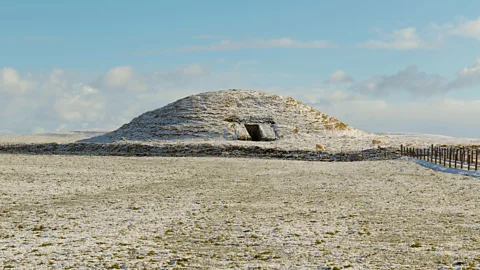
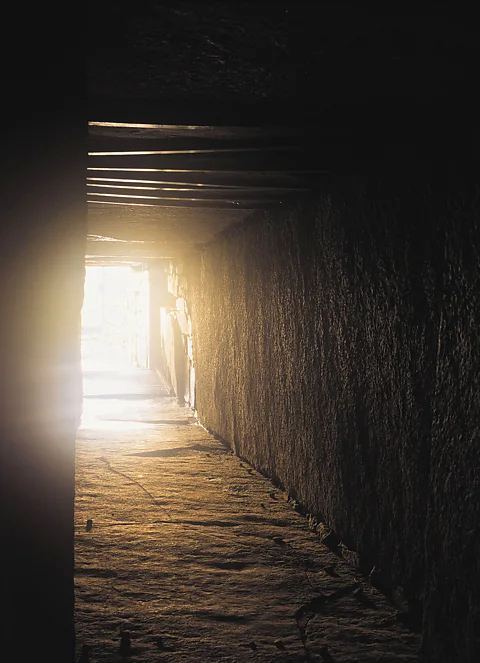
The significance of this day is manifested in ancient monuments that were designed to acknowledge and celebrate its passing. One example is Maeshowe tomb in Orkney. To the untrained eye this burial cairn, created around 2800BC, looks like a grassy hillock – but it conceals a cuboid, stone-clad sepulchre and a 33ft (10m) long entry corridor oriented to the south-west. During midwinter, three weeks either side of the winter solstice, the setting Sun aims directly down the corridor and emanates its light into the tomb.
When the sky is cloudless, the light seems to carve a golden aperture into the tomb's rear wall – a sacrament of pure light. These days of radiance are interrupted by the solstice itself, when blackness temporarily takes over. But daylight reappears soon after, to blaze for another few days as if in celebration of the promise of nature's rejuvenation in spring.
 Alamy
AlamyWe will probably never know the specific beliefs and rituals that inspired Maeshowe tomb. But it's nonetheless possible to understand the enormous significance of the winter solstice as the "year's midnight", both as the darkest moment in the calendar and the pivot to six future months of greater illumination. It was a moment of death and rebirth, and a reminder of the cyclical nature of time.
In the deep past, understanding the markers of nature's clockwork – including solstices – was a matter of survival. Predicting the recurrent patterns of animal migration, for example, could help successful hunting and fishing. Knowing when the climate was likely to change meant being able to adapt and survive. In pre-agricultural societies, it helped people anticipate the availability and location of edible roots, nuts and plants.
After the introduction of farming, around 9000BC, it was essential – for successful planting and harvesting – to anticipate the timing of seasonal changes. Monuments that calculated time had practical value, but it's likely that they also embodied spiritual beliefs in Neolithic times too, with the winter solstice being of particular importance. This very ancient recognition of the solstice's significance even echoes through to the modern world. The word "Yule", now associated with the winter holiday period, derives from the historic Norse festival of Jól, which was based around the winter solstice. Modern Christmas traditions recall bygone midwinter celebrations like the Roman holiday of Saturnalia, which involved feasting and gift-giving. And the solstice continues to be acknowledged in hundreds of traditions across the world, such as the Inca celebration of Inti Raymi, and the Dōngzhì festival in China.
'Nature's sublime power'
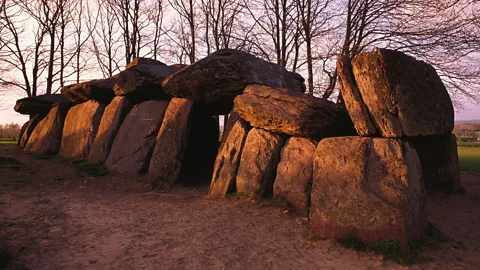
Alongside Maeshowe tomb, archaeologists have discovered dozens of Neolithic monuments that stare directly at the Sun on the winter solstice. There's Stonehenge (England), whose tallest trilithon once framed the setting sun; Newgrange (Ireland), which has a passageway aligned to sunrise on this auspicious day; and the standing stones at Callanish (Outer Hebrides) which create similar solar sightlines. In Brittany, north-western France, is La Roche aux Fées: a megalithic passageway constructed from 41 blocks of stone, some of which weigh over 40 tonnes (40,000kg). At sunrise on the winter solstice, it breathes in its annual dose of restorative midwinter light. Legends once told that fairies constructed it over the course of one night, but it is actually a dolmen (tomb) created by Neolithic architects around 2750BC.
 Alamy
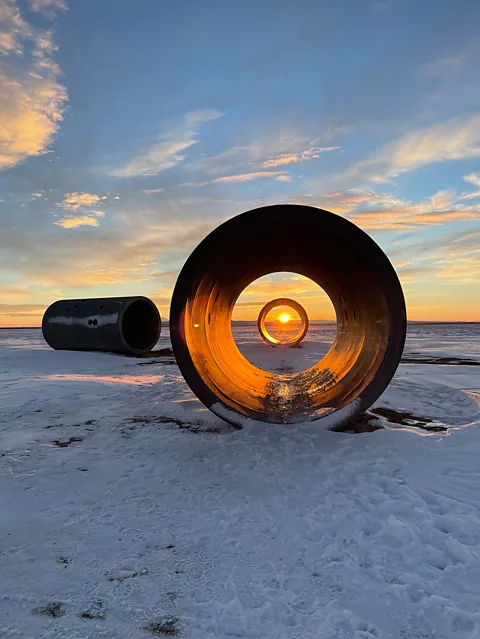
AlamyIn the 20th and 21st Centuries there has been a resurgence of Neolithic-inspired solar-oriented artworks. Nancy Holt's seminal land art piece, Sun Tunnels (1973-76) is one example, set in the Great Basin Desert of Utah, and comprising of four 22-tonne (22,000kg) concrete tubes arranged in an X-shape formation. The view down each of them perfectly frames the Sun as it rises and sets on the winter and summer solstices. Holt bought the land in 1975 and created her artwork with the help of engineers, an astrophysicist, an astronomer and a team of contractors.
 Natalie Rae Good Holt/ Smithson Foundation and Dia Art Foundation
It's best to understand Sun Tunnels in the context of the Land Art movement of the 1960s and 70s. Artists like Holt who are associated with this movement worked with the landscape rather than within traditional studios and galleries, and aimed to reconnect people with the awe of nature. Unlike its Neolithic predecessors, Sun Tunnels has no religious significance – Holt explained that she simply wanted "to bring the vast space of the desert back to human scale". It is also a response to modern concerns about nature. In an age where humans seem hell-bent on despoiling and exploiting nature, Sun Tunnels turns our attention back to its sublime power and rhythmic patterns.
More like this:
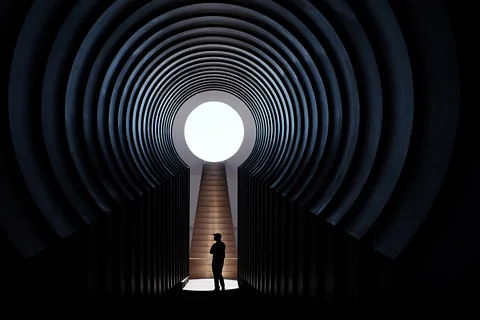
Another masterpiece of Land Art, James Turrell's Roden Crater (begun 1979), does this on an even more epic scale than Sun Tunnels. It occupies a volcanic cinder cone in the Painted Desert region of northern Arizona and houses multiple spaces from which to watch celestial phenomena. One of them is a 900ft- (274m) long tunnel drilled through the volcanic cone. It acts like a camera obscura, focusing an image of the midwinter sun (via a glass lens halfway down the passage) on to a slab of white marble in a central chamber. Like Maeshowe tomb's passage, it aligns with the Sun's position around 21 December each year, and drinks down the Sun's light from 10 days before the solstice to the 10th day after it.
 Getty Images
Enoura Observatory in Kanagawa Prefecture, Japan (completed 2017) was designed by photographer and architect Hiroshi Sugimoto. Its various buildings are all calibrated towards the movement of the Sun, to create what the artist describes as a "new Neolithic aesthetic". He wanted to correct what he saw as a lack of purpose in contemporary art by exploring the primal concerns of our ancient ancestors – our status within the infinite wilderness of the cosmos, our sense of time, and our notion of a human identity within the natural order.
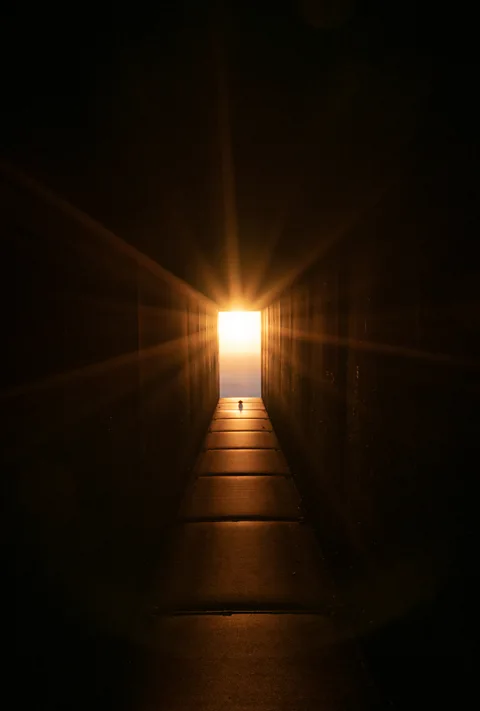
One of its structures, the "Winter Solstice Light-Worship Tunnel", points directly at the spot on the horizon where the Sun rises at about 06:48 local time on 21 December each year. The solstice sunlight floods this 230ft-(70m) long chamber made of Corten steel and illuminates a stone medieval wellhead that is situated halfway along its length. It passes underneath another structure which aligns with the Sun on the summer solstice. The entire site, which took a decade to build, was intended by Sugimoto to act like a living clock, and to make an artwork with the ancient function of helping humans "identify their place within the vastness of the universe".
 Odawara Art Foundation
Holt's, Turrell's and Sugimoto's structures put us back in contact with seasonal patterns and the rhythms of nature, just as Maeshowe tomb and La Roche aux Fées once did. These monuments and artworks orient us in time, to the landscape, to our place within nature and to reoccurring celestial events. The winter solstice – which they all respond to directly – has always been of critical importance to humans, enshrining the significance of light, and honouring death and rebirth in the annual calendar. If the spectacle of these solar-aligned structures lining up perfectly with the rising and setting solstice Sun quickens the soul, it's because it triggers a primal recognition that the darkest hours of the year have passed. It's the first sign of spring's promised return, and future days of increased lightness and warmth.
--
If you liked this story, sign up for the Essential List newsletter – a handpicked selection of features, videos and can't-miss news, delivered to your inbox twice a week.
