Dubai's tourism industry reels from 'brutal' impact of war

 AFP via Getty Images
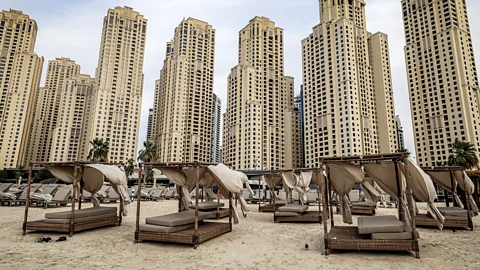
Last year Dubai welcomed 19.59 million international visitors, making it one of the most-visited cities globally, but the US-Israel war with Iran has had a devastating impact on visitor numbers, and local businesses are struggling.
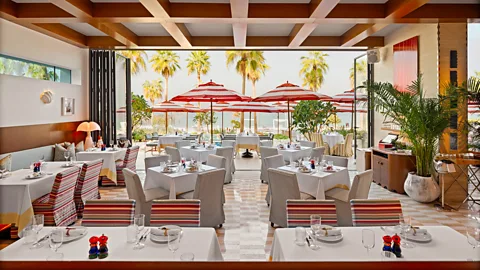
On most evenings, Dubai's restaurants would usually be packed, with the constant buzz of diners, of tourists and residents filling tables across the city. But over the past month, many of those tables have sat empty.
For Natasha Sideris, the shift has been sudden and stark. She opened her first restaurant in Dubai in 2014. Over the past decade, her Tashas hospitality group has grown to 14 outlets across the country, employing more than 1,000 people. But the US-Israel war with Iran is now taking a heavy toll on her business.
Sideris says many of her restaurants, which are popular with both residents and expats, have seen revenues fall by more than 50%. But outlets that depend heavily on tourists have been hit much harder, with declines of 70% to 80%. The crisis has forced her to cut salaries by 30% for all staff including herself.
"The current situation is brutal," she says. "I had a choice – either fire 30% of my staff or cut salaries to save jobs. I chose the latter for now."
Sideris adds that the impact would have been worse if many of her outlets were not located inside community malls and close to residential neighbourhoods, where they still rely on local customers.
 Tashas Group
The current tough reality is playing out across much of Dubai's restaurant sector.
One senior executive at a restaurant chain, who asked not to be named, said footfall at its outlets has dropped to just 15-20% of normal, forcing them to place more than half of staff on unpaid leave.
"We have no option," he says. "We've already shut down a few outlets temporarily, and the rest are operating with minimal staff."
The impact is not limited to restaurants. The entire tourism ecosystem – from hotels and travel agencies, to transport companies and airlines – is feeling the strain.
Over the past two decades, Dubai has built itself into one of the world's leading tourism hubs. Last year, the emirate welcomed 19.59 million international visitors, making it one of the most-visited cities globally.
But since the war began, that momentum has been sharply disrupted.
The wider UAE has come under repeated attacks, with Dubai among the key targets of Iran's military response following US and Israeli strikes. Authorities say more than 2,400 missiles and drones have been launched towards the UAE, targeting airports, ports and civilian areas, including hotels and residential buildings.
More than 90% of them were intercepted and destroyed, officials say.
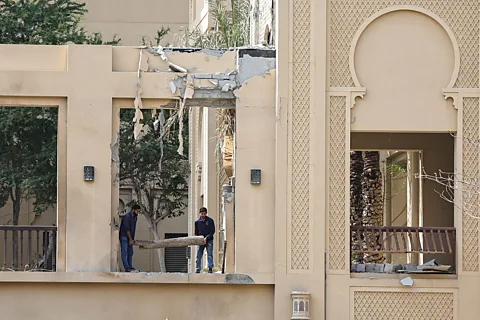
But some debris has fallen across parts of Dubai, including major residential areas, hotels and the airport. Images of fragments striking the Fairmont hotel on the upscale Palm Island were circulated widely online.
To date, 11 people have been killed and more than 185 injured across the UAE, according to authorities in the country.
 AFP via Getty Images
The conflict, which began on 28 February, has disrupted air travel across the region. In the early weeks, tens of thousands of visitors were stranded before being evacuated on special flights.
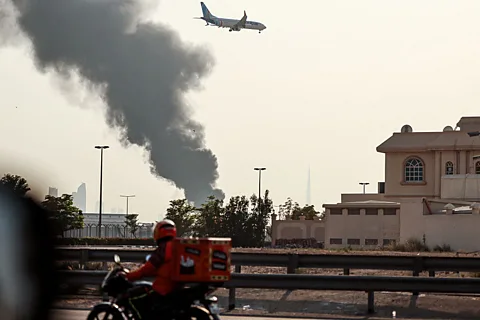
Thousands of regular, scheduled flights have been cancelled since the conflict began, bringing one of the region's busiest travel hubs to a halt at times. Dubai International Airport – the world's busiest for international passengers – handled 95.2 million travellers last year.
 AFP via Getty Images
Some operations have since resumed, with flag-carrier Emirates operating a reduced flight schedule while working to restore full network operations.
But with tourists leaving and the number of new arrivals collapsing, hotel stays in Dubai have fallen steeply. Occupancy levels across Dubai hotels dropped to between 15% and 20% of the usual level for this time of the year in the weeks following the outbreak of the war, according to Mamoun Hmiden, chief business officer at travel booking firm Wego.
Hotels have responded with deep discounts, particularly during the Eid period, in an attempt to attract residents. Some luxury properties on Palm Jumeirah, one of the city's premium hotel hubs, have cut prices by as much as half.
"The uncertainty is disrupting everyone at the moment," says Hmiden.
Some hospitality chains have temporarily shut down some properties or closed certain sections, citing scheduled renovations – a move typically seen during the quieter summer months.
A senior executive at an international hospitality group said occupancy at some properties had fallen to single digits. "It made sense to cut operational costs by shutting down for a few weeks and reviewing the situation later," he says.
Even business hotels are under pressure. Dubai, a major hub for conferences and events, has seen organisers cancel or postpone large gatherings in the coming months. Majestic Hotels, which operates around 450 rooms across three properties, says occupancy has dropped to record lows.
"We are seeing cancellations beyond April," says Varun Raj, cluster director of sales and marketing. "A lot of events have been cancelled, making it difficult for travellers to plan ahead."
The slowdown comes after several years of rapid growth. During the Covid-19 pandemic, Dubai was among the first destinations to reopen to international visitors, allowing its tourism sector to recover faster than many global peers.
Since then, it has expanded into a broader and more diversified market – strengthening its position as a luxury destination, while also attracting large numbers of mid-market and price-sensitive travellers from regions such as South Asia, Europe and the former Soviet states.
That surge in demand has been matched by a sharp increase in supply. Years of growth have driven expansion not only in hotel capacity, but also in short-term apartment rentals across the city. That additional supply is now under pressure.
Data firm AirDNA shared that a little over 226,500 short-term bookings were cancelled across the UAE between February 28 to March 29, the first month since the war began.
The downturn is also being felt by the migrant workforce that form the backbone of Dubai's hospitality industry – from restaurant staff to hotel workers.
As demand weakens, many have seen their hours reduced, or they have been placed on unpaid leave. While the UAE's labour system allows companies to adjust quickly to changing conditions, that flexibility can leave workers exposed to sudden income losses.
"It feels like we are back to the Covid-19 period," says a South Asian waiter working at a high-end restaurant. There are fears we could lose our jobs again and be forced to go back home."
He and several colleagues have been placed on unpaid leave, with no clarity on when – or if – they will return to work. Some hotels, including five-star properties, have started laying off employees. Rights groups say many migrant workers in the UAE are already financially vulnerable, with some carrying debt linked to recruitment fees.
The impact of the war is also being felt across the wider Middle East. Research by Tourism Economics, part of Oxford Economics, suggests that between 23 million and 38 million fewer people could travel to the region this year, depending on how long the conflict continues. Between $34bn (£25bn) and $56bn in visitor spending could be lost.
 Tashas Group
"If the war ends soon, there could be a quick recovery," says Hmiden. "But if it drags on, we have to start questioning the entire summer season."
This week – Dubai announced $272.26 million in support for businesses, including tourism, over the next three to six months. Hotels will be allowed to delay sales-related fees and tourism dirham charges – a fee applied to guests staying in the city.
Authorities in Dubai are also working on plans to revive tourism once the conflict subsides, including new campaigns and promotional offers.
"The war is out of our control," says one official. "But we are preparing for when it ends."
More like this:
• How the Iran war is affecting global travel
• How a prolonged Middle East conflict could reshape how we fly
• Is Dubai's glossy image under threat?
Sideris is hoping that landlords will provide rent relief in the form of deferred payments or reduced payments for the time being to support local businesses.
For Sideris, the outlook remains uncertain. She says a recovery is possible from October if the war ends soon. But if the conflict continues, the timeline could shift to next year – bringing the risk of layoffs and outlet closures.
"We've got enough cash to see us through a month or two... maximum three, and then past that, what do we do? After that, we will have to take tougher calls. Hopefully not. And this insanity ends soon."
--
For global insights and expert analysis for the boardroom and beyond, sign up to the World of Business newsletter, while The Essential List delivers a handpicked selection of features and insights.
For more on business and beyond, follow us on LinkedIn.
