Where no human eyes have gone before: How the Artemis Moon missions will set new records

 Nasa/ Jim Ross
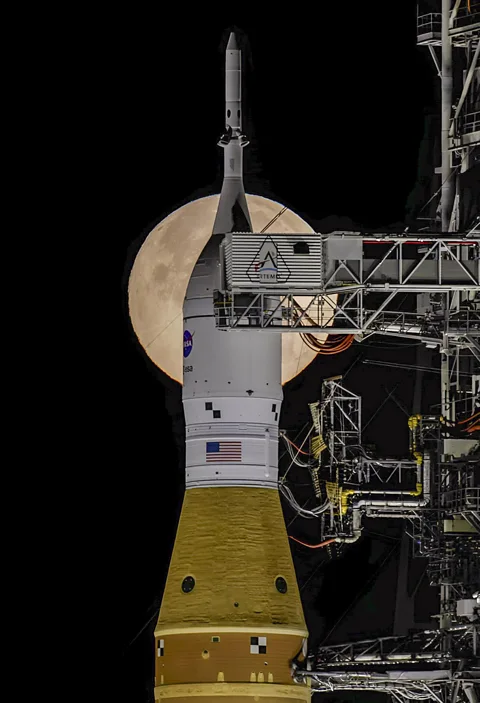
Artemis II will take a team of four astronauts further from Earth than any other human has in history when it orbits around the far side of the Moon. But how else will the Artemis missions make history?
It's been more than 50 years. Now Nasa is about to return to the Moon.
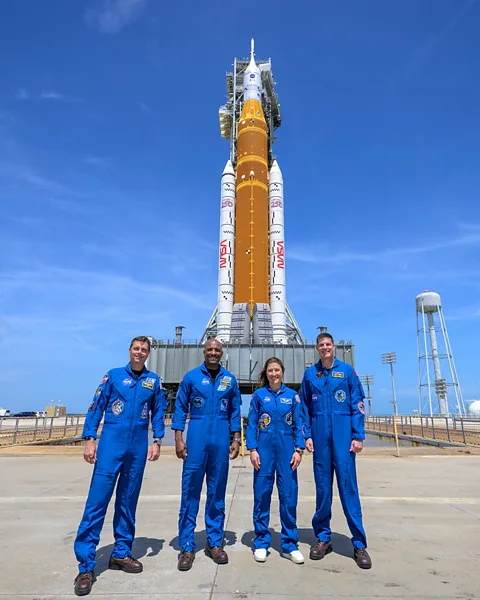
Four astronauts – Reid Wiseman, Victor Glover, Christina Koch and Jeremy Hansen – are soon to fire into space on a 10-day journey around the far side of the Moon. Their trip will take them further than any humans have gone before – making them the most distant Earthlings to have ventured into the depths of space so far.
Their mission, called Artemis II, is part of a wider programme of missions that aim to eventually return humans to the surface of the Moon.
The last time humans set foot on the lunar surface was in 1972 with Apollo 17. The Artemis programme is aiming to not only repeat the feats achieved by the Apollo missions, but surpass them.
Named after the Greek goddess of the Moon and twin sister of Sun god Apollo, Artemis II will achieve something Apollo neglected to do: it will send the first woman and the first black man to the Moon.
Koch will become the first woman to circle the Moon if the Artemis II mission goes to plan. Alongside her in the crew capsule, Glover will become the first black person to make the journey.
These are part of a long list of firsts that the ambitious Artemis programme will attempt to achieve during its long journey to return humans to the surface of the Moon on board Artemis IV, which is due to launch in 2028.
Appropriately, it was Nasa's first female launch director, Charlie Blackwell-Thompson, who oversaw the countdown and lift-off of Artemis I, the first mission of the programme in 2022.
During Artemis I's almost 26-day journey to orbit the Moon, the spacecraft achieved another important milestone. The uncrewed Orion capsule travelled 270,000 miles (386,000km) away from Earth, the furthest any vehicle designed to carry humans has ever been.
Now Artemis II will attempt a similar record, but this time with humans onboard.
 Getty Images
The four astronauts will fly 6,400 miles (10,299km) above the surface of the Moon's dark side. The 10-day journey will take them up to 252,799 miles (406,840km) from Earth as they loop around the far side of the Moon.
If everything goes to plan, the spacecraft and those on board are expected to exceed the previous record set by Apollo 13 – 248,655 miles (400,171km) – to become the furthest humans have ever travelled from Earth.
But even so, Nasa's chief flight director Emily Nelson is keeping her sights firmly on other aspects of the Artemis II mission. "It is a little over 4,000 miles further than Apollo 13," she says. "You want every mission to keep exploring and learning new things. Getting further from Earth than we have ever been before is a fun statistic, but there are a lot of other things we are going to learn on this mission that are going to be a lot more exciting."
After several delays caused by technical glitches, a hydrogen leak and problems with helium flow in the rocket during prelaunch tests, Artemis II is set to launch in the evening of 1 April 2026 at the earliest. But the launch window could run from 1-6 April and then again on 30 April.
"Depending on which day we launch, it really changes what we're going to see on the far side of the Moon," explains Jeremy Hansen, a Canadian astronaut and one of two mission specialists on board Artemis II, making him the first Canadian to fly to the Moon. "In the early parts of this window, we are going to see an eclipse. So, we'll see the Sun go behind the Moon."
This will give the astronauts the opportunity to study and potentially discover new information about the dust lofting from the lunar surface and how it moves around the Moon. But they also hope to study parts of the Moon that have never been observed with human eyes.
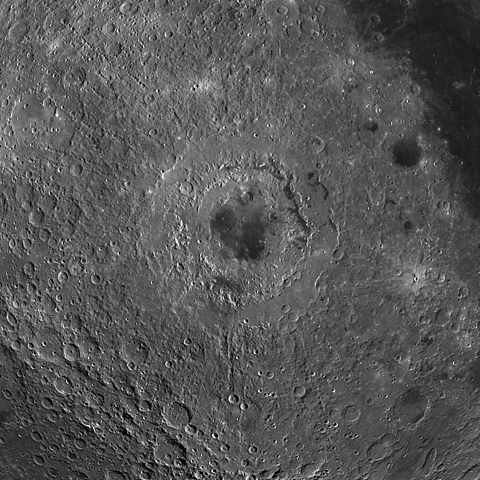
"Orientale is this huge crater on the far side of the Moon," says Hansen. "With telescopes you can see the edge of this crater, but no one has ever seen this full crater on the far side of the Moon."
"It turns out there is 60% of the far side I think that has never been seen by human eyes," adds Wiseman, the Artemis II commander. "When we see Orientale – human eyes have never seen that."
 Nasa
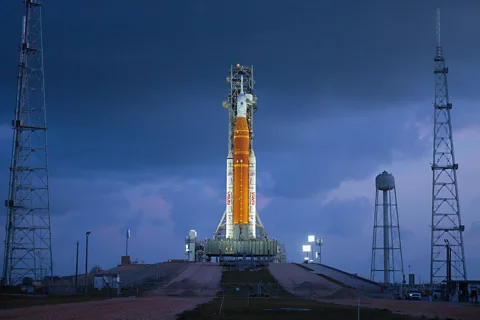
NasaBut the records will begin to tumble long before the astronauts make their orbit on the Moon. They will be hurled into space on top of the most powerful rocket ever built – the Space Launch System (SLS). Although smaller than the Saturn V used in the Apollo missions, it packs a considerably bigger punch, producing 8.8 million pounds of thrust, 15% more than Saturn V.
"When you see this vehicle on the pad, you know it's going one place – it is going into space and it is going there in a hurry," says Wiseman. "When those engines light, this thing is moving out."
Perched on top of the SLS is the Orion spacecraft that will carry the crew to the Moon and back home again. Although the Orion spacecraft may resemble a larger version of the Apollo spacecraft, its technology is on another level. According to Nasa, Orion's computer operates 20,000 times faster with 128,000 times more memory than those used on the Apollo missions.
The aim is to eventually land two astronauts on the surface of the Moon near the South Pole for around a week before bringing home again. That mission – Artemis IV – is currently expected to launch in early 2028 and will be the first time humans have set foot on the Moon since the last Apollo mission in December 1972. On that occasion, astronauts spent just over three days on the lunar surface – to date the longest time humans have spent on the Moon. Artemis IV will aim to surpass that and subsequent missions will go further, aiming to eventually establish a long-term human presence on the Moon by building a lunar base. (Read more about the epic quest to build a permanent Moon base.)
The focus for Artemis will also be different. Back in the 1960s, Apollo was primarily part of a Cold War power race between the US and the Soviet Union. Artemis is an international effort led by Nasa including the Canadian Space Agency (CSA), the Japan Aerospace Exploration Agency (Jaxa) and the European Space Agency (Esa).
"This is not about flags and footprints," Thomas Zurbuchen, Nasa's former associate administrator for science told the BBC in 2022. "It's about building a sustainable presence on the Moon and to set in place the foundations for a moonbase and future missions to Mars."
 Getty Images
Nasa had also previously stated it intended the Artemis missions to send the first woman and first person of colour down to the surface of the Moon. But that pledge quietly disappeared from Nasa's website in November 2025 following an executive order signed by President Donald Trump. Nasa subsequently said that the change in language does not indicate a change in crew assignments.
In February 2026, Nasa also announced changes to its Moon landing programme, adding an extra mission before it attempts to land on the lunar surface.
Artemis III will stay now stay in a low-Earth orbit to practice docking with a lunar lander, a crucial step needed to bring any crew home safely. That mission will happen in 2027 before Artemis IV and V aim to land on the Moon in 2028.
Those missions will go to a part of the Moon that has never been explored by humans before, the lunar South Pole. There, astronauts will search for water ice and minerals that have been identified by observations from space. (Learn more about the mysteries of the Moon's enigmatic South Pole.)
The water ice, for example, could provide vital supplies for a permanent Moon base while also potentially offering a way of creating fuel by splitting the water into hydrogen and oxygen.
Nasa is even hoping to install the first lunar communications network – called LunaNet – that will bring internet-like services to the Moon, along with navigational capabilities.
But even this is just a stepping stone. Nasa has its sights set on Mars and is hoping to send astronauts there by the 2030s. The Moon will provide an important testing ground for the technologies and life support systems needed to do that. (Find out more about how the Moon will help Nasa get to Mars.)
Despite all the firsts that will come with the launch of Artemis II and the missions will follow, Koch sees it differently. For her, it is the start of a new era of lunar exploration, but also of human cooperation to allow that exploration to happen.
"We are at a time where we recognise the importance where if we aren't going for all and by all, we aren't truly answering all of humanity's call to explore," she says. "It is our strong hope that this mission is the start of an era where everyone, every person on Earth, can look at the Moon and think of it as also a destination."
--
If you liked this story, sign up for The Essential List newsletter – a handpicked selection of features, videos and can't-miss news, delivered to your inbox twice a week.
For more science, technology, environment and health stories from the BBC, follow us on Facebook and Instagram.
