Sleepy Hollow: The town that renamed itself for Halloween

 Historic Hudson Valley
Two centuries after Washington Irving wrote The Legend of Sleepy Hollow, the once-industrial town of North Tarrytown has rebranded itself around his ghostly horseman – and discovered that myth still sells.
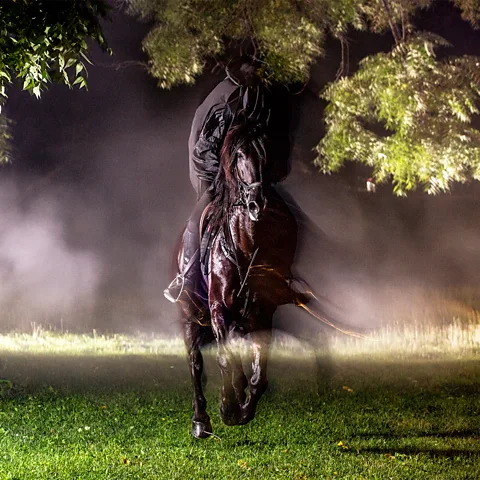
It was early October in Sleepy Hollow, New York, when I saw the Headless Horseman for the first time. He burst from the tree line on horseback and parted the fog as he galloped towards me, his cloak billowing behind him – a giant spectre in the dark night.
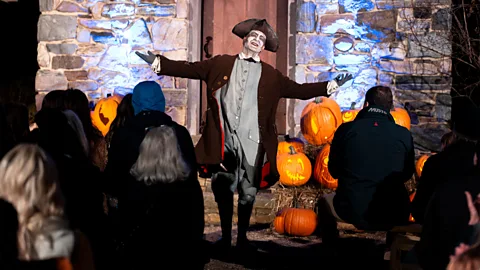
After a couple of laps around the show's mock graveyard, the crowd cheered as the Horseman trotted over. Tonight's rider, a woman, welcomed everyone to pet her horse, a rescue named Eagle. As I gave Eagle a scratch, people lined up for tarot readings, vendors sold art and oddities at a pop-up market beside the barn and a roving band paraded through the grounds. This was Twilight Village at Philipsburg Manor – one of Sleepy Hollow's many immersive Halloween events.
The next night, I saw the Headless Horseman again at Irvington's 'Legend' at Sunnyside, a storytelling performance at American writer Washington Irving's historic home. I saw the Horseman everywhere else too: on street signs and police squad cars, on t-shirts and storefronts and even on the Christmas ornament I bought as a souvenir.
But I wasn't here for the spooky sights; I'd come to learn how a fictional place could transform into a real one – and how one story reshaped an entire town.
 Getty Images
A town reborn
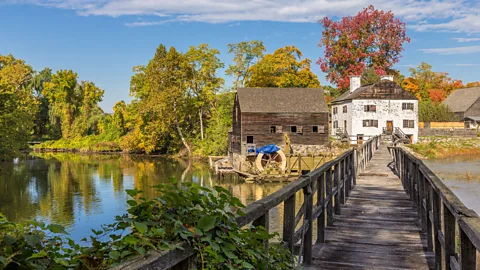
Few places in the United States are as entwined with a single story as Sleepy Hollow. Immortalised in Washington Irving’s 1820 tale The Legend of Sleepy Hollow, the town became synonymous with its ghostly rider – the Headless Horseman – and helped shape early American gothic fiction. The legend grew from Hudson Valley folklore and has since inspired countless retellings in film, literature and popular culture. With social media, increasing numbers of travellers have discovered that Sleepy Hollow, just a 50-minute train ride north of New York City, is a real place they can visit. But few know that the Halloween hotspot wasn't always called that – and for much of the 20th Century, it was better known for building cars than for ghost stories.
How Sleepy Hollow got its name
It's a common misconception that Irving coined the name, but it actually predates him by more than a century, with Dutch colonisers in the 1600s referring to the village as "Slaepers' Haven" and "Slaepers' Hol". The anglicised version, "Sleepy Hollow", was used informally in the region from then on.
Between 1870 and 1996, the town was officially named North Tarrytown. When the General Motors plant that had operated in the area for a century closed in the mid-1990s, residents were forced to reimagine their town's future. Seeing the need for a rebrand, they voted in favour of changing the name to Sleepy Hollow.
The rebrand worked and the town embraced its new identity. The Headless Horseman became the town's unofficial mascot – and the official mascot of the local high school. But while locals expected some tourism with the new moniker, they didn't foresee just how completely their town on the Hudson River would transform into a Halloween pilgrimage site.
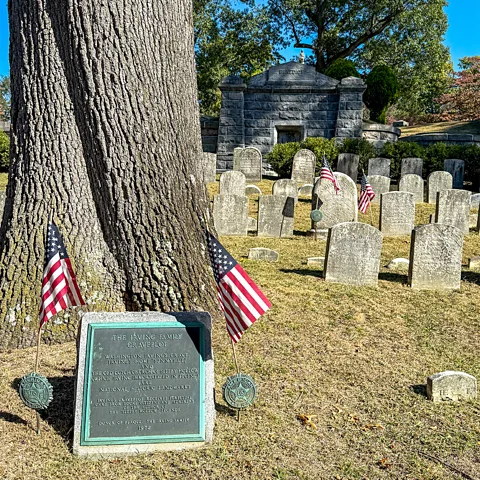
Across the street from Philipsburg Manor sit three of Sleepy Hollow's most famous attractions: the Old Dutch Church (founded in 1697 and featured in Irving's story); the Sleepy Hollow Cemetery, where the Headless Horseman first appears cloaked in a white mist; and the cemetery's rustic bridge that looks similar to the Headless Horseman Bridge he gallops over in the tale.
 Kayla Smith
Earlier that day, I met with cemetery superintendent Jim Logan, whose family has been involved in the cemetery's business for decades. As we drove across the 90-acre labyrinth of rolling hills, worn headstones and forest to inspect a burial plot, he told me that finding the balance between running an active cemetery and welcoming tourists "has become an increasing challenge". The cemetery has always drawn visitors – its notable graves include Washington Irving, Andrew Carnegie, Walter Chrysler and William Rockefeller – but since tours began about 20 years ago to fund restoration, numbers have grown exponentially.
Logan told me that some visitors don't realise this is still a working cemetery, assuming it was fabricated by Irving, and there have been instances where tourists have refused to move for funeral processions. He recalled one encounter with gallows humour, noting that a woman once saw the cemetery logo on their van and asked if they'd "put out the gravestones" for the season. They'd done two burials that morning.
He added that confusion is especially common among first-time visitors expecting Hollywood's Sleepy Hollow. "Here in the cemetery, we notice that a fair number of visitors don't really understand what they're coming to visit," he said. "We'll have people looking for a covered bridge. That was Disney and Tim Burton."
The business of Halloween
That blurred line between fiction and reality is something Julia McCue knows well. McCue is the owner of Horsefeathers restaurant-bar that's been a staple in Tarrytown, a mile south of Sleepy Hollow, since 1981. The place is so popular that you can expect a long line to get in, but it means that McCue's plan to become the best Halloween bar in the country is going well. During autumn, the moody interior is transformed with an atmospheric Halloween display that social media has turned into a must-see attraction.
 Kayla Smith
McCue sees the full spectrum of visitors to Sleepy Hollow. Often, she says, they didn't know the town was a real place until they saw it on social media. Others come expecting a Halloween theme park rather than the small, normal town that it is. "It's not a tourist trap," she tells me. "We are just a town that is trying to entertain people while they're here."
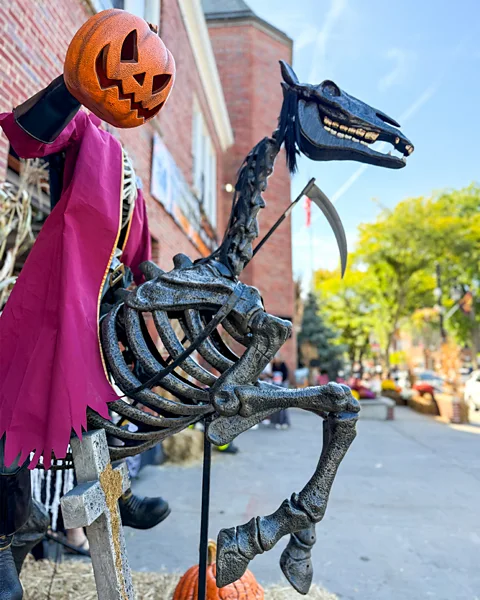
On the village's main street, nearly every storefront is decorated for the season, from restaurants and shops to banks and the fire station. Even the local funeral home has a giant Headless Horseman and an even larger skeleton grinning at passersby. They need to be committed because it's important for business. Leah Bloom, who owns the Sleepy Hollow Bookshop, says the six weeks leading up to Halloween are crucial for survival. "We could not exist in a town this size without the influx of tourist business," she says.
More like this:
Much of that influx began with The Great Jack O'Lantern Blaze launched 21 years ago in the neighbouring town of Croton-on-Hudson. This massive Halloween event features more than 7,000 illuminated jack-o'-lanterns, all carved by hand onsite, with synchronised lighting, special effects and a spooky original soundtrack. The walking path glows with elaborately carved tableaus – animals, zombies, flower gardens, a spinning carousel and even a pumpkin Statue of Liberty. It's widely considered one of the best family-friendly Halloween events in the US, drawing more than 100,000 visitors each season.
 Historic Hudson Valley
With the success of The Blaze, Historic Hudson Valley, the nonprofit behind the region's heritage sites, developed new Halloween events at its other venues, including Washington Irving's Sunnyside at Philipsburg Manor. Sleepy Hollow Cemetery followed suit, adding special themed tours and night tours that sell out weeks in advance during October weekends.
My favourite was one of these eerie evening rambles. For two hours, our guide Amanda led us by kerosene lanterns to the tombs of some of the cemetery's most notable and intriguing residents. It wasn't a haunted tour but a historical one, filled with intrigue, humour and surprisingly touching stories. At Irving's grave, she acknowledged, "This is why most of you are here" and explained that Irving is on his third headstone because tourists chipped away pieces of the previous ones to bring home as souvenirs.
Two hundred years after Irving spun a story from local lore, the town has brought that legend to life for visitors. Irving's tale is open-ended, allowing readers to choose whether they believe the Headless Horseman is real or not. And the town of Sleepy Hollow offers visitors the same choice: to believe in the legend – or simply admire how storytelling shaped a town's second life.
--
If you liked this story, sign up for The Essential List newsletter – a handpicked selection of features, videos and can't-miss news, delivered to your inbox twice a week.
