Discover Seoul’s five best hiking trails with an expert guide

 Twenty47studio/Getty Images
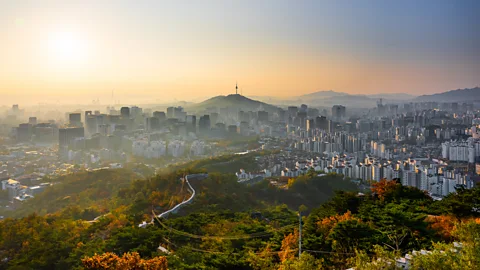
Lacing up your boots and hitting the mountains is a unique way to experience Seoul. Park Jeong-ho, the head of Seoul International Hikers Club, reveals his favourite trails.
Hiking is one of South Korea's favourite national pastimes. In Korean culture, a deeply held belief is that outdoor exercise is crucial for preserving health and mental acuity into old age. As a result, don't be surprised if you're overtaken on steep mountain trails by fiercely fit octogenarians.
The Baekdu-Daegan mountain ridge runs through South Korea like a vertiginous spine, from Jirisan in the south all the way to Seoraksan and Taebaeksan near the border with North Korea. The result is countless beautiful hiking locations, with constantly changing scenery due to Korea's four distinct seasons.
The capital Seoul is no exception, as the city contains no fewer than seven mountains. Bukhansan National Park, one of the world's most-visited national parks, lies within the city's boundaries, as do many other parks. According to outdoor recreational app AllTrails, the city is home to 142 trails of varying difficulty levels. In fact, if you jump on the subway on a Saturday morning, many passengers will be dressed in hiking gear heading off for a day in the mountains.
Few people know Seoul's hiking trails like Park Jeong-ho, who has led the Seoul International Hikers Club since creating it in 2005. Here, he recommends the best hiking trails within Seoul's city limits.
 Christina Too
1. Best for getting to know the city: The Seoul Trail
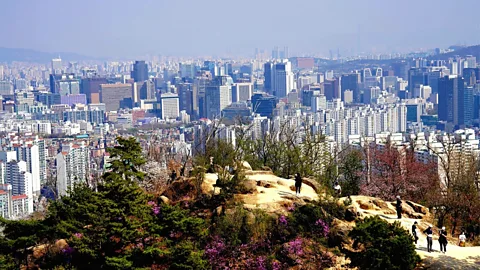
This 157km multi-day, epic-in-length-but gentle-on-the-knees trail that circles the megacity of Seoul was the brainchild of the former mayor of Seoul Park Won-soon. He was the longest-serving mayor in the city's history, serving from 2011 until his death in 2020, and was known for focusing on improving outdoor activities to enhance Seoul's liveability. The trail is split into eight courses – the longest being 33.7km and the shortest being 12.3km – so tourists can choose to do one, a few or the entire loop.
"The Seoul Trail hugs the outer city boundary, where it's formed of gentle paths along the slopes of the mountain peaks that ring Seoul," said Jeong-ho. "Visitors can see some of Seoul's best views of the Han River weaving through the cityscape. The trekking is pretty easy, unless you opt to do the whole 157km!"
Eighty-five kilometres of the 157km network runs through forests and 32km run alongside streams. It's a fantastic, well-signposted way to get acquainted with Seoul.
"My favourite part of [the] Seoul Trail is the [stretch] that runs beside Anyang stream [Course 6] during early spring. Trout return upstream to lay eggs where they were born and you can see thousands of fish jumping out of the water, fighting to swim against the flow. It's a spectacular sight," said Jeong-ho.
 TwilightShow/Getty Images
2. Best for sky-high views: Bugak Skyway
The Bugak Skyway is a hiking trail and road that runs along the ridge of Bugaksan (Mt Bugak) just north of downtown Seoul, and it's one of Jeong-ho's favourites for "its exceptional beauty".
The SpeciaList
Professor Jeong-ho Park was a lecturer of Korean literature at Hankuk University of Foreign Studies and founded the Seoul International Hikers' Club in 2005 with five foreign professors and another Korean professor. A self-described "civilian ambassador and peacemaker", Park has helped thousands of expats in Seoul make friends while teaching them about Korean nature and culture by guiding them on hikes.
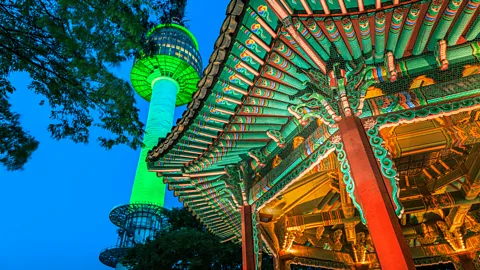
According to him, there are two highlights along the trail: the Palgakjeong Pavilion, a traditional eight-cornered pavilion at one of the highest points of the Skyway and the impressive 360-degree panoramic views over the city and to the peaks of Bukhansan National Park. Hikers can also peer into the grounds of the Blue House at the foot of the mountain, which traditionally served as the residence of the president of South Korea until it was moved in 2022.
Mayor Park was also responsible for this trail, which he commissioned after being petitioned by the public. The trailhead is easily reached from Hansung University station on Line 4, and the Skyway can also be cycled the entire way, which is 6-7km in total. From Palgakjeong Pavilion (altitude: 342m), hikers can return the way they came or continue down the other side to the neighbourhood of Buam-dong where they can fill up on handmade kimchi mandu (kimchi dumplings) at Jaha Son Mandu. Just steps away is the iconic stairway from the Oscar-winning film Parasite.
 Twenty47studio/Getty Images
3. Best for a spiritual experience: Inwangsan
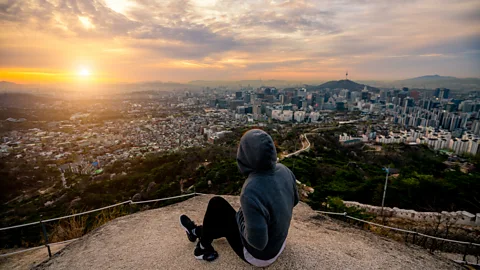
Mention the word "Inwangsan" (literally "mountain of the generous king") to most Seoulites and it's likely to elicit a wistful sigh. With its 4km winding hilltop trail, views east over Gyeongbokgung (the largest of Seoul's five grand palaces) and an ancient shamanic shrine once used for exorcisms, this mysterious mountain located to the north-west of downtown Seoul is not to be missed. Just south of the peak is Guksadang Shrine, where visitors may find a lone female shaman chanting, seemingly in a trance (shamanism, or Mu-ism, is an ancient folk religion of the Korean peninsula), while nearby are food offerings on an altar and perhaps even a grinning pig's head on a spike, like a scene from Lord of the Flies. You may feel as though you've slipped through a portal into another time.
"From Gyeongbokgung station on Line 3, take exit 2 and walk north for about 1 mile (1.6km) or take a bus marked 'Buamdong' until you reach the Hill of Yun Dong-ju the poet," advised Jeong-ho. "From there, follow the signs for the Inwangsan hiking trail – there's only one – and enjoy the views of the old Seoul City Wall." Along the way, there are large granite rock formations named after what they are said to resemble, including a "train rock" and a "worm rock".
 Christina Too
4. Best for photo-ops: Gwanaksan
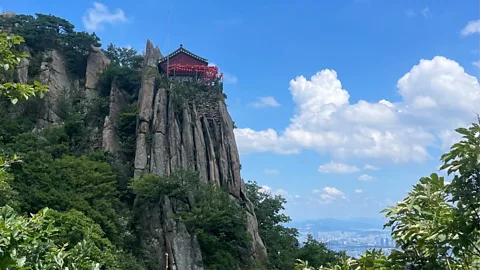
Vying for Jeong-ho's pick of the "most beautiful hiking trail in Seoul", and marking an increase in difficulty from the previous recommendations, is Gwanaksan: the trail leading to the summit of Mt Gwanak (altitude: 632m) in the far south of the city.
Practical tips
• Locals like to greet others while hiking. Join in with a friendly “Annyeong haseyo!” to passersby.
• Post-hike, Park recommends makgeoli (rice wine) and haemul pajeon (seafood and leek pancakes) – a classic feel-good pairing.
• No hiking boots? No problem. The Seoul Hiking Tourism Center, located a five-minute walk from Bukhansan Ui station, rentes boots for 2,200 KRW (£1.30) for the day.
Along the way are rocks in the shapes of horses and elephants, and near the peak is the jaw-dropping Yeonjuam, a precariously perched Buddhist hermitage belonging to the Jogye Order of Korean Buddhism. It's arguably the most photogenic sight in Seoul.
The trail starts from Seoul National University's main campus (Gwanak station – Sillim line) and is well-signposted. At the top, Jeong-ho likes to find a good viewpoint and contemplate the lone Buddhist hermits who used to isolate themselves at Yeonjuam. "This place used to be significantly harder to reach many hundreds of years ago compared with today. If one can separate oneself from the world… like those monks did, and grow to truly love loneliness, then I think there is a kind of melancholic beauty to that," said Jeong-ho.
He recommends continuing down the other side of the mountain to Gwacheon – actually a separate satellite city of Seoul but connected to the subway system – following the signs to the ancient Gwacheon Hyanggyo Confucian Academy. There, many excellent restaurants await to feed hungry hikers, such as The Chadol, which serves duck hotpot cooked at the table in a bubbling vat, and Igangsan Sutbul Dakgalbi, where fiery chicken thighs are cooked tableside in a giant pan with rice cakes and vegetables.
 Ben McKechnie
5. Best for athletes: Dobongsan & Baegundae
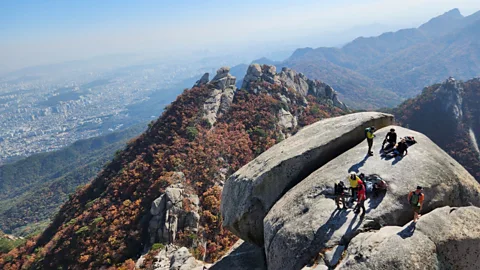
If you're in good shape and only have time for one proper hike while visiting Seoul, Jeong-ho recommends heading for Bukhansan National Park to scale either Baegundae (Seoul's highest peak at 836.5m) or hike up to Dobongsan (Seoul's most challenging trail at 740m). You'll need proper hiking shoes – while the trails are well-maintained and the altitudes may not sound extreme, both summits are steep granite protrusions that require the use of fixed ropes.
Hiking Baegundae takes approximately four to five hours, although there are various secondary trails to take along the way to visit Buddhist temples like Mulyangsa. Much of the main hike is on stone staircases, often with handrails. After passing through the fortress wall, the most challenging (and steepest) part of the trail begins, which will see you pulling yourself up rock faces on fixed metal ropes in parts. Be prepared for traffic jams at the weekend. At the top, however, a spacious plateau with a large South Korean flag offers 360-degree views of the park and city, and is a perfect spot to tuck into a packed lunch.
For Dobongsan, you'll be in a different section of the national park – start from exit 1 of Dobongsan Station (Line 1 or 7) and follow the hordes of hikers towards the park entrance. The trail follows Y Valley, named after its shape, and soon arrives at Darak Ridge, where Jeong-ho likes to stop to watch advanced rock climbers scaling sheer rock faces. The trail then reaches Mangwolsa, the largest and most historic temple on Dobongsan, only accessible on foot, which was once closed to the public due to it being a place for Buddhist priests to focus on long periods of meditation.
BBC Travel's The SpeciaList is a series of guides to popular and emerging destinations around the world, as seen through the eyes of local experts and tastemakers.
---
If you liked this story, sign up for the weekly bbc.com features newsletter called "The Essential List". A handpicked selection of stories from BBC Future, Culture, Worklife and Travel, delivered to your inbox every Friday.
