A celebration to ‘remove obstacles’

 Alamy/HPT Images
Once used to unite Indians against British rule, this spectacular 10-day party sees millions of people around the world take to the streets.
 Ocean Film Company and Sreya Chatterjee
With its ancient temples, Bollywood billionaires, punishing humidity, wafting scent of spices and endless gridlock, India’s biggest city, Mumbai, is an intense explosion of sights, sounds and smells at any time of year. But in late summer, this throbbing mass of 19.98 million residents buzzes even more than usual, and there’s a palpable excitement in the air for one of the year’s most anticipated festivals: Ganesh Chaturthi.
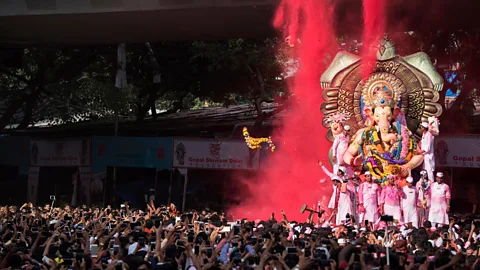
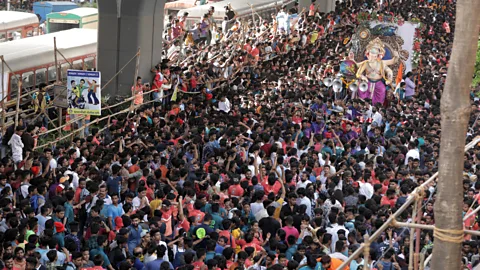
This massive event, which is held in late August or early September (starting on 2 September in 2019), honours the birth of Lord Ganesha, the beloved elephant-headed Hindu god who is believed to remove obstacles and bring good fortune and wisdom. The 10- to 15-day festival is both sacred and celebratory. Residents fast, recite Vedic hymns and place richly decorated clay idols of Lord Ganesha in their homes, but also swarm the streets in boisterous parades and to dance to thumping music.
The festival is now celebrated by millions of people both elsewhere in India and in Hindu communities around the world – but nowhere is it bigger than in Mumbai.
 Ocean Film Company and Sreya Chatterjee
To understand why many millions of Mumbaikars get so swept up in this annual event, one must understand the role Ganesha – or "Bappa" as he’s belovedly called – plays in their lives.
The patron saint of the Indian state of Maharashtra, where Mumbai is located, Ganesha is widely adored and considered to be a family member who visits once a year. His strong devotion in the region dates to the 1600s when Shivaji, the Maratha ruler who fought to save the region from foreign occupation, encouraged Ganesha’s worshipping as a way to unite Indians across castes. Shivaji started the Ganesh Chaturthi festival to promote harmony, and, after a period of abandon, it was revived in the 1880s by Bal Gangadhar Tilak, a renowned freedom fighter, as a way to protest against the ruling British who had banned public assemblies. As Indians from across castes joined together, the festival evolved to become an important social unifier and inspired Indians to rise up against the British.
As a result, Ganesha is still associated with removing enemies from one’s path and remains an integral part of Mumbaikars’ daily lives. Locals recite mantras to Ganesha before taking on a new venture, as he’s also thought to bring prosperity and peace. It’s common to hear train commuters chanting praises of “Ganpati Bappa Morya!” (roughly: “Lord Ganesha bless us!”) each day on their way to work. This all culminates with Ganesh Chaturthi, which marks some of the holiest days for the city’s residents.
 Ocean Film Company and Sreya Chatterjee
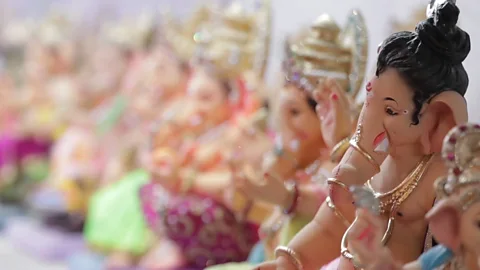
The festival starts with millions of Mumbai residents placing elaborately detailed clay idols of Ganesha on raised platforms in their homes, or hoisting them onto highly decorated outdoor stands. Worshippers then begin the prana pratishtha – a ritual prayer to invoke life into the idols. While this first day of the celebration is the most joyous, the final day, when devotees chant in a public procession as they carry the Ganesha statues towards a body of water and then poignantly place them in the river or sea, is the most solemn.
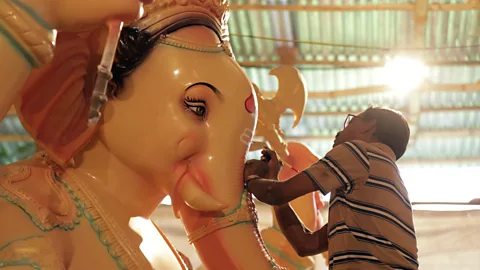
Thousands of clay idols are custom commissioned each year from professional artists in specialist studios – many of whom are second- or third-generation clay idol artists. These delicately decorated deities may only "live" for less than two weeks on Earth, but the painstaking process behind their creation can take up to three months and involve many teams of artists.
 Ocean Film Company and Sreya Chatterjee
The thousands of Ganesha statues that are created each year for the festival range from knee-high idols with pint-sized trunks to towering gods reaching 4.5m. But no matter their size, what most specially made statues have in common is that they start as sketches.
Generally, a wealthy family or organisation that is hosting a public event will send a series of sketches to a clay idol studio, and they will decide on a final design together. This usually takes place at the beginning of June, two to three months before the festival. This sketch will serve as a blueprint for a series of artist teams.
The design first goes to a team of clay artists who create moulds in the shape of the sketch, before being passed on to a dye-maker. Next, the newly dyed deity is transferred to a team who cast it, and then on to another team that finishes it. Only then is it ready for the painters who prime the bare Ganesh before colouring it.
 Ocean Film Company and Sreya Chatterjee
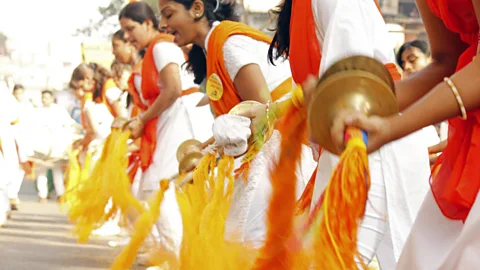
While Ganesh Chaturthi evolved to unite Indians across castes and backgrounds during British rule, local youth organisations called mandals have been continuing the festival’s social legacy since India’s independence. These days, in addition to the festival’s religious component, more than 1,000 mandals in Mumbai put on plays, films, essay competitions and poetry recitals, which has further transformed the festival into a broader cultural event.
“We are blessed to have the opportunity to preserve the cultural ethos of Mumbai by organising this festival annually,” said Umesh Naik, chairman of a Mumbai mandal. “Over 2,000 local residents participate in [organising] this journey to make these 10 days special.”
 Alamy/Dinodia Photos
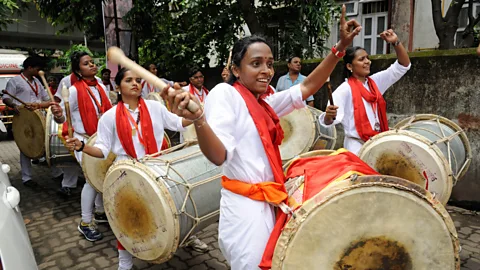
As Ganesh Chaturthi approaches, the beats of Indian drums fill the air. In the past, Ganesha used to be welcomed by chants and prayers, but loudspeakers have since taken their place. Yet, in recent years, the role of the drummers has intensified in the festivities.
Each mandal typically has multiple drum performances, with an offering made to the drums before playing them. The players are either students or professionals who sometimes wear traditional kurta, dhoti or sari garments. The drumming primarily happens at the end of a public procession on the festival’s first day. More than a ritual, it has become one of the most highly anticipated aspects of the opening day.
Alamy/HPT ImagesDuring the festival, the streets transform into a citywide dance floor, with popular Bollywood, EDM and traditional music blasted on speakers. People irrespective of age and gender dance without inhibition, while gulaal (coloured powder) is thrown in the air. Thanks to social media, the processions have become even bigger in recent years.
“We wait for the procession ceremony intently!” said Rachna Patil, a tea vendor and festival attendee from Mumbai. “It is the time when the traffic-heavy Mumbai streets become truly pedestrian – a stream of joy, pulsating with music.”
 Ocean Film Company and Sreya Chatterjee
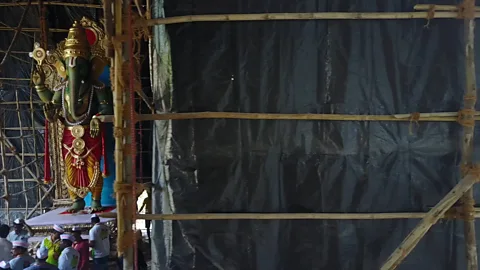
Decorations play a vital role in Ganesh Chaturthi. Flowers are used to make garlands and bouquets for Ganesha, who is often draped in jewellery. Elaborate backdrops surrounding the deities are often made with polystyrene, but as environmental awareness increases, many are now being made with paper.
The larger idols have a clay backdrop, which is made by the same sculptors who created the idol. Occasionally, specialised painters are commissioned to create vivid landscape backdrops to complement the theme of the Ganesha’s design.
 Ocean Film Company and Sreya Chatterjee
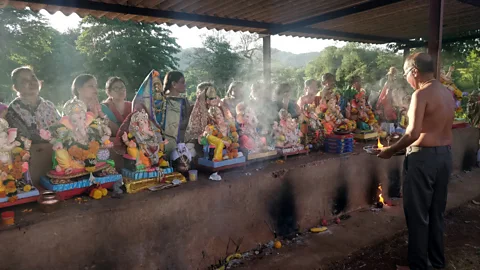
Once Ganesha is displayed at the festival and devotees perform the ritual prayers to invoke life into the idol, worshippers place Ganesha’s favourite sweet at his feet as an offering. Called modak, this dumpling is made from rice or wheat flour with a filling of grated coconut and jaggery sugar.
Legend has it that the gods once visited Ganesha’s parents (Shiva and Parvati) and presented them with a divine modak, saying that only the wisest and most knowledgeable had a right to eat it. Ganesha’s mother wanted to present it to her sons, Ganesha and Kartikeya, but they were unwilling to share it, so she challenged them to go around the world three times, saying that whoever finished first would get to eat it. Instead of circling the world, wise Ganesha circled his parents, as they were the world to him. Since that day, Ganesha is always pictured with a modak beside him, and his love for the sweet is recognised by his worshippers.
“Along with the festivities comes the joy of making modak and sharing them with one and all,” said Parul Dewal, a festival-goer from Mumbai. “Modak does not taste as good during the rest of the year as it does during the festival. Undoubtedly the warmth of the festive spirit makes the difference.”
 Alamy/Stringer/Xinhua
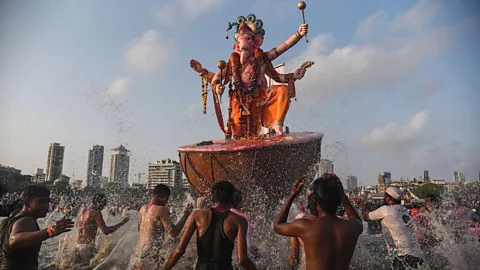
The final day of the festival, known as visarjan ("immersion"), is the most poignant, as this is when most Mumbaikars part with their beloved Bappa. The immersion ceremony is dependent on each family’s tradition and may actually take place on any day during the 10- to 15-day celebration, but the 11th day is when the largest and most elaborate idols commissioned by the mandals are immersed.
A procession of beating drums and chanting surrounds the Ganesha idol as he’s led from the city towards the sea. The beaches of Mumbai become packed with thousands of small idols and those queuing to return them to the water. The small- and medium-sized Ganeshas are carried on people’s shoulders atop bamboo frames and then immersed into the sea, followed by the larger ones. These idols are later retrieved to prevent environmental waste.
Teary-eyed, the devotees then return home to begin a year-long wait to see their beloved Bappa again.
Why We Celebrateis a BBC Travel series that revels in how a festival or event is intertwined with a place’s culture.
