Safety has improved after fatal train derailment, inquiry hears

 BBC
BBCAn inquiry into a fatal train derailment that left three men dead has heard that progress has been made on safety improvements on its final day of evidence.
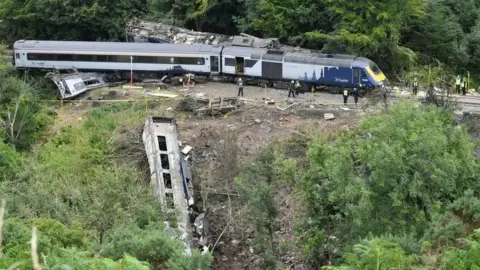
The Aberdeen to Glasgow train came off the rails at Carmont in Aberdeenshire on 12 August 2020, after it hit debris washed from a drain which had not been built as designed.
Driver Brett McCullough, 45, conductor Donald Dinnie, 58, and passenger Christopher Stuchbury, 62, died in the crash.
Network Rail was fined £6.7m in court for a series of failings in connection with the crash.
The seventh day of the fatal accident inquiry (FAI) heard that 17 of 20 Rail Accident Investigation Branch (RAIB) safety recommendations made in the wake of the crash have now been met.
The inquiry began in Aberdeen on 26 January.
It had been set down for an initial three-week period.
However the last witness led by the Crown finished giving evidence on Wednesday afternoon, midway through the second week.
Anna O'Connor, head of inspection at safety regulator the Office of Rail and Road (ORR), went through the 20 recommendations issued by the RAIB.
Those implemented include improving drainage systems design and improved methods for reducing rainfall-related threats.
Three recommendations including safety management and train infrastructure are still classed as open - although O'Connor said progress was being made on those.
There will now be closing submissions at the end of March, before Sheriff Lesley Johnson later publishes her findings.
 PA Media
During the court case in 2023, Network Rail admitted a number of maintenance and inspection failures before the crash.
It also admitted failing to warn the driver that part of the track was unsafe, or tell him to reduce his speed.
The accident happened after what was described as a once-in-a-century level of rainfall in the area in a short period of time.
The FAI heard that rail network is now better prepared for the risks of extreme weather than when the train derailed following heavy rain.
Network Rail's head of programme management Russell Shanley told the inquiry that there were still improvements to be made, but better systems were now in place for reacting to bad weather forecasts.
