Crash inquiry hears rail network is better prepared for extreme weather

 Reuters
The rail network is now better prepared for the risks of extreme weather than when a train derailed following heavy rain, an inquiry has been told.
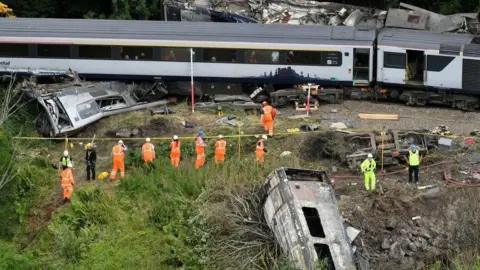
The Aberdeen to Glasgow train came off the rails at Carmont in Aberdeenshire on 12 August 2020, after it hit debris washed from a drain which had not been built as designed.
Driver Brett McCullough, 45, conductor Donald Dinnie, 58, and passenger Christopher Stuchbury, 62, died in the crash.
Network Rail's head of programme management Russell Shanley told the sixth day of a fatal accident inquiry (FAI) that there were still improvements to be made, but better systems were now in place for reacting to bad weather forecasts.
Network Rail was fined £6.7m in court for a series of failings in connection with the crash.
Shanley told the FAI he led a Weather Risk Task Force which was set up in the wake of the Carmont derailment.
Advocate depute Alex Prentice KC, for the Crown, asked if it was still in operation.
He confirmed it was, and said: "There's still work to do."
Asked for a comparison between now and before Carmont, Shanley said he believed much better processes and systems helped to see possible hazards.
He said there is now also a wider knowledge and appreciation of forecasts and the potential risks.
Prentice asked if there had been a recognition that "climate change is a real thing, a real risk".
The witness agreed.

The advocate depute asked if there was now a better opportunity of understanding when storms were forming and the potential of issues from downpours, and Shanley said that was right.
Shanley said systems now generated weather alerts to staff who needed to be aware and who could take steps to mitigate risks, rather than having staff have to search for information.
"That's a major shift, isn't it?" Prentice asked, and Shanley agreed, adding the plan going forward was to improve further.
Peter Gray KC, for Network Rail, asked if one of the most significant changes since Carmont was full-time meteorologists working round-the-clock in rail control, and Shanley said it was.
He also told Sheriff Lesley Johnson that there would now be much earlier sight of specific weather incidents and much quicker action taken from those alerts.
He said this would also allow better understanding of when to impose any speed restrictions.
During the court case in 2023, Network Rail admitted a number of maintenance and inspection failures before the crash.
It also admitted failing to warn the driver that part of the track was unsafe, or tell him to reduce his speed.
The inquiry earlier heard that the accident happened after a once-in-a-century level of rainfall in the area in a short period of time.
Also giving evidence on Tuesday, Network Rail programme manager Karl Grewar said the rulebook had changed in the months after Carmont.
It meant rainfall was now seen among weather hazards - such as snow depth, wind speed and actual flooding - and could lead to speed restrictions being imposed.
Grewar explained that Scotland had been divided into hundreds of route sections, and there was now the ability to designate high-risk areas that could tolerate less rainfall.
He said the employment of professional weather experts was "without question the single most transformational difference" that had been made.
He said he had a high degree of confidence that with the knowledge and skills now at the table after Carmont, that would now see a speed restriction put in place in the same circumstances.
The inquiry, which began in Aberdeen on 26 January, continues.
