Transfer of safety-related information 'ineffective' - train crash inquiry

 BBC
BBCThe transfer of safety-related information between Network Rail and its contractors was "ineffective" before the derailment of a train in Aberdeenshire in which three men died, an inquiry has heard.
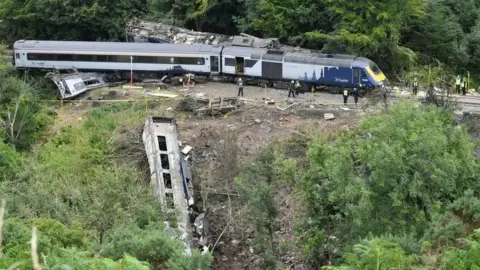
The Aberdeen to Glasgow train came off the rails at Carmont in Aberdeenshire on 12 August 2020 after it hit debris washed from a drain following heavy rain.
Driver Brett McCullough, 45, conductor Donald Dinnie, 58, and passenger Christopher Stuchbury, 62, died in the crash. Network Rail was later fined £6.7m in court for a series of failings.
Changes made to drainage during construction were not communicated by contractor Carillion to the designer or Network Rail, a fatal accident inquiry heard.
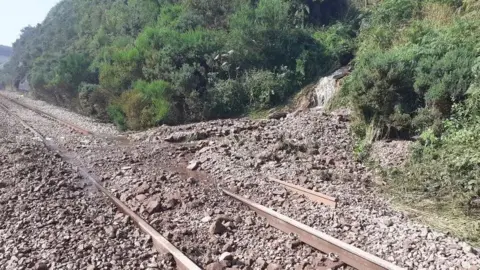
The train hit debris after heavy rain in an area where a drainage system had been incorrectly installed.
The drainage system at the Carmont crash site was built between 2011 and 2012.
Rail Accident Investigation Branch (RAIB) inspector Nick Bucknall was continuing with his evidence on the second day of the fatal accident inquiry (FAI).
"Network Rail's processes that were intended to ensure a managed transfer of safety-related information from constructor to infrastructure manager were ineffective," he said.
"Had this managed transfer taken place in accordance with Network Rail's processes, it is possible that the divergence between the design intent and the asset that had been delivered would have been noted and remedial action taken."
 RAIB
RAIBCivil engineering company Carillion made several changes to the drainage system - including the omission of a soil particle filter that would have reduced the risk of a washout occurring - which were not communicated to the designer in final "as-built" drawings, the inquiry heard.
The accident inspector had previously said the amount of rainfall experienced in about three hours before the crash was unusual as it was 90% of the average total rainfall for August.
He had added that such an extreme downpour would not be expected to happen more than once in, at least, 100 years.
Mr Bucknall told the inquiry on Tuesday: "Unless informed verbally or through correspondence, Network Rail staff would not have been aware of changes made during construction, unless evidence was seen during a Network Rail site visit.
"Network Rail's project team were probably unaware that the 2011/12 drain was significantly different from that intended by the designer and therefore did not take action.
"Had the team been aware of this, it is possible that the consequent risk would have been recognised and remedial actions taken."
 PA Media
During the court case in 2023, Network Rail admitted a number of maintenance and inspection failures before the crash.
It also admitted failing to warn the driver that part of the track was unsafe, or tell him to reduce his speed.
Law firm Digby Brown later said that almost £1m in civil actions against Network Rail had been settled.
On the fifth anniversary of the tragedy, the RMT union warned "urgent action" was still needed to improve rail safety.
The RAIB annual report for 2024 revealed eight of its 20 safety recommendations remained "open".
These included control room capability and drainage design. Network Rail said "meaningful progress" had been made.
Statements which were read on behalf of relatives of those who died told of their loss, as proceedings got under way on Monday.
The inquiry in Aberdeen, before Sheriff Lesley Johnston, is expected to last about three weeks.
