Stonehaven train derailment inquiry told of 'lives ripped apart'

 BBC
BBCA fatal accident inquiry into a train derailment which killed three men in the north east of Scotland has been told lives were "ripped apart" in the crash.
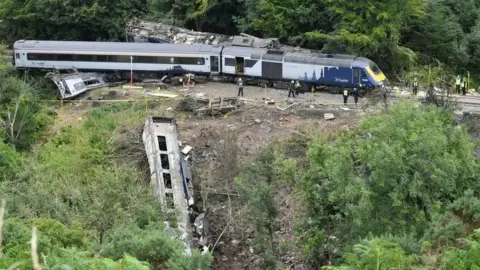
The Aberdeen to Glasgow train came off the rails at Carmont in Aberdeenshire on 12 August 2020 after it hit debris washed from a drain following heavy rain.
Driver Brett McCullough, 45, conductor Donald Dinnie, 58, and passenger Christopher Stuchbury, 62, died in the crash. Network Rail was later fined £6.7m in court for a series of failings.
Statements read on behalf of relatives of those who died told of their loss, as proceedings got under way. The inquiry in Aberdeen is expected to last about three weeks.
Sheriff Lesley Johnston started by expressing her "sincere condolences" to the families involved, and promised a thorough inquiry.
 PA Media
Alex Prentice KC, for the Crown, detailed agreed evidence about how the bodies of the three men were found.
He said Stuchbury was found on an embankment, as was the train driver, while the conductor was in a train doorway.
He said all three had suffered what were described as "non-survivable" injuries, and their deaths were likely to have been immediate.
Prentice said Stuchbury's wife had described every day with him as a gift, but that on 12 August 2020 "our lives were ripped apart" in an accident she said should not have happened.
He said Dinnie's daughter described the family as continuing to be "devastated" by his loss.
McCullough's family said he would always be remembered in their hearts.
Peter Gray KC, for Network Rail which operates the line, offered its "deepest sympathies" to the families for their "tragic loss".
 RAIB
RAIBRail Accident Investigation Branch (RAIB) inspector Nick Bucknall was the first witness to give evidence.
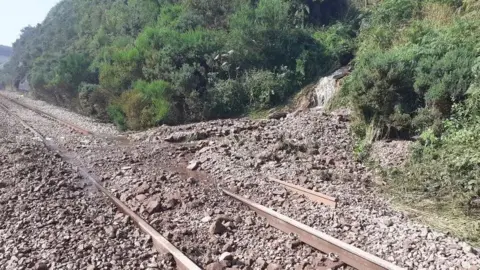
He said the RAIB investigation found the train had collided with debris washed from a drain on to the track.
The six others who had been on the train were injured.
The RAIB noted the "unusually low" number of people on board was because the accident happened during the Covid pandemic.
Asked by Prentice if the outcome would have been much more severe had the train been busier, Bucknall replied: "Almost certainly, yes."
The accident inspector said the amount of rainfall experienced in about three hours before the crash was unusual as it was 90% of the average total rainfall for August.
Bucknall added that such an extreme downpour would not be expected to happen more than once in, at least, 100 years.
He said the line re-opened to traffic on 3 November 2020 - nearly three months after the crash - after new drainage was installed.
Why did the train derail?
The train hit debris near Stonehaven after heavy rain in an area where a drainage system had been incorrectly installed.
The 06:38 service to Glasgow had been unable to complete its journey due to the conditions.
It was returning to Aberdeen when the accident happened.
A recording of the driver showed he queried with a signaller if any reduced speed was needed to return north.
He was told everything was fine for normal speed, so he continued to accelerate the train towards 75mph - the maximum permitted speed at the accident site.
As the signaller was not aware of any obstruction on the line, railway rules did not require him to instruct the driver to travel at a speed slower than the maximum normally permitted.
Data from the on-train data recorder (OTDR) showed it was travelling at about 73mph as it approached the washout debris at Carmont.
The train struck debris on the track, derailed, and collided with a bridge parapet.
During the court case in 2023, Network Rail admitted a number of maintenance and inspection failures before the crash.
It also admitted failing to warn the driver that part of the track was unsafe, or tell him to reduce his speed.
At the High Court in Aberdeen, Lord Matthews said no penalty could compensate for the loss suffered by the families of those who died and the people injured.
Law firm Digby Brown later said that a total of nearly £1m in civil actions against Network Rail had been settled.
On the fifth anniversary of the tragedy, the RMT union warned "urgent action" was still needed to improve rail safety.
The RAIB annual report for 2024 revealed eight of its 20 safety recommendations remained "open".
These included control room capability and drainage design.
Network Rail said "meaningful progress" had been made.
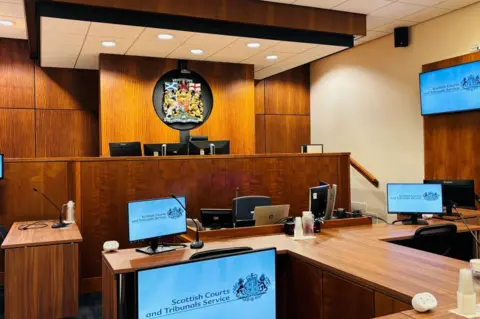
The FAI itself is being held in the civil annexe of Aberdeen Sheriff Court.
Several rooms are being used to accommodate a large number of legal representatives, as well as relatives of those involved, the media, and members of the public.
Initial court time has been set aside for the next three weeks.
There will also be later closing submissions, which will be done remotely.
Aslef, the train drivers union, welcomed the start of the FAI.
Scottish organiser Kevin Lindsay said: "We hope and expect that this FAI establishes all the facts and helps ensure that no family goes through the pain endured by those closest to Christopher, Donald and Brett."
The inquiry continues on Tuesday.
