Stonehaven crash train lacked modern safety features - inquiry

 Reuters
The fatal derailment of a train in Aberdeenshire would "more likely than not" have had a better outcome if it had been built to modern safety standards, an inquiry has heard.
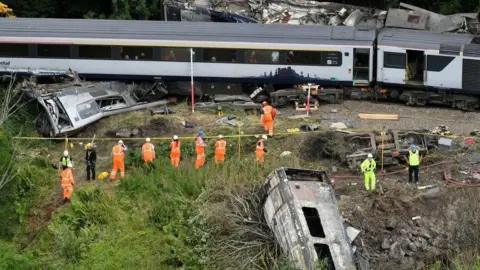
The Aberdeen to Glasgow train came off the rails at Carmont in Aberdeenshire on 12 August 2020 after it hit debris washed from a drain following heavy rain.
Driver Brett McCullough, 45, conductor Donald Dinnie, 58, and passenger Christopher Stuchbury, 62, died in the crash. Network Rail was later fined £6.7m in court for a series of failings.
The third day of a fatal accident inquiry (FAI) heard the coaches involved lacked a number of safety features that are now standard in modern trains.
The FAI heard on Wednesday that the train was made up of mark 3 high speed train (HST) coaches, which were built by British Rail in the 1970s.
Dominique Louis, a principal inspector at the Rail Accident Investigation Branch (RAIB), told the inquiry the 50-year-old coaches lacked a number of safety features that were now standard in modern trains.
He told the inquiry: "The RAIB considers it more likely than not that the outcome would have been better if the train had been compliant with modern crashworthiness standards."

Louis said the coaches were built before the requirement for "anti-climb devices" - which prevent one coach riding over the top of another in the event of a crash - and "energy-absorbing vehicle ends" such as crumple zones.
Had these been in place, he said, they would have reduced the risk of coach D "overriding" the lead power car, which he said caused a "complete loss of survival space" that resulted in the death of the conductor.
He also said the "couplers" linking the coaches were together less capable than modern designs of withstanding the forces caused by the collision, which resulted in the train breaking up.
The train hit debris after heavy rain in an area where a drainage system had been incorrectly installed.
During the court case in 2023, Network Rail admitted a number of maintenance and inspection failures before the crash.
It also admitted failing to warn the driver that part of the track was unsafe, or tell him to reduce his speed.
The inquiry began in Aberdeen on Monday before Sheriff Lesley Johnston and is expected to last about three weeks.
