'My brother's tinnitus was a brain tumour'

 Rebecca John
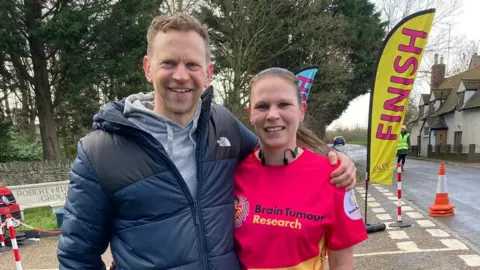
A woman has completed the first of 12 half marathons she is running to raise money after both her brother and friend were diagnosed with brain tumours.
Rebecca John's brother Richard Morris and her friend were both diagnosed with meningiomas - the most common form of adult primary brain tumour - which tends to be non-cancerous.
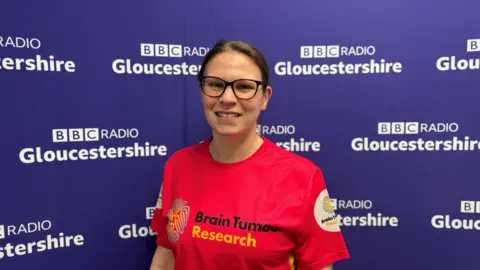
Inspired to raise money for charity Brain Tumour Research (BTR), John from Longlevens, Gloucester, ran her first half marathon on Sunday, and will complete one every month of 2026.
She said Morris was diagnosed after years of tinnitus, while Dr Karen Noble from BTR said it often takes several GP visits for a brain tumour to be diagnosed.
While her brother and friend were diagnosed with the same type of brain tumour in 2023 and 2025 respectively, John said their stories were "very different".
John said by the time Morris was diagnosed, after years of tinnitus, the size of the tumour meant emergency surgery was the only option.
Following a tough recovery, he is now healthy and a recent scan revealed no re-growth, John said.
Whereas her friend's tumour was picked up early, and she is now on a watch and wait list.
"She is on the active surveillance pathway, but may likely need surgery in the future. Her recent scan showed no further growth," John added.
Noble said symptoms of brain tumours can include headaches, tinnitus, memory loss, seizures, and weakness of limbs.
With more than 100 types of brain tumours, she added it can be "very hard" for GPs to identify the signs if presented with "quite generic, non-specific" symptoms.
"We know that 40% of patients will ultimately get diagnosed in A&E and that's after three/four/five trips to the GP," Noble said.
"It's not because the GP isn't doing a good enough job, it's just fortunately, brain tumours are rare, and so it's not likely that a GP will see many brain tumours in their time."
Noble said BTR wants to increase awareness of symptoms among patients and GPs to "make sure patients get better access to the treatment they need in good time".
About 12,000 people in the UK are diagnosed with a primary brain tumour - of which there are more than 100 different types - each year.
The number of diagnoses has increased by 11% during the last decade.
'Raring to go'
John has raised more than £1,000 of her £1,370 target for the charity.
After her first half-marathon in Boddington, John will take on her next half-marathon in Cardiff on Sunday.
"I'm trying to do three runs a week... we're very lucky with the amount of half marathon races there are [in Gloucestershire]," she said.
"My legs are feeling alright, a little bit achy but ready and raring to go for Sunday."
Follow BBC Gloucestershire on Facebook, X and Instagram. Send your story ideas to us on email or via WhatsApp on 0800 313 4630.
