High Court challenge over home birth suspension

 Getty Images
The decision to suspend home birth services in Gloucestershire is to be challenged in the High Court.
Gloucestershire Hospitals NHS Trust announced the suspension in November after staff raised safety concerns over dealing with more complex births.
A coalition of women and professionals is taking the trust's leaders to judicial review, claiming health chiefs are ignoring a legal obligation to provide home birth services - which they say is part of women's human rights.
The trust said its decision is based on clinical evidence showing a risk to the safety of patients or staff. A spokesperson added: "We are committed to reinstating a safe and sustainable home birth service as soon as possible."
Trust bosses said they have struggled to find cover for the on-call home birth service at night without using staff who had already worked a full day shift, which it said could be unsafe. They say they are also dealing with increasingly complex cases.
Despite the suspension, the trust has seen an increase in the number of requests to support births at home "against medical advice".
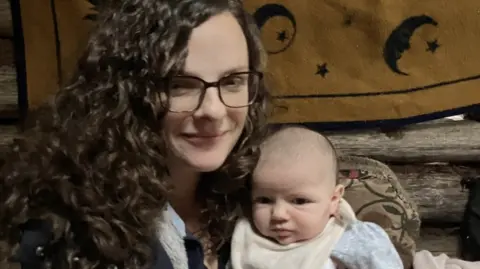
Jordan gave birth to her daughter Beatrix shortly after the home birthing service was suspended in November last year.
The 33-year-old had wanted a home birth after her two previous deliveries had been very quick, and because she lived 45 minutes from Gloucester, in the Forest of Dean.
But at 41 weeks, with high blood pressure and suspected pre-eclampsia, she went into hospital for a check up. She had an emergency delivery after a bleed following an induction .
Jordan said that had a home birth option been available, she could have stayed home, where she would have been relaxed, and potentially "opted for less invasive procedures, such as a stretch and sweep" - to get the labour started, rather than an induction.
"I felt under pressure from doctors at 41 weeks, with suspected pre eclampsia, that I ought to be induced and get it over with it," she said.
She added her birth experience had been "poor".
"I felt completely abandoned by the midwives on the maternity ward.
"Through the day I asked to be seen by midwife to discuss what was happening.
"I was having tightenings but didn't know what was normal.
"No-one came to see me while I was on the ward until the point that I started to bleed and at that point I became a medical emergency," she added.
A trust spokesperson said they were really sorry to hear about her experience and will continue to support her through the complaint process.
Reasonable alternative?
The trust is one of 14 across England to have their maternity services examined over what has been described as "failures in the system" by Baroness Valerie Amos.
National Institute for Health and Care Excellence (Nice) guidelines state that "commissioners and providers... should ensure that all four birth settings (home, freestanding midwifery unit, alongside midwifery unit and obstetric unit) are available to all women".
The charity Birthrights, Gloucestershire Maternity Action Group (GMAG), as well as a mother they are supporting are planning to take the trust to judicial review.
Group leaders hope their civil claim will make the trust reconsider the suspension of home births and work on a plan to support women wanting home births.
Birthrights legal lead, Laura Mullarkey, said the trust should have considered paying for independent midwives to support home births.
"I would ask why contracting independent midwives would not be a reasonable alternative here.
"They have undergone the same rigorous training and qualification process as midwives employed by the NHS," Mullarkey said.
Birthrights claimed other NHS trusts have contracts with a private company called Zest that provides independent midwives.
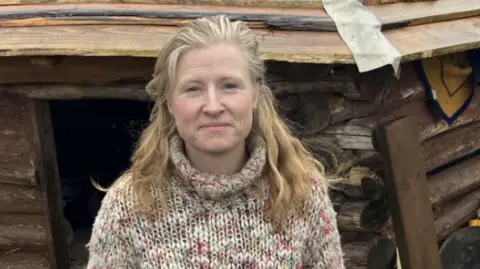
The campaign is partly being led by GMAG, which is a community interest company formed in direct response to the suspension of home birth services in the county.
GMAG, made up of a coalition of women and professionals, exists to promote and protect women's rights to lawful, evidence-based maternity care - including access to midwifery-led services, continuity of carer and informed choice.
Its spokesperson Emma Gleave, who is a doula - someone who provides support to mums before, during and after birth - said: "We have spoken to a lot of women who don't feel safe to transfer to hospital.
"Other women have traumatic experiences and women just want to be in control of their bodies.
"It is a human right that they can choose the place of birth."
Ewelina Sicinska, from Gloucester, is part of the legal action.
After a traumatic birth in a hospital in another area of the UK, she has opted for a freebirth, where babies are delivered without qualified medics.
One expert described freebirths as risking "reversing [care] to the middle ages" .
Ms Sicinska said she would prefer to have a home birth supervised by a midwife, but because her first birth was so bad, it has changed how she views hospitals.
"I am standing up for myself and for other women who had this right taken away.I feel calm and empowered about freebirth. I feel confident that I can handle it," she added.
'Significant safety risk'
Professor Mark Pietroni, director for safety and medical director at the trust apologised to families who had planned a home birth, and said the maternity, team is supporting them to explore alternative options.
"We have considered suggestions to use independent midwives, but this is not a viable option.
"Independent practice operates under different governance and training, which would create significant safety and legal risks and would not resolve the current safety concerns.
"Although we cannot offer home births at this time, midwifery‑led care remains available at Stroud Maternity Unit and Gloucester Birth Unit, both offering calm, homely environments," he said.
Correction 28 Jan: We have corrected an error in this article to make it clear that Jordan's pregnancy was low risk and her wish for a home birth was backed by medical advice.
Follow BBC Gloucestershire on Facebook, X and Instagram. Send your story ideas to us on email or via WhatsApp on 0800 313 4630.
