Why are councils voting for 'rights' of rivers?

 AFP via Getty Images
The right to flow, the right to native biodiversity, the right to be free from pollution.
These are some of the rights that a small but growing number of local authorities in the south-east of England have decided their area's rivers should have.
The lawyers, campaigners and councillors behind the "rights of rivers" declarations accept it is up to Parliament to give England's waterways the same legal status as people.
But they claim they are building a growing movement to improve the condition of the country's rivers.
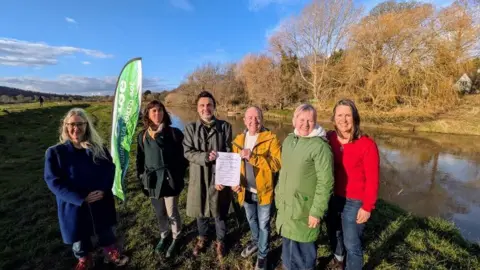
Backed by campaign group Love Our Ouse and other organisations, Lewes District Council became the first authority in East Sussex to declare rights of rivers in February, two years after first agreeing it would work towards doing so.
Emma Montlake, a director at Love Our Ouse, said it was "very much a community-led process".
The Environmental Law Foundation lawyer said the district's town and parish councils were also "endorsing and supporting the charter, so it feels very grassroots".
 Lewes District Council
Wealden District Council voted in favour of a similar declaration to Lewes in July.
Rother District Council, which like Lewes and Wealden is coalition-run, voted in September to support the rights of rivers.
It passed a motion backing rights for heritage trees at the same meeting and declared a "nature emergency" in December.
In Hampshire, Conservative Party-run Test Valley Borough Council and Labour-majority Southampton City Council passed rights of rivers motions in July.
East Hampshire District Council recognised the rights of rivers in November.
 Getty Images
"It felt like there was a movement to try and change the relationship between human beings and nature," Rother councillor Nicola McLaren said, "so we thought it was a great opportunity to be part of that movement."
The Liberal Democrat, who proposed the motions alongside Green councillor Sue Burton, says the rivers declaration helps the council review policies such as its local plan, which influences planning decisions, and its climate strategy action plan.
The charter gives "not just moral support" to local environment groups but also practical support, she told the BBC, as it "lends power to their work".
McLaren said: "We're trying to behave as if the rivers do have these rights so that we can use that thinking and that framework to underpin our decision making."
Emily Julier, a counsel knowledge lawyer at Hogan Lovells, who has helped draft rights of rivers motions, said councillors "should have a mind to [the motions] in council decision making, because they've all agreed to it".
"Rights of rivers is quite a unifying topic, and it's also been something which has been unifying across the political divide," she told the BBC.
 Mark Brumell/Friends of the River Medway
In Kent, Maidstone Borough Council leader Stuart Jeffery says the council is "working on a range of measures to embed the rights of nature into our policies and practices".
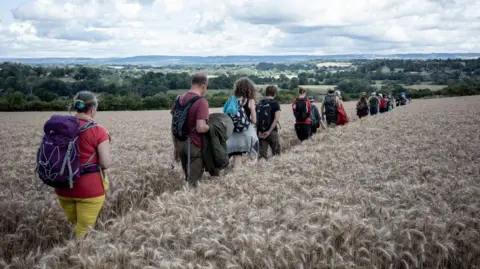
The authority supported a nine-day "source to sea pilgrimage" of the River Medway organised by campaigners in July.
Zofia Page, campaigner with Friends of the River Medway, said the event was a space "for councils to come together to actually discuss it".
'Grassroots pressure'
According to a 2024 report by conservation charity The Rivers Trust, none of England's rivers were in good overall health.
The government says it is "taking decisive action to clean up England's rivers, lakes, and seas", but it does not have plans to enshrine rivers as living entities with rights.
This step has been taken elsewhere. Most famously New Zealand granted the Whanganui River the same legal rights as a person in 2017.
Paul Powlesland, co-founder of Lawyers for Nature, says national legislation in England "feels like a long way away".
"If the national change never happens then there is still crucial work happening locally on rivers," he told the BBC.
"These motions are everything and nothing," he said.
"If you don't act upon them and go out there and make those rights a reality, they're meaningless.
"But if you do do that, they are utterly transformative in how humans in our society relate to rivers."
Medway campaigner Ms Page said it would be "a successful campaign if we've got around 75% of councils in the UK having passed this as a motion" within a year.
"Obviously it's a hugely ambitious number," she said, but "if there's a snowball effect with this it could lead to that, definitely".
Follow BBC Sussex on Facebook, on X, and on Instagram. Send your story ideas to southeasttoday@bbc.co.uk or WhatsApp us on 08081 002250.
