Bits of beach 'rubber' are left by predatory snails

 BBC
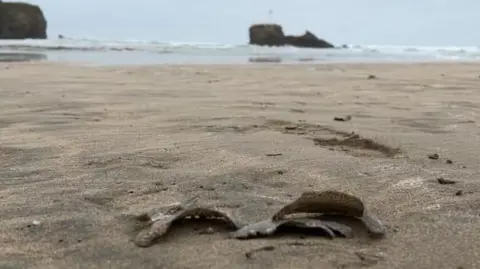
BBCBeach goers have expressed concern "chunks of rubber" washing up on beaches are some form of man-made pollutant.
Some believe the bits of circular material which have appeared in large quantities on beaches in Cornwall and Devon are tennis balls, bits of artificial football pitches or even old shoes.
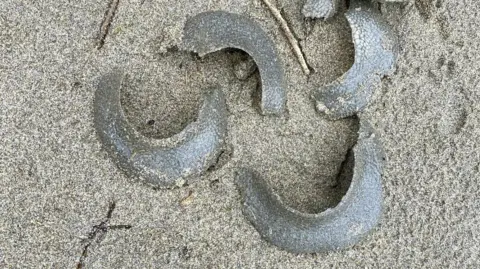
But an expert told the BBC the substance was actually the egg casing created by a moon snail (naticidae), a predatory mollusc which creates the structure during its breeding season.
Matt Slater, from Cornwall Wildlife Trust, said: "It's actually a sort of a mucus structure that gets lots of sand stuck in it and looks kind of like plastic and that's why people have been getting a bit confused."
Dog walker Dan Alderman, 30, said Perranporth beach was covered in the casings and he had been wondering for weeks what the substance was.
"I've just been clueless as to what they are," he said.
"I thought maybe they were like eel skin or something, I don't know or just something off a fish.
"I almost asked Chat GPT today and now, well, now I don't have to."

Another walker, Janet, said she had noticed the bits of material "everywhere".
"It looks like it's bits of plastic of something that's broken up in the surf and just been washed ashore with this heavy surf."
In one post on a Facebook group for Widemouth near Bude, a man said people had spotted "dozens" of the casings in recent weeks.
 Perranporth Marine Conservation Group
What is a moon snail?
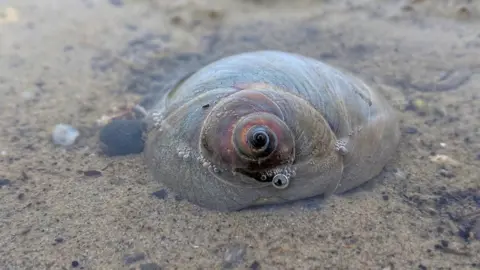
Slater said moon or necklance shells were native to the UK. They arelarge round snails, about an inch across, which live on soft sandy seabeds all around Cornwall's coastline.
He said they were a predatory creature which feasted on other molluscs like clams and mussels, using a kind of teeth and enzymes to break through their shells.
"The strange thing is this incredible structure they create to embed their eggs," he said.
"It's actually a sort of a mucus structure that gets lots of sand stuck in it and it looks kind of like plastic and that's why people have been getting a bit confused when they've seen these things.
"It might have been a really good year for this particular species. We often see a few of these washing up after storms, but we've had reports of quite large numbers [this year]."
 Getty Images
Moon snails are partial to other molluscs like clams and mussels.
Slater said they drilled a hole through their prey and then used a special acid gland in their foot that releases an enzyme, acids, to weaken the shell.
"Then they scrape away that weakened shell, and it makes a perfect circular hole. It almost looks like it's been drilled.
"Once they've created that hole, they then inject a load more enzymes, dissolving the flesh, turning it into soup, and the little worm just sucks."
Follow BBC Cornwall on X, Facebook and Instagram. Send your story ideas to spotlight@bbc.co.uk.
