Why thieves target catalytic converters

 BBC
BBCA driver whose car parts were stolen twice at an Oxford park and ride is just one of many motorists across the South to fall victim to catalytic-converter theft.
The devices reduce harmful emissions from cars, but the precious metals inside such as platinum and palladium make them attractive to thieves.
Converters can be removed in a matter of seconds, leaving drivers with costly repairs and, in some cases, vehicles that are written off entirely.
Catalytic-converter theft rose sharply across the UK in the early 2020s, driven in part by the high value of precious metals.
A Freedom of Information request showed almost 100,000 converters were stolen between 2019 and 2022.
But recent figures suggest the scale of the crime may be declining.
Analysis of police data by Auto Express indicates reported thefts in some areas have fallen significantly since their peak in 2021.
Police and motoring experts say the decline may be linked to targeted enforcement, tighter controls on the scrap-metal trade, as well as falling precious metals prices.
There are also signs some criminals may be turning to other items like electric vehicle charging cables, which can also contain valuable materials.
Here is what catalytic converters do, why they are stolen and how drivers can reduce the risk of becoming a target.
What is a catalytic converter and what does it do?
 Getty Images
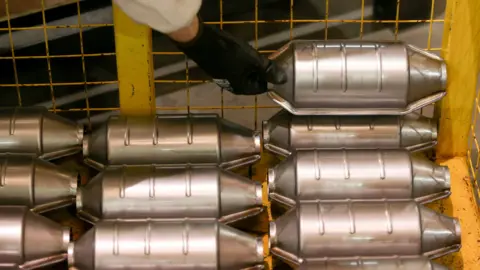
A catalytic converter is an essential part of a vehicle's exhaust system that helps cut the amount of harmful pollution it releases into the air.
It is fitted in the exhaust pipe and converts up to 98% of the harmful fumes produced by a car's engine into less harmful gases.
The converter on modern cars, which works best when hot, is usually placed close to the engine.
Since 1993, all petrol cars manufactured in the UK have been legally required to have a catalytic converter to meet European emissions standards.
Why are catalytic converters being stolen?
Thieves target catalytic converters because they contain extremely valuable metals like platinum, palladium and rhodium.
Some of those metals, which are used to regulate and cleanse the exhaust flow, have, at times, been worth more per gram than gold.
Past increases in the value of those metals have been linked to spikes in converter thefts.
According to Crimestoppers, a single converter can sell for more than £500 on the black market.
They can also be stolen in less than a minute with basic tools and without the need for thieves to enter the vehicle.
Which cars are most at risk?
 Getty Images
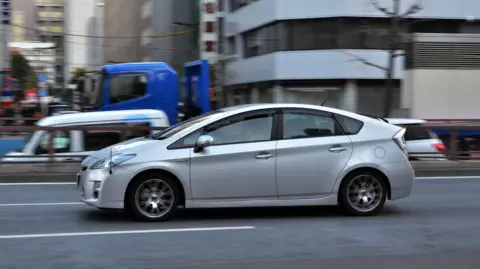
Hybrid vehicles are among those most commonly targeted by thieves.
Their converters are used less often, meaning the valuable metals inside tend to be in better condition.
Cars that sit higher above the ground, like vans and 4x4s, can also be at greater risk, as the extra room underneath makes converters easier to access and remove.
Car.co.uk conducted an analysis of vehicles that used its Scrap My Car service, and found that some cars are disproportionately likely to have had their catalytic converter replaced - a strong indicator of theft.
According to that data, the Honda Jazz topped the list with 57% of converters replaced, followed by the Toyota Aygo (35%) and the Volkswagen Beetle (31%).
How can you tell if yours has been stolen - and can you still drive?
It is not always immediately obvious when a vehicle has had its catalytic converter removed.
The car will still start and drive but it will likely sound much louder than usual.
A missing converter can also trigger the engine warning light and lead to reduced performance or loss of power.
It is illegal to drive a car in the UK without a catalytic converter, meaning motorists could face a fine for breaching emissions rules.
How much does it cost to replace?
 Getty Images
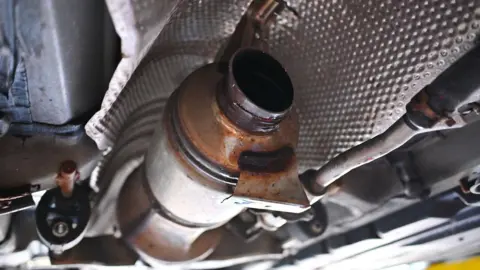
Replacing a catalytic converter can be expensive - due to the value of the same precious metals that make them appealing to criminals.
The total cost may also include more than just the part itself if further damage has occurred.
Prices vary, but industry estimates suggest typical replacement costs are between about £150 and £900, including labour.
What can you do to prevent catalytic converter theft?
Thames Valley Police, Hampshire and Isle of Wight Constabulary, Dorset Police, the RAC and the AA have offered advice to drivers:
- Park in a locked garage or a well-lit, overlooked area
- Park close to walls, fences or other vehicles to restrict access underneath the car
- Install security measures such as CCTV, motion-activated lighting, driveway alarms or reinforced garage doors
- Fit locks, guards or cages to the catalytic converter
- Mark the converter with a serial number or forensic identifier to make it harder to sell on
The RAC says guards fitted underneath vehicles are intended to slow thieves down or act as a deterrent, rather than guarantee a converter cannot be stolen.
Police urge anyone who sees a catalytic-converter theft in progress to report it immediately.
You can follow BBC Oxfordshire on Facebook, X (Twitter), or Instagram.
