Waste firm starts turning used nappies into fuel

 BBC
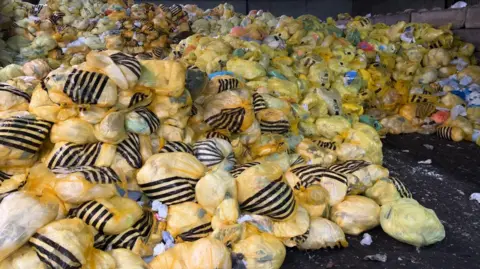
BBCOf all the different types of waste, disposable nappies and sanitary products are among the hardest to deal with.
The contamination from human waste means the vast majority are thrown away with general waste and end up in landfill, where they can take hundreds of years to decompose, emitting methane - a potent greenhouse gas.
Derby-based company Go4Greener, however, says there is a way to turn this particularly unpleasant form of waste into a sustainable source of fuel.
The firm has invested £1.25m in a new machine which uses aerobic digestion to break down contaminants, leaving non-organic matter.
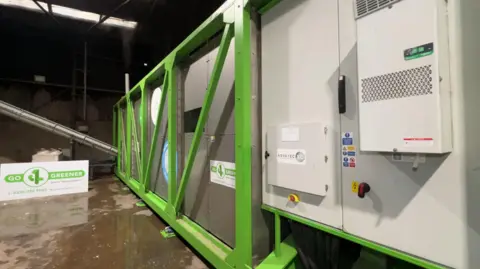
Lee Knott, CEO of Advetec, which manufactures the machine, said: "We're loading nappies and hygiene products into a shredder to get to the right particle size and then into this box, where the biology works its magic."
A stimulant, he said, means the process is completed in 48-72 hours.
"It goes through four chambers, all the time being eaten and dried by biology, and you can see the floc (a cluster of particles) that comes out at the end.
"What's remaining there is a very high-calorific-value product which can be used as a coal replacement."
Through this process, the machine can turn 4,000 tonnes of nappy waste into 2,000 tonnes of "alternative fuel" each year.
The carbon emissions, Knott said, are "significantly less" than from burning coal.
"Nappies and absorbent hygiene products are never going to go away, so we do need to innovate and find a more cost-effective and environmentally friendly way of dealing with it, and this is it," he said.
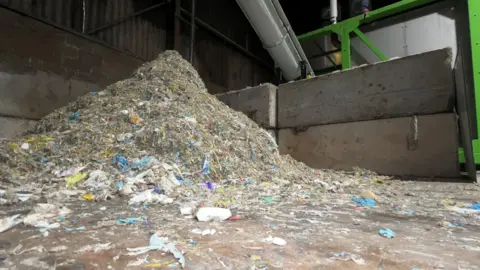
The process also reduces the mass and volume of waste, meaning lower transport costs and emissions, he said.
Go4Greener managing director Samantha Turton said switching on the machine - called the XO22 - is a "huge milestone" for the waste industry.
"We're proud to be leading the way in turning one of the hardest waste streams into fuel and reducing waste to landfill in the process," she said.
The waste processed by the machine is sourced from nappy and sanitary bins found in public spaces such as retail and leisure settings, as well as care homes, schools and nurseries.
While they can process 4,000 tonnes annually, it has been estimated the UK throws away about 400,000 tonnes of nappies a year.
This is a dated estimate, but demonstrates that tackling domestic nappy waste may require a more fundamental change to the way we throw things away.
There are signs, however, that attitudes are shifting.
Stacey Fox, a procurement supervisor at waste collection firm Trust Hygiene - one of Go4Greener's customers - said the green credentials that come with reducing waste sent to landfill has a commercial benefit.
"We have our customers constantly asking, 'What are you doing for your carbon footprint?' and talking about sustainability," she said.
"To be able to go back and say we're taking our sanitary waste away from landfill, it's absolutely massive."
Zaharaddeen Hussaini, lecturer in concentrated solar power at the University of Derby, added: "Nappies are a nightmare waste stream.
"Despite years of effort, current recycling methods barely scratch the surface, with the vast majority of the UK's 3.6bn annual nappies still ending up in landfill.
"This creates a 500-year environmental legacy for a product used for only a few hours.
"This biological processing could potentially transform a difficult biohazard into a stabilised fuel capable of providing a lower-carbon alternative to traditional fossil fuels.''
Follow BBC Derby on Facebook, on X, or on Instagram. Send your story ideas to eastmidsnews@bbc.co.uk or via WhatsApp on 0808 100 2210.
