'Incredibly rare' ancient gold coin found in field

 David Duggleby Auctioneers
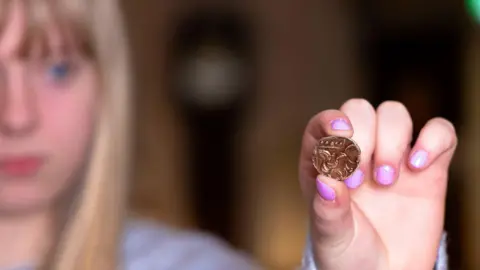
An ancient coin has been discovered that could show evidence of trading between two tribes thousands of years ago.
Unearthed by a metal detectorist in Lelley, East Yorkshire, the coin dates back to around 50-10BC - the Iron Age period.
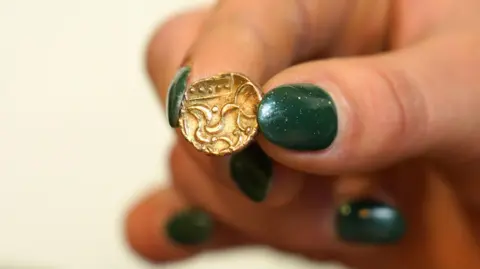
It is a variant of a Corieltauvi tribe gold stater, made by a Celtic tribe that occupied all of Lincolnshire, all the way up to the south bank of the Humber.
Coralie Thomson, of auctioneers David Duggleby, in Scarborough, which is putting the coin up for auction, said it was "incredibly rare" and appeared to be "only the second ever found".
 David Duggleby Auctioneers
The coin was found in what was the Iron-Age territory of the Parisi tribe, who occupied an area of East Yorkshire.
The Corieltavian mint was sited at Sleaford, with the extra pip to the domino on a small number of coins remaining a mystery, Thomson said.
Leicester was the Roman capital of the Corieltauvi tribe, with the mint being one of their workshops.
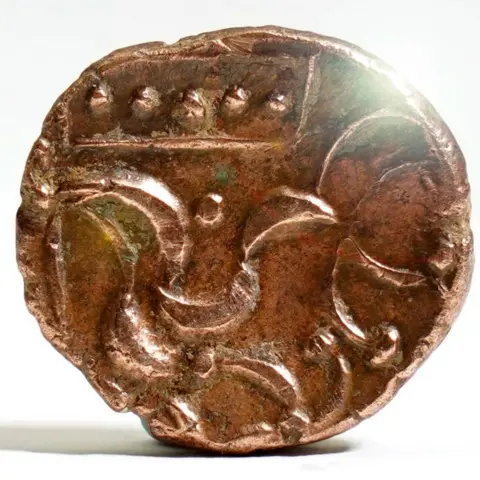
The auction house said the coin was about the size of the old decimal halfpenny, weighing 5.5g, with a composition of 33% gold, 54% copper and 9.5% silver.
It has five dots on it with a depiction of a horse below it.
Thomson said: "It is the fifth pellet on this coin that makes it so incredibly rare.
"Corieltauvi staters always had four pellets - or so everyone thought until a five-domino variant was unearthed in Northamptonshire last year."
Thomson said the two tribes were "apparently pretty civilised", adding that raiding, robbery or murder were less likely reasons for the Corieltauvi gold to wind up in Parisi territory.
"It is more than likely evidence of trading between the two," she said.
 David Duggleby Auctioneers
The stater goes into David Duggleby's auction of coins, banknotes and stamps on Thursday with a pre-sale estimate of £2,000 to £4,000.
Thomson added: "One extra pellet might seem insignificant but in terms of collectable desirability it is an absolute game-changer.
"We're talking a doubling or trebling of auction value."
Listen to highlights from Hull and East YorkshireorLincolnshireon BBC Sounds, watch thelatest episode of Look Northor tell us about a story you think we should be covering here.
Download the BBC News app from the App Store for iPhone and iPad or Google Play for Android devices
