Fire service lays out changes after moor blaze

 NYFRS
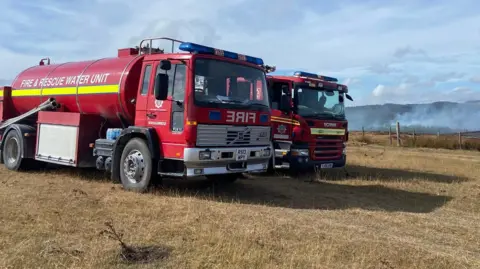
NYFRSOnly one of North Yorkshire Fire and Rescue's (NYFRS) two water bowsers will be replaced between 2025 and 2029, under proposals approved by the region's deputy mayor.
Officials said they would also change their policy on automatic fire alarms; only responding to call-outs from locations where somebody could be asleep, unless a fire was confirmed.
Money saved by not renewing both water bowsers, which carry more water than traditional fire engines, would be invested into "rural firefighting, wildfire fighting and the provision of water", said interim deputy chief fire officer Damian Henderson.
The changes are as part of the service's Community Risk Management Plan (CRMP).
"They are used quite rarely across North Yorkshire, but they are used," said Mr Henderson.
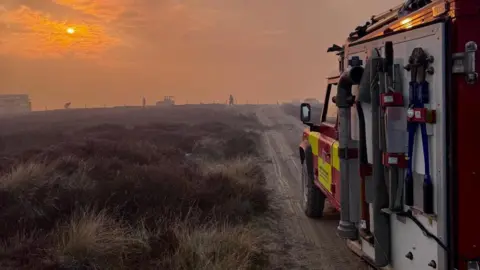
The vehicles were used during the summer's wildfire on the North York Moors, which burned intensely for several weeks.
But Mr Henderson said the vehicles had limitations, such as being based on a "traditional heavy goods vehicle chassis".
"They can only sort of travel on roadways and when we get our wildfires, as we've seen recently within the county, sometimes they are some distance from the road," he said.
 HFRS/Pocklington Fire Station
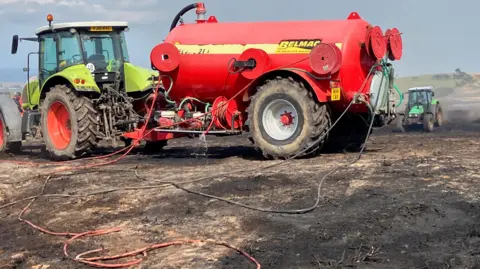
During the major incident, NYFRS was supported by local contractors and farmers to transport more water to the fire.
Mr Henderson said some of the bowsers they contracted from the farming community had "a vastly increased capacity" compared to the service's own.
"They were towed on the back of tractors and allowed for the water bowser to get where we needed them the most," he said.
According to the CRMP, which sets out strategic objectives for 2025 to 2029, the wildfire has already altered NYFRS protocols and planning for similar incidents.
The document added: "We will develop a community asset register, formalising contracts with those who can support attendance at such incidents."
Mr Henderson said this would be reviewed alongside vehicles, equipment and training, for the next 20 to 25 years.
"That's how old the water bowsers that we've got currently are, so [new vehicles] will remain in service for upwards of 20 years."
The proposal was altered following feedback from local residents and the deputy mayor to include alternative vehicles and a review of water provision across the NYFRS area.
The service also sought feedback on its plan to reduce call-outs to automatic fire alarms.
Currently, in a property where there is no risk of somebody being asleep, firefighters do not respond to an automatic alarm between 07:00 and 19:00 unless a fire is confirmed.
Under the CRMP, that will change to being a 24-hour policy, but does not affect residential properties.
Mr Henderson said the policy was common across England because false alarms took firefighters away from prevention activities and trainnig.
He thanked 800 residents from York and North Yorkshire who responded to the consultation on the two policies in the CRMP.
However, elsewhere in the document, he identified "major build projects" and "multi-million investment in control and their mobilising system", which were not part of the consultation.
"We haven't identified those to the public, because the public are going to go, 'that's brilliant, thank you very much'."
Listen to highlights from North Yorkshire on BBC Sounds, catch up with the latest episode of Look North.
