'Utterly devastating wildfire shows we need to be more prepared'

 BBC/Stuart Prandle
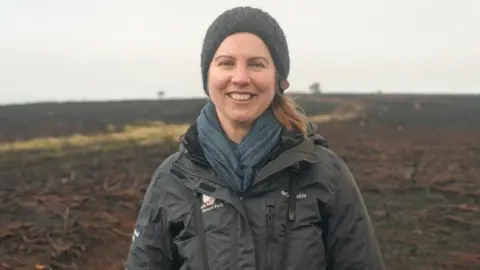
"It's utterly devastating. This was a really special moorland. It had a real diversity of plants and animals here, some really wonderful habitats, and that's all gone."
Senior ecologist Eleanor Ingleby, from the North York Moors National Park Authority (NYMNPA), is standing on Fylingdales Moor.
It is part of the 10 sq miles (25 sq km) of moorland ravaged by a wildfire, which stared on 11 August and smouldered until December.
This week, North Yorkshire Fire and Rescue Service (NYFRS) said a fire in June, caused by cooking on a campfire or gas burner in Langdale Forest, was the likely cause.
Meanwhile, officials in North Yorkshire have warned that business owners and farmers risk losing their livelihoods without changes to financial support available from the government following wildfires.
The government has said it is taking "decisive action to ensure fire services and national bodies can manage and respond to emergencies".
Ingleby said last year's fire was at a scale "none of my colleagues or myself have ever dealt with before".
"There is not enough resources to try and recover everything as perfectly as we would want to," she said.
While in some areas, often ditches which remained wet as the fire ripped across the moor, grasses have re-established since the summer, she said others had no remaining vegation and would be a priority for her team
"If we did nothing in some of those areas, decades could pass and you're still not getting anything growing in it because it's just too harsh an environment."
 BBC/Robbie McGregor-Watson
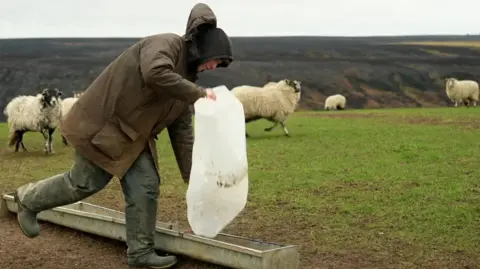
The destruction of plants is also impacting local farmers, like George Cromack at Pond Farm.
He said he lost 80 acres of his farm to the fire and is having to buy costly feed for his sheep, which would normally be grazing on the moor.
"We need more support, financial aid, but also recognition for the scale of this ongoing crisis," he said, adding that the fire would not have been brought under control without support on the front line from farmers like him.
"No discredit to the fire service, but it became apparent that nobody was equipped for something of this scale."
 BBC/Seb Cheer
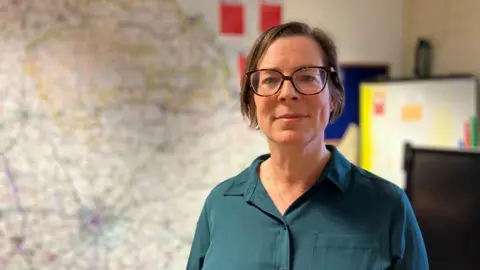
Cromack's experience is common among local farmers, graziers and business-owners, according to a strategic recovery group for the incident.
Formed of representatives from North Yorkshire Council, emergency services, landowners and NYMNPA, it was set up in September.
Leader Rachel Joyce said as well as businesses directly affected by the wildfire, such as those evacuated, others suffered a drop in takings because of road closures or smoke putting off tourists.
The strategic recovery group is calling for £418,354 of government money, which it said was equivalent to support which would be offered in the event of flooding.
"If we have an unprecedented flooding event, we immediately can ask ministers to activate the national flooding framework, which provides almost-immediate relief," Joyce said.
"We haven't got that so for the last six months, since the fire started, those communities, businesses and individuals and landowners have seen no financial help or support and they have been left with those losses."
The request was formalised in a letter to communities secretary Steve Reed on 25 November, alongside a request for £3.17m to reinstate fire breaks.
"To date, we have had no response to that letter," Joyce said.
The calls for more support are being supported by Scarborough and Whitby's Labour MP Alison Hume.
"I share their frustration," she said.
"I'm determined to see grants extended to include wildfires. They already exist for flooding - why not wildfires?"
Joyce added that some individuals have "talked about not returning to farming".
"They were there on the front line doing their best with fire and partners to stop the fire and it feels quite harsh that they could lose their livelihoods because of that," she said.
A government spokesperson said its planned changes include "funding a National Resilience Wildfire Advisor to support a more coordinated response to wildfires, alongside an increase of almost £70 million in funding for standalone fire and rescue authorities in 2025/26".
 BBC/Stuart Prandle
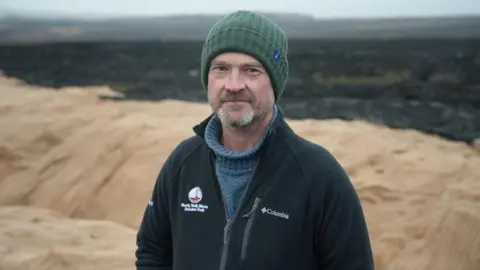
In some places, the fire burnt so intensely it uncovered features of the North York Moors not seen for centuries, Miles Johnson, NYMNPA head of historic environment said.
"There's a paradox in fire sites in that they reveal the landscape in a way you can't normally see," he said.
"The flip-side of that paradox is that everything you see is very damaged and subject to erosion."
Johnson said his team was examining sites exposed by the fire, with "initial conservation work" funded by Historic England and the York and North Yorkshire Combined Authority.
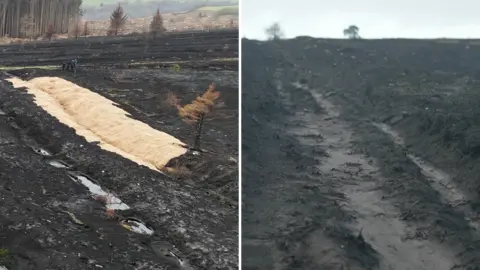
Certain monuments have been covered to protect them from rain, such as John Cross Rigg near Sneaton Forest.
Dating from the Bronze Age, the series of ditches and banks runs for approximately half a mile and is thought to have been built to divide the moorland.
However, the surface has been "eroding really badly", Johnson said.
 BBC/Stuart Prandle
Another discovery from the blaze was hundreds of miles of holloways across Fylingdales Moor, erosional routes caused by cart tracks.
"Fylingdales Moor was effectively a main road and in 1760 [a] turnpike was built between Whitby and Pickering and that removed most of the traffic," Johnson said.
However, Ingleby added that soil and other sediment were being washed through holloways by rain, causing more erosion.
"I would love to block these off and get them back full of wetland vegetation but we have to do it in a way that we're not affecting the readability of that historic feature," she said.
She is hoping that last summer's fire is seen as a "worst-case scenario" during future incidents, but admits that wildfires are "likely to become more regular" because of climate change.
"We need to learn from this. We need to make our moorlands more resilient."
Additional reporting by Carla Fowler.
Listen to highlights from North Yorkshire on BBC Sounds, catch up with the latest episode of Look North.
