Wildlife researcher spends Christmas counting penguins

 Tiago Figueiredo/UKAHT
It might feel cold here right now, but spare a thought for a man who is spending three months in Antarctica, counting penguins.
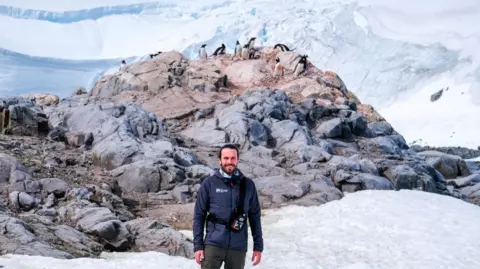
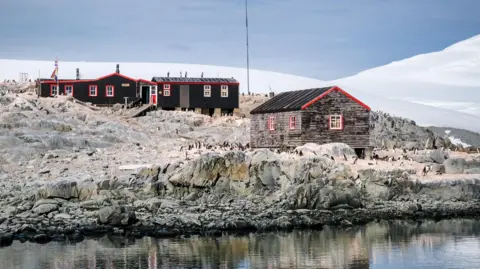
Pete Watson, 41, from Caister-on-Sea, Norfolk, is based at Port Lockroy on the football pitch-sized Goudier Island in the Antarctic Peninsula, living alongside a colony of more than 1,000 gentoo penguins.
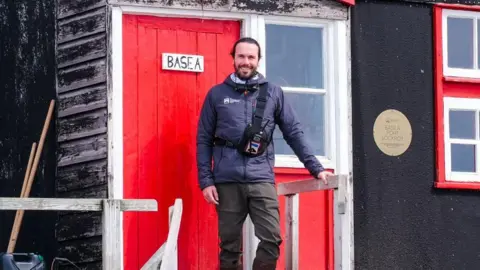
Watson is there for the UK Antarctic Heritage Trust as part of a three-year project to help safeguard the British heritage site, Base A, from the impact of climate change.
"Even though some days can be quite tough and quite challenging, you only have to step outside or look outside the window to just remember how fortunate we are," said Watson.
 Pete Watson/UKAHT
Gentoos are the third-largest member of the penguin family, after emperor and king penguins, and an important part of the ecosystem in Antarctica.
They can live for 15 to 20 years in the wild, mate with the same partner each year and are the world's fastest underwater birds, reaching speeds up to 22mph (35km/h).
With some 774,000 gentoos in the wild, the species is regarded as stable.
"We're only really focused on the immediate number on the island," explained Watson.
"I'm particularly interested in the number of nests, the number of eggs, then eventually the number of chicks and the number of chicks that make it through to maturity.
"Obviously, climate change is a concern. This region of the world is one of the fastest warming places on the planet.
"And even though the species in itself isn't in decline, it's still important for this kind of data to be collected."
The information will be collated in a longer-term study by the British Antarctic Survey, which has a much broader understanding of everything happening on the peninsula and the continent.
 Tiago Figueiredo/UKAHT
Life on Port Lockroy, one of the most remote places on the planet, "doesn't come without its challenges," said Watson, who is experiencing 24-hour daylight for three months.
"We haven't got any running water on the island, we haven't got any showers.
"Life is pretty basic here, but at the same time, it is utterly charming.
"I don't know how you spend your Christmas morning, but I spent my morning up in my small colony of penguins, and I was counting the number of chicks that were up there."
 Pete Watson/UKAHT
Watson, who has a background in expedition travel writing, had visited Antarctica once before.
This is his first time living there for an extended period, and his first experience as a penguin monitor.
Alongside conservation work, the team will be carrying out crucial repairs to Base A, Britain's first permanent scientific base in Antarctica and home to the world's southernmost post office and museum.
The UK Antarctic Heritage Trust said its buildings - now more than 80 years old - faced escalating deterioration from age, climate change and environmental factors.
Follow Norfolk news on BBC Sounds, Facebook, Instagram and X.
