How much is council tax going up by in Norfolk?
 PA Media
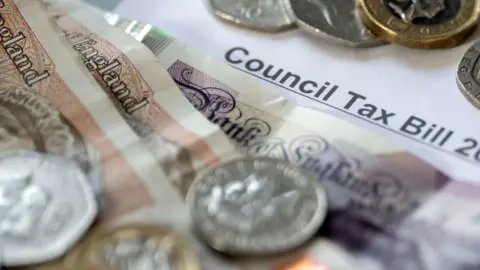
It is a bill that most of us face every year – council tax.
The charge pays for a wide range of local services: from social care to libraries, street lights to road repairs, the fire service and police.
And, as is the case every year, it is going up.
So how much more do councils in Norfolk want us to pay?
 Paul Moseley/BBC
Norfolk County Council
Most of your council tax bill goes to the county's largest authority and pays towards services including social care for adults and children, roads, education, street lights and the fire service.
When setting the charge for the tax, councils always use band D properties as a benchmark – with the other bands (A-C and E-H) calculated as a relative proportion to that.
Last month the council agreed to increase its share of council tax by 4.998%.
Under government rules, if it had set an increase above 5% it would have had to hold a public referendum.
That means, if you live in a band D property, you will pay £1,843.38 – an increase of £87.75 on last year.
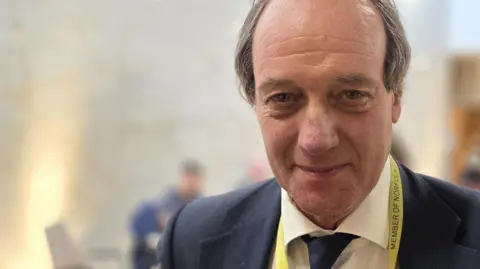
Conservative Andrew Jamieson, the deputy leader, said the budget set by the authority "protects and develops essential services while continuing to invest in Norfolk's future".
But referring to the fact that councils funding from central government has dropped since 2010, he added that "it becomes harder every year".
Norfolk Police
Council tax also goes towards the county's police force, with its part of the bill rising by £14.94 to £344.79.
That follows the independent Police and Crime Commissioner Sarah Taylor's proposal to increase it by 4.53%.
Like councils, much of the police's funding comes from Whitehall, and Chief Constable Paul Sanford has said that following a lower-than-expected deal, he needs to make £3m of savings.
 Paul Moseley/BBC
District, town and parish councils
The rest of your bill is paid to your district council and, depending on where you live, possibly a town or parish council as well.
District councils are responsible for services including rubbish collections, housing, planning and leisure centres.
They can increase council tax by a maximum of 3% or £5 on a band D property - whichever is higher - before having to hold a public referendum.
There are too many town and parish councils to list here, but this is a breakdown of what is happening in the districts.
Breckland
Councillors agreed the bill for band D properties should go up by £4.95 to £123.48.
That works out at about £2.40 a week which Phillip Cowen, the Conservative councillor for finance, compared to "the price of two Mars bars" a week.
With the council warning it was facing "economic uncertainty" amid rising costs, he said it would enable the authority to "deliver all of the services we provide across our district".
Broadland
Unlike the other authorities in Norfolk, Broadland , which is run by a coalition of Liberal Democrats, Labour and the Greens, froze its share of council tax.
That keeps it at £134.91 for the year for a band D property.
Liberal Democrat Steve Riley, who is responsible for finance, said the council was able to keep it at the same level as last year through "careful financial management, efficiency savings, and income-generating opportunities".
Great Yarmouth
The Conservative-run council increased its share of council tax by 2.99%.
That means if you are in a band D property, your annual bill goes up by £5.76 to a total of £198.25.
While Great Yarmouth has seen its funding increase from central government, leader Carl Smith said it was not enough when compared to other parts of the country.
"It is hard to understand why our settlement should be almost 10% less than some other deprived parts of the country," he said.
King's Lynn and West Norfolk
Agreeing its budget for the year, the council, run by the Independent Partnership, increased its share of council tax by 2.99%.
That will see a band D property's bill rise by £4.57 to £157.44 for the year.
Cabinet member for finance Chris Morley said that, like other councils, it was concerned about future government funding.
He also warned it was operating in "a climate of uncertainty about how local government is going to be organised in two years" - echoing doubts over plans for a shake-up of councils.
 Paul Moseley/BBC
Norwich
The city council, run by Labour, also put up its share of council tax by 2.99%.
That equates to an increase of £9.15 for band D, making it £315.26 for the next year.
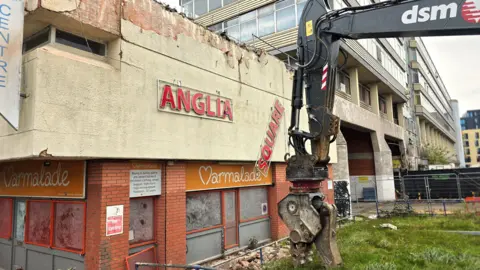
The council said the rise came at a time when it was overseeing work including the redevelopment of Anglia Square and Norwich Market.
"We are driving forward regeneration projects that will create jobs, attract investment and deliver new homes for our city," said Carli Harper, the cabinet member for finance.
North Norfolk
The district council, where the Liberal Democrats are in charge, agreed an increase of 2.96%, meaning the bill for a band D property rose £5.13 to £178.65.
It warned its central government funding was set to fall further in the future and it had been spending more on temporary accommodation.
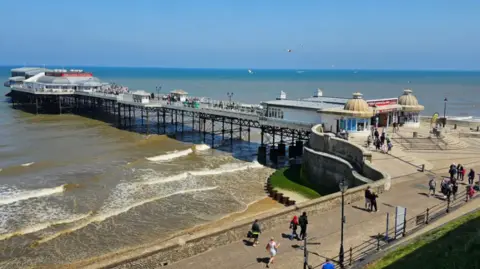
It has also been investing in new public toilets and Cromer Pier ahead of its 125th anniversary.
"This council's priority is financial stability, protecting essential services and ensuring North Norfolk remains resilient in the face of national funding pressures," said finance councillor Lucy Shires.
 Paul Moseley/BBC
South Norfolk
The Conservative-controlled authority voted to put band D homes up £5 to £180.
Leader Daniel Elmer said it was investing in a range of projects, including the new leisure facilities in Diss and a revamp of Wymondham town centre.
He added money was also being spent on a new community space in Poringland, work to Pyes Mill and the public realm in Loddon, a new country park in Cringleford, and investment in Costessey too.
Follow Norfolk news on BBC Sounds, Facebook, Instagram and X.
