Cracking up: Can the pothole problem be fixed?

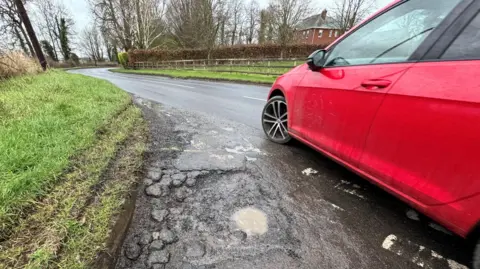 BBC
BBCPotholes - they're the bane of road users' lives.
And as much as we hate them, we love talking about them and no wonder - the problem seems to be getting bigger and bigger, literally.
The dismal weather of late appears to have made the problem worse, with one garage owner telling BBC News NI he's dealing with 10 cars a day damaged by potholes.
The Department of Infrastructure - which is in charge of maintaining the roads - last week allocated another £8m to help deal with the problem. But one DUP assembly member, who branded the problem a "pothole pandemic", said more must be done and a roads expert has said closer to a billion is needed to solve the issue.
So are the cracks being papered over and how deep does the pothole problem go?
How many potholes are there?
According to the motoring organisation RAC, there are more than one million potholes in the UK so it's not a local problem.
But the local pictures shows a serious problem - figures from 2024 show there were about 120,000 road defects and potholes recorded in Northern Ireland from January to November of that year.
More recently, 49,000 defects have been recorded in the last three months, according to Infrastructure Minister Liz Kimmins.
She said this was close to half the total for the whole of the previous year.
What is a pothole and what causes them?
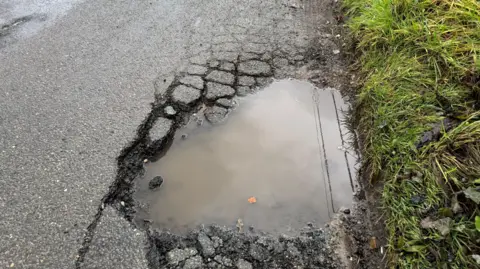
They are a depression or hollow in the road surface, caused by ground water and traffic.
Potholes form when water seeps into small cracks in the road surface, usually caused by traffic. When this water freezes it expands and then, when it thaws, it gets smaller.
This makes the cracks larger, further weakening the road and increasing the amount of water that can get under the surface.
As the road surface weakens, traffic breaks it up to create a small hole, which expands as more traffic passes over.
Heavy rain worsens existing potholes - and so far in 2026, it has been very rainy. Northern Ireland saw 64% more rain than normal in January.
How dangerous are potholes?

Depending on their size, potholes can cause significant damage to vehicles and pose a danger to motorists, cyclists and pedestrians.
Although small potholes rarely cause major accidents, if a vehicle hits a lot of them over time, it can lead to damage to the tyres, suspension and steering system.
Damian Carthy, who owns a garage in County Fermanagh, said he was dealing with up to 10 people a day who have damaged their vehicles on potholes.
He said many of the vehicles brought to him were not just in need of new tyres.
"I'm talking about bent wheels, broke wheels, broke suspension, broke springs. People have to be towed off the road," he said.
What are drivers saying about potholes?

Paschal O'Shea travels on the 23-mile long Loughshore Road in County Fermanagh most days.
He said it was extremely dangerous and fears there will be a fatality.
"If you bought something off Amazon, or something in a shop, you could go back. If the builder doing your house made a mistake you'd be complaining but we can't," he said.
"We have to pay our tax, we have to get our car an MoT and have our car ready for the road, but the roads aren't ready for us."
Tour guide and bus driver Jerome O'Laughlin damaged his car on a pothole on the same road.
"I'm taking clients from Australia, America, Canada and having to apologise for the state of the roads," he said.
"Sometimes the potholes are filled with water, and you don't actually know how deep they are."
What is the government doing?
The Department for Infrastructure is responsible for looking after public roads.
Between 2018 and 2023, £547m was spent on road maintenance.
The £7.75m allocated by the infrastructure minister last week is in addition to a £30m investment announced in December 2025.
The minister said she was aware that even with the new funding, there were limitations to what can be done.
"Given the scale of the damage caused, it is not possible to address every issue in the short term."
However, she said she had asked department officials to also "maximise our available workforce capacity to ensure we are doing as much as we can, as quickly as possible".
Speaking in the assembly, DUP assembly member Jonathan Buckley said the minister had "offered no clear answers".
"The pothole pandemic needs a cure, but the minister does not seem to have one," he added.
The chair of the infrastructure committee at Stormont, DUP MLA Peter Martin, told BBC Radio Ulster's Good Morning Ulster there had been a "lack of focus" on potholes in the last number of years.
Welcoming the additional £8m, he added: "Any fixes on our road is worthwhile. The scale is massive. People feel really strongly about it and it's up to the minister to fix it."
How can the pothole problem be fixed?

Researcher and roads expert Wesley Johnston believes decades of "underinvestment" in roads means some in rural areas are not fit for purpose and more funding is needed.
For Johnston, the latest investment of close to £8m won't be enough to solve the pothole problem.
"It would take about £1.6bn to get the road network up to the standard it needs to be.
"But you're going to then you need to follow it up each year with regular structural maintenance costing maybe another £150m, £200m per year after that."
How to report a pothole and how to deal with them
There is a dedicated website where road users have to fill in a number of details.
The AA recommends drivers and cyclists avoid potholes where it is safe to do so, but when there is no other option than to pass over them, reduce speed and keep an increased distance from nearby vehicles. They also advise drivers to keep two hands on the wheel to allow for maximum control.
