Why has January been so rainy?

 Pacemaker
January was wet. Very wet. Unless you were on holiday for the entire month, you probably already know that.
In fact, up until 09:00 BST on Friday, the weather station in Katesbridge, County Down, had recorded more than 3.5 times the amount of rain it normally gets in January.
Northern Ireland as a whole has seen 64% more rain than normal.
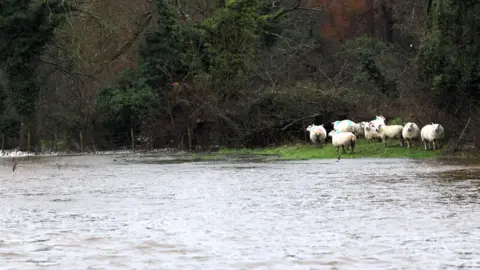
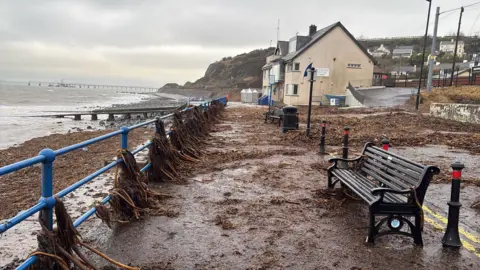
Storm Chandra caused widespread damage and disruption, while Friday saw another yellow weather warning in place for heavy rain.
County Down has been the wettest county overall in January, with more than double its normal rainfall.
Fermanagh, which is normally one of our wettest counties, was the driest - but still with above average rain.
These figures do not take into account the amount of rain that fell on Friday and over the weekend.
'A real shock'
 Sophie Ingram
The Department for Infrastructure said 943 incidents were recorded during Storm Chandra on Tuesday, including 343 reports of obstructions and 570 reports of flooding.
Gift shop owner Sophie Ingram, who was one of those affected walked down to the lower floor of her shop in Dromore, County Down, and stepped into about two inches of water.
"It just came in, it went up to almost knee high within a very short space of time," she said.
The shop is situated beside a river.
 Sophie Ingram
Ingram said it was "a real shock" but they managed to save most stock, moving items of furniture upstairs and into a store.
The shop will need redecorated - but they have had many messages and offers of help.
"I didn't know I was going to get through it but it's really helped, the thought that people care," she said.
Storm Chandra school closures
 Rachel Taylor
More than 350 schools closed as a result of Storm Chandra.
Teacher Rachel, from Crossnacreevy, County Down, was off - as were her two children, Ava, nine, and James, five.
She said she felt there had been more frequent school closures recently.
"The school I worked in previously was in the country and we never closed in rain or hail. It felt like we were always open," she said.
"I work in a school in east Belfast now and we have had a couple of closures in the past couple of years."
She said school closures could be difficult for parents, who may be juggling working and looking after children.
"Those children will inevitably get plopped in front of screens as parents try and work from home. It's not ideal," she said.
Rachel said closures could be frustrating as exam classes lose time - and even missing "one or two" makes a difference.
But for the kids, the day off was fun.
"The primary school sent some work home for them," Rachel said.
"It was nice for them to be in their pyjamas, make pancakes and get baths in the middle of the day."
 William Fisher
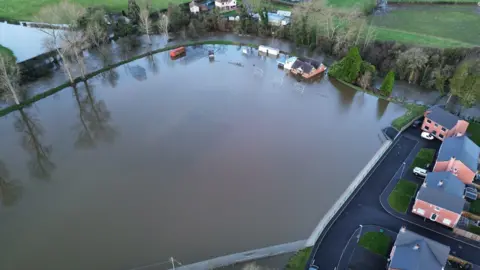
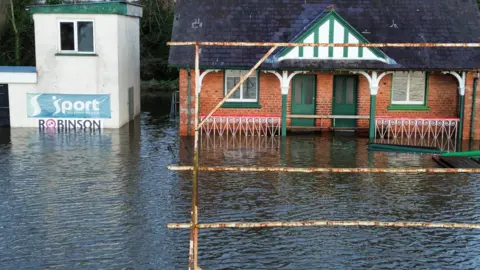
Timothy McClure, the treasurer of Donacloney Mill Cricket Club in County Armagh, which was badly flooded said the river banks "burst at both sides of the ground and the ground, pavilion and tool sheds were completely under water".
"It probably was four to six feet deep round the whole ground," he said.
Club members have not yet been able to access the sheds to assess the damage, and are waiting to hear whether they are covered by insurance.
"At the end of every season we spend a significant amount of money getting our ground set down for the winter - about £3,000 - I would say there'll be significant damage there so that money could be potentially wasted," he said.
The club's pavilion is a listed building which is "expensive" to do work on and money earmarked for renovations will now have to be used for repairs.
"Our big concern is is this going to happen again if we get another deluge of rain over the next few weeks," Timothy said.
 William Fisher
Why has it been so wet?
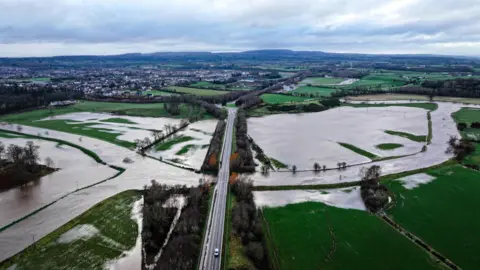
According to Aidan McGivern from the Met Office, the prolonged wet weather has been driven by a powerful and unusually positioned jet stream, repeatedly bringing Atlantic storms towards Ireland and the UK.
"With little opportunity for drier conditions in-between, the ground has become saturated, so even moderate rainfall has had a greater impact," he said.
The Met Office said several large scale weather factors have combined to create the unsettled conditions.
Very cold air over North America has increased the temperature contrast across the Atlantic Ocean, helping to strengthen the jet stream.
Normally, the jet stream tends to guide storms between Scotland and Iceland but this winter it has shifted further south, pushing low pressure systems directly towards the south west of Ireland and the UK.
McGivern said cold air and higher pressure to the north east "have acted as a block", which is why "repeated spells of heavy rain" have arrived in the west and south.
 BBC Weather Watcher Steve Haslett
Wet all over Ireland
In the Republic of Ireland it is a similar story, but again some areas have been wetter than others.
Weather stations at Dublin Airport and Phoenix Park in Dublin have both recorded their wettest January since 1948.
A study carried out between Maynooth University and Met Éireann found that the amount of rain over eight days, including during Storm Chandra, was three times more likely due to climate change.
 Weather Watcher Stephen Wright
 Weather watcher Stephen Wright