Naming Stakeknife would be 'step towards apology'

 PA Media
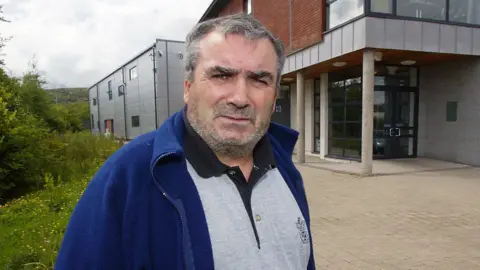
Naming the agent Stakeknife could be the "final piece of the jigsaw" towards a government apology, according to the solicitor acting for the victims of the Army's IRA spy.
It follows a report from a Westminster committee which urged the government to formally identify the high-ranking agent who was linked to 14 Troubles murders.
Stakeknife was the west Belfast man Freddie Scappaticci, who died in 2023.
The final report of a investigation into his crimes, which cost in excess of £40m, was published last year but its authors could not secure government permission to name Stakeknife.
Successive governments have refused to identify the agent under the 'neither confirm nor deny' policy which is sometimes adopted in matters of national security.
In response to the MPs' report, the government said the secretary of state will update Parliament as soon as he can.
Closure 'still hanging in mid-air'
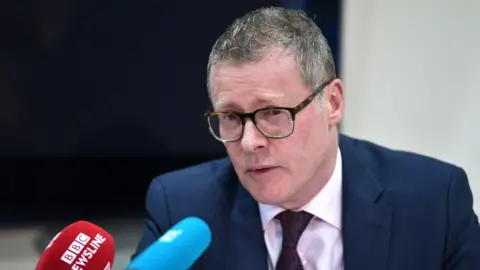
Speaking to BBC News NI, solicitor Kevin Winters of KRW Law said not naming Stakeknife is "insulting to the families" and treating them "as some sort of second-class victims".
He added that the families had "engaged in good faith" in with the investigation into Stakeknife - known as Operation Kenova - and "had an expectation of information and justice disclosure, which they have in large part".
But he insisted that disclosure "still falls short if the very agent who is at the apex of all of this isn't even named".
"Identifying him as the agent Stakeknife brings that necessary closure which to date is still hanging in mid-air," Winters said.
He added it would be a "huge step forward in urging the British government to make an apology long overdue which was called for on the back of the Kenova report and still hasn't happened after all this time".
 Charles McQuilla/Getty Images
Naming would send 'strong signal' to rogue agents
Winters was speaking on the day MPs on the Northern Ireland Affairs Committee released a report calling on the government to formally name Stakeknife
The cross-party group said state agents who were "guilty of conduct beyond acceptable limits" should not be "shielded from the consequences of their actions".
The chair of the committee, Tonia Antoniazzi, said the lack of formal identification was having "a profound and lasting effect" on Stakeknife's victims.
"By naming Stakeknife, the government can send a strong signal that agents who cross a line will not receive the protection of anonymity," Antoniazzi added.
The committee released its report after taking evidence from officers who led the lengthy investigation into Stakeknife.
"Given the reassurances we've heard that active agents won't be put in harm's way and future recruitment won't be compromised, formal identification in this specific instance is appropriate, proportionate and in the public interest," Antoniazzi said.
In its response, the government said the "behaviour described in Operation Kenova's final report is deeply disturbing".
"It should not have happened, and in recent decades there have been significant reforms to agent handling practice, including through legislation."
It said that the "use of agents is nowadays subject to strict regulation, overseen by the Investigatory Powers Commissioner and the Investigatory Powers Tribunal".
It added that the government is not yet in a position to formally respond to the request by Operation Kenova to name Stakeknife as "there remains ongoing litigation and consideration of the recent judgment in the Thompson Supreme Court case".
Claire Hanna, leader of the Social Democratic and Labour Party (SDLP) is among the MPs who sit on the Northern Ireland Affairs Committee.
She argued the blanket application of NCND does not acknowledge "what went on in the dirty war" and said not publicly naming the agent is "costing victims time, and the public money".
 PA Media
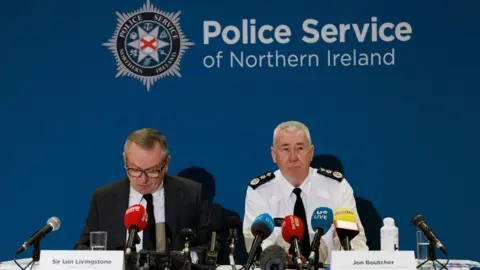
Operation Kenova was initially led by the now chief constable of the Police Service of Northern Ireland (PSNI) Jon Boutcher but was later headed by Sir Iain Livingstone.
Both men gave evidence to the Northern Ireland Affairs Committee in January and both have now welcomed the committee's report.
In a statement, Boutcher endorsed the call for Stakeknife to be named, saying it "would bring much needed closure to many victims and families".
Who was Freddie Scappaticci?
 Pacemaker
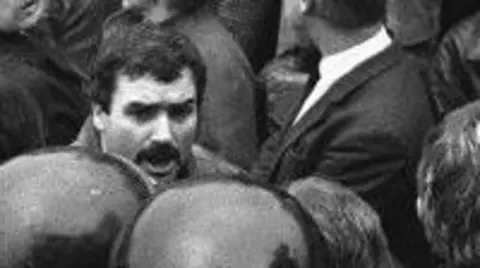
Scappaticci was alleged to have been the most high-ranking British agent within the Provisional IRA, who was given the codename Stakeknife by the Army.
He was the grandson of an Italian immigrant who came to Northern Ireland in the 1940s search of work.
Scappaticci was raised in the Irish republican stronghold of west Belfast where he would find work as a bricklayer.
During the height of the Troubles in the early 1970s, he was among hundreds of people who were interned without trial during civil unrest.
In the late 1970s he was reportedly beaten up by the IRA following a row with a senior member of the paramilitary group.
It was around this time that the Army is believed to have recruited Scappaticci as a paid spy within the IRA.
By the 1980s, he was a leading figure within the IRA's internal security unit which was set up to hunt down informers who were leaking information to the police.
The unit was known as the "nutting squad" because they often shot alleged informers in the head - the nut - before dumping their tortured bodies.
In 2003, media organisations unmasked Scappaticci as Stakeknife - the feared spy who had set up other IRA informers for murder.
Scappaticci denied the allegation but then went into hiding in England, where it is believed he lived for two decades under MI5 protection.
In 2016, Boutcher, then Bedfordshire's chief constable, was appointed to lead a multi-million pound investigation into the activities and handling of Stakeknife.
The Kenova report said Stakeknife probably took more lives than he saved.
It found that MI5 was aware of Stakeknife's "involvement in serious criminality" and received regularly briefings about him.
It also found that his Army handlers twice took him out of Northern Ireland for a holiday "when they knew he was wanted by the [police] for conspiracy to murder".
In 2023, while the Operation Kenova investigation was still ongoing, Scappaticci died at the age of 77.
