'Difficult choices' needed to recruit more Catholics to PSNI

 PA Media
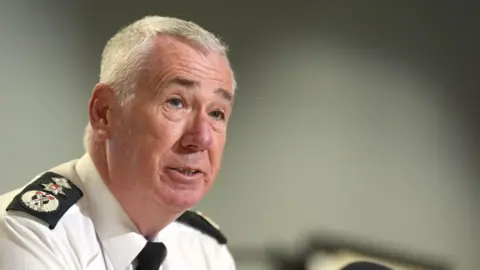
The Police Service of Northern Ireland Chief Constable Jon Boutcher has said "difficult choices" will be needed if the organisation is to recruit more Catholic officers.
Boutcher was speaking as the force launched a recruitment drive for new student officers and custody detention officers.
Early last year, it was reported that 66% of its 6,300 officers are "perceived" as Protestants, according to police data.
Boutcher told MPs that if the government publicly revealed the identity of the state agent in the IRA known as Stakeknife it could help to persuade more Catholics to join the police in Northern Ireland.
Last month, a major investigation into Stakeknife revealed MI5 had a bigger role in his handling than previously claimed.
The final report of Operation Kenova also said the belated discovery and disclosure of documents by MI5 to the investigation in 2024 was "a serious organisational failure".
Stakeknife was west Belfast man Freddie Scappaticci, who died in 2023.
The Kenova report had urged the government to publicly reveal the identity of Stakeknife.
The government has resisted the calls arguing that departing from its policy of neither confirm nor deny (NCND) would have implications for national security.
Boutcher, who headed the Kenova team before joining the Police Service of Northern Ireland (PSNI), and its current lead officer Sir Iain Livingstone appeared before the Northern Ireland Affairs Committee on Wednesday.
Boutcher said the PSNI was currently recruiting and he was "desperate for this society to move forward" for all communities, adding: "not just the two traditional communities".
"To help society move forward, to help me get Catholic officers into the PSNI, we need to start making some difficult choices," he said.
"And each secretary of state that I've dealt with, and I've dealt with a number, now get the same advice.
"Please listen to other people who have some considerable experience and understanding and more accountability in policing."
 PA Media
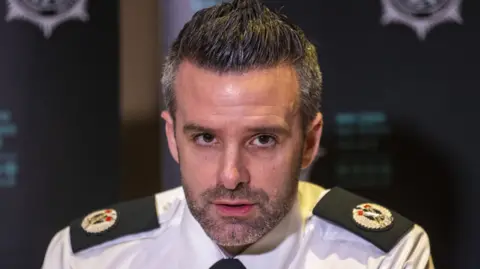
Speaking on BBC Radio Ulster's Evening Extra on Wednesday, PSNI Deputy Chief Constable Bobby Singleton said he thought "anything that works to address the issue of legacy would have a potential benefit to the PSNI".
"It would allow policing to be seen, as it should be, I believe, as a contemporary public safety issue and would prevent it from being stained or tainted by the legacy of our past," he added.
Singleton said that the PSNI had made diversity "a key pillar of all of our external engagement that we will seek to try and promote policing as an employer of choice".
"That means that virtually every opportunity we get, we're trying to promote how diverse a career in policing it can be, how rewarding it can be, both in terms of public value and the financial and learning benefits."
Between 2001 and 2011 there was a 50-50 recruitment initiative for the police in Northern Ireland, which meant there was one Catholic recruit for every one person from a Protestant or other background.
Since then, there has been no legislation to address the issue.
A PSNI recruitment campaign in February 2025 was the first since 2021.
Singleton said on Wednesday that "25 years on, I think it's important to recognise the significant progress that has been made".
"During that period we've seen the number of Catholics within the PSNI increase by over 200%," he added.
"We should never forget the ground that has been made in that respect.
"With regards to women, we have somewhere in the region of two to three times the number of women as there were when we first started and comparatively with other policing organisations, the PSNI has done well, but we want to do better.
"We want to be fully representative of our community."
PSNI chief operating officer Pamela McCreedy said the organisation was currently sitting at about 6,300 officers, and it was "seeking to get to 7,000 officers by 2028".
"So I need to recruit 350 officers to stand still, and then whatever growth I want on top of that," she added.
"So for the next few years, we're looking to recruit around 600-650 officers a year, which is quite significant."
