Police admit illegally obtaining journalist's data and retaining family names

 PA Media
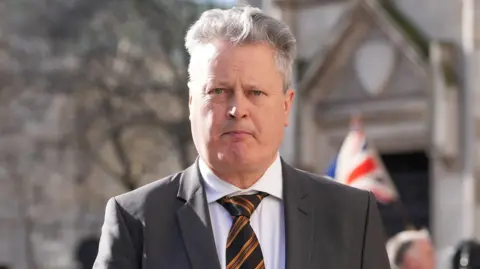
The Police Service of Northern Ireland (PSNI) has admitted it illegally obtained phone data from a Belfast journalist and created a "profile" on him, which included the names of his wife and mother-in-law.
In one operation against Vincent Kearney, it gleaned information relating to 1,580 calls or texts he made and received, while its profile on him contained details about his vehicles and his family.
Its actions were aimed at identifying his journalistic sources.
Details have emerged at the Investigatory Powers Tribunal (IPT) in London, in a case being brought by Kearney and the BBC, who was his employer at the time.
Last year, as part of the case, MI5 conceded it breached his source protection and privacy rights by accessing his communications data in 2006 and 2009.
Among the issues the tribunal is being asked to decide upon are damages, and whether the BBC was also a victim of unlawful interferences of journalistic material.
'Treated as a suspect'
Speaking outside court, Kearney said he had been "treated as a suspect rather than a journalist".
He went on: "This case has established that I was the target of a systematic and years-long pattern of law enforcement agencies illegally accessing my journalistic sources and mapping my professional activity.
"This has had a chilling effect on my ability to conduct public interest journalism with source relationships damaged and, in some cases, destroyed."
Fresh details on communications surveillance emerged at the IPT hearing on Wednesday and in legal papers.
Kearney, who is seeking damages, worked for the BBC for 18 years until 2019, when he joined RTÉ, where he is currently its northern editor.
The PSNI targeted him numerous times between 2009 and 2014.
It included investigations into the murder of PC Stephen Carroll in Craigavon in 2009 - Kearney received the Continuity IRA claim of responsibility - and other probes seeking to uncover sources for his policing and security stories.
The PSNI has said the relevant legal framework at the time was later held to be inadequate in cases involving journalistic material.
The Metropolitan Police has also admitted unlawfully obtaining Kearney's data twice in 2012.
'Must never be repeated'
Kearney's lawyer, Jude Bunting KC, told the IPT there were seven separate police or MI5 operations in which communications data was unlawfully acquired over a period of more than ten years.
Information obtained included phone billing data and "subscriber names and address details" in respect of the numbers that had contacted Kearney.
The hearing is expected to last a number of days - some of it will be held in the absence of the media and public.
Adam Smyth, the director of BBC Northern Ireland, said: "The independence of the BBC is hard won and we will stop at no lengths to defend our journalism.
"What happened to Vincent Kearney was completely wrong. He was treated as a suspect not as a journalist.
"His rights as a journalist were not respected."
He said the collection of source data is not just "deeply worrying" for the BBC and Kearney, but "they are important issues for all of journalism".
 PA Media
Speaking to BBC News NI outside the court on Wednesday, the National Union of Journalists (NUJ) general secretary, Laura Davison, said that "journalists have to be free to do their work in the public interest and we need to know what's happened here".
"We need to know whether it's impacted other colleagues within the BBC. There has to be clear accountability and transparency in terms of what's taken place," Davison said.
"We're calling for there to be a full public inquiry surveillance into journalists in Northern Ireland, that has to be what comes out of this."
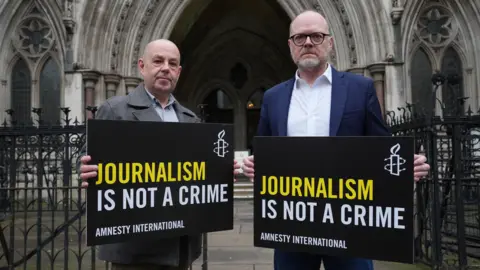
Speaking ahead of the hearing, Amnesty International's Northern Ireland director Patrick Corrigan said he expected it would reveal "more about the true scale" of surveillance journalists faced.
"What is ultimately required is full transparency, genuine legal accountability, and a decisive end to unlawful spying on the media," he added.
Calls for public inquiry over surveillance
Northern Ireland director of Amnesty International UK Patrick Corrigan has called for a public inquiry into the unlawful surveillance of journalists.
He said the findings "expose a pattern of unlawful surveillance that strikes at the heart of press freedom".
"Only a full independent public inquiry with the power to compel evidence can restore trust, deliver accountability and safeguard press freedom in Northern Ireland."
He has also called on Hilary Benn to establish a commissioner for covert law enforcement in Northern Ireland to "ensure covert surveillance techniques are only used within the law".
The Social Democratic and Labour Party MP Colum Eastwood has also called for a public inquiry.
He called surveillance on journalists and their families "utterly appalling".
Deirdre McCarthy, managing director, RTÉ News & Current Affairs said the scale of the surveillance was "deeply concerning", adding that it was "particularly significant in relation to security and legacy issues in Northern Ireland" that journalists are able to work without fear.
"Any deliberate circumventing of long established legal protections of journalists and their sources damages trust in media and ultimately our democracy."
The first indications of action against Kearney emerged during an IPT case brought by two other journalists, Barry McCaffrey and Trevor Birney.
The PSNI was ordered to pay each £4,000 in damages in 2024 for unlawful intrusion.
Following their legal action, the PSNI asked a lawyer, Angus McCullough KC, to conduct an independent review of its surveillance of journalists and lawyers.
He reported it was not "widespread or systemic".
