'Workers don't deserve this' - health staff attacked 72,000 times in five years

 Getty Images
There have been more than 72,000 physical and verbal attacks on health and social care staff in Northern Ireland in the last five years, according to figures released by the Department of Health (DoH).
The figures were given to Democratic Unionist Party (DUP) assembly member Diane Dodds in response to an assembly written question.
She described them as "utterly appalling".
Health Minister Mike Nesbitt said the attacks were unacceptable and said his department took the incidents extremely seriously.
Dodds, who sits on Stormont's Health Committee, said perpetrators of violent acts against healthcare staff needed to "feel the full force of the law against them".
"While we accept that if you're in A&E and things may be a little bit fraught and people are frustrated, there's absolutely no excuse whatsoever for either physically or verbally abusing the staff who are there to help you," she told BBC News NI.
Dodds added while body camera pilot schemes were already in place in some health trusts for worker and patient safety, the fact they were needed was an "indictment on our society".
She called for legislation to be introduced which would impose harsh sentences on people who attack staff.
"The law should state that these workers who are working to help us should be protected in law from the physical abuse that we've seen," Dodds added.
"Workers who are in the public sector, who are working in emergency services, do not deserve this and we need to offer them protection in law."

The figures state there were about 60,000 physical attacks on staff and more than 12,000 incidents of verbal abuse recorded in the past five years.
Of the 72,000 attacks, about 21,000 happened in the Belfast Health Trust alone, which was more than double the number of the second-highest, the Southern Trust.
The incident numbers only cover health trust staff, and do not include other settings like health centres, independent providers and private care homes.
Dodds said the figures only showed reported incidents, and that the actual number could be much higher.
"I suspect that there are many staff who think: 'What can be done? What's the point?', and just get on with their job, and I think that is a terrible reflection on society," she said.
"It's a reflection on the state, particularly of our emergency departments, and we really need to do something about it."
Dozens of incidents each day
The figures mean there is an average of 32 attacks each day.
Doods said the figure was "eye-watering".
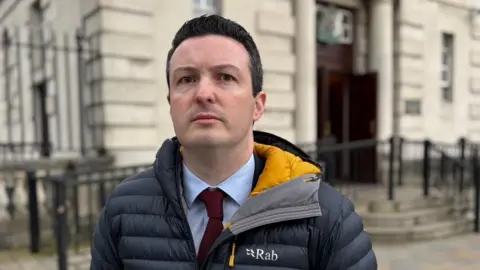
John Patrick Clayton, from Unison, one of the largest healthcare unions in Northern Ireland, said the figures were "very, very disturbing".
"It should sound alarm bells to us all about the extreme circumstances [in healthcare]... every incident is one too many, no health and social care worker should suffer violence and abuse by doing their job," he said.
Clayton said the figures needed to be scrutinised.
"It's extremely important that we understand the trends in these figures, we need to understand more clearly where these incidents are happening," he said.
"I don't think these are solely confined to A&E departments (EDs) or solely related to attacks on the ambulance service… we need to acknowledge this is a much more wide spread problem."
'Zero tolerance approach'
Responding to the figures, the health minister said attacks would not be tolerated and a framework was launched in 2023 to help tackle the issue.
"The framework sets out a clear, consistent approach for preventing and responding to incidents of violence, ensuring staff have access to support, that incidents are properly reported, and that action is taken when staff are harmed or threatened," Nesbitt said.
"We are clear that creating a culture of zero tolerance towards violence and aggression in the workplace is not a one-off action, but a sustained commitment.
"Every member of staff has the right to feel safe and respected at work, and we will continue to take all necessary steps to protect and support our workforce."
 PA Media
However, Dodds said the number of incidents would point towards the framework not being "that successful".
Dr Alan Stout from the British Medical Association (BMA) said the figures were "very concerning, but perhaps more so because the actual numbers are underreported as they do not count attacks on GPs and their staff".
Stout, chair of the BMA's Northern Ireland Council said pressures across the health service and failure to plan long term meant workers were "stretched to the limit".
"One of the unacceptable consequences of this is stressed patients taking their frustrations out on staff," he said.
"It is vital that doctors are allowed to work within safe limits and provide a safe service."
