The day Chichester Cathedral's spire collapsed

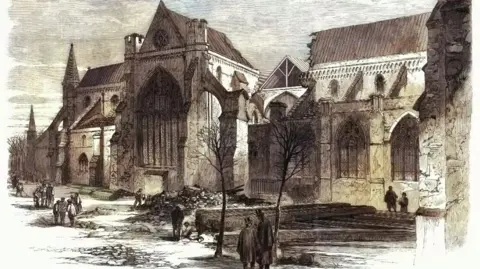 Getty Images
It was one of the biggest architectural disasters in English ecclesiastical history.
The collapse of Chichester Cathedral's great spire in the mid-19th Century grabbed the nation's attention, bringing with it an end to long-held speculation about the medieval structure's serious weaknesses.
And its subsequent daring reconstruction is equally renowned and still stands today as a distinctive feature of the city's skyline - even if it is known to sway slightly in blustery weather.
Former clerk of works, Tony Allen, said despite being made from solid stone the replacement could still move "an inch and a half in each direction, depending on which way the wind is blowing".
Before it fell in February 1861, cracks had become clearly visible in the Norman-built cathedral's steeple.
Concerns had been raised repeatedly about its vertical load-bearing supports, which culminated when a period of heavy rain and high winds finally saw it give way.
It tumbled down in a matter of seconds, destroying large sections of the roof and leaving the building's interior open to the sky.
No one was injured.
"But they did end up with the biggest pile of rubble right in the very middle of the cathedral," said Allen.
"What is more, it's said that the capstone, which is the top piece of stone in the spire, rolled in two pieces right down the nave."
An urgent debate began about how the spire should be rebuilt.
That task fell to the architect George Gilbert Scott, whose proposed design involved recreating the spire in stone but with improved internal supports, including iron reinforcements and more robust foundations.
The project was costly and controversial, but public fundraising and diocesan support ensured work went ahead.
The new 269 ft (82m) spire was completed in 1866 and remains intact 160 years later.
But engineers say that its tendency to sway slightly in strong gusts is nothing to worry about, being more a sign of flexibility as opposed to weakness.
Follow BBC Sussex on Facebook, on X, and on Instagram. Send your story ideas to southeasttoday@bbc.co.uk or WhatsApp us on 08081 002250.
