Your questions answered on the huge fire next to Glasgow Central

 PA Media
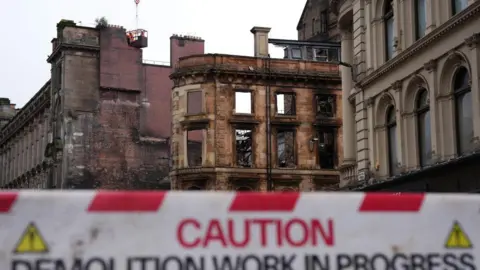
It's over a week since a huge fire engulfed a landmark Victorian building next to Glasgow Central Station.
Demolition work is under way but Scotland's busiest railway station remains partially closed. Some Scotrail trains and cross-border services will return on Wednesday.
Over the last seven days, you have been getting in touch with BBC Your Voice with your questions about the Union Street fire.
BBC Scotland News has tried to answer a selection of them.
Why did the fire service send a high-reach appliance from Edinburgh to tackle the fire?
 PA Media
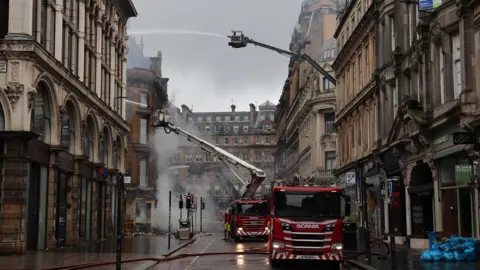
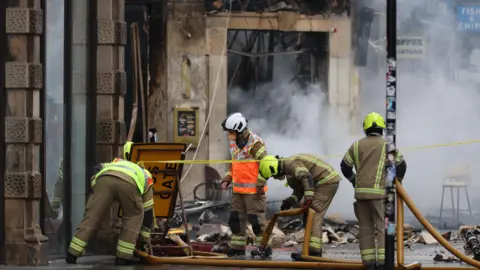
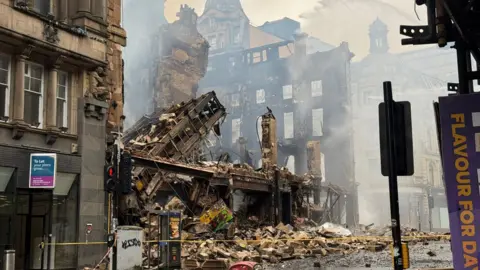
The fire engulfed the entire building on the corner of Union Street and Gordon Street on Sunday 8 March, causing it to partially collapse.
At the height of the incident about 250 firefighters, 18 fire engines and specialist resources, including a high-volume pump drawing water from the River Clyde, were deployed to the scene.
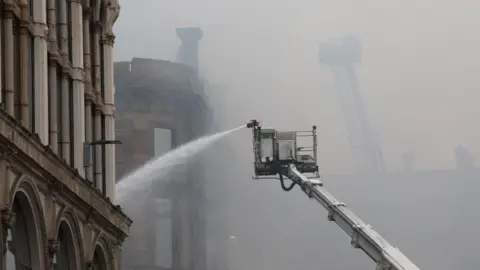
This included high-reach vehicles to hose water from a height on to the fire and what remained of the building.
At First Minister's Questions on Thursday Scottish Labour leader Anas Sarwar claimed high-reach appliances in the city had been cut from six to two, both of which were off for annual inspection on the night of the fire.
This meant one had to be called through from Edinburgh.
 PA Media
The Scottish Fire and Rescue Service (SFRS) confirmed two high-reach appliances based at Maryhill and Castlemilk were unavailable but said the vehicles were national resources "placed strategically" across Scotland.
"The first high-reach appliance was mobilised from Coatbridge and arrived on scene within 19 minutes but ultimately was not required for external firefighting operations until almost two hours later," said the service's director of operational delivery David Farries.
"This was supplemented by vehicles from Johnstone and Kilmarnock at the request of the incident commander."
Three more high-reach appliances were sent as relief crews to replace the existing vehicles, from Greenock, Falkirk and McDonald Road in Edinburgh, on Monday 9 March.
Who owns the vape shop and was it operating legally?
The fire appears to have started in a vape shop at 105 Union Street.
The tenants of the shop were being pursued by a debt recovery service for unpaid business rates, BBC Scotland News understands.
At the time of the fire, Junaid Retail Limited had been the registered tenant since August 2024, and had not paid non domestic rates at any point during this period.
Also known as business rates, this is a tax on non-residential properties like shops and factories which helps fund council services.
It is understood that Junaid Retail Limited were being pursued for these arrears by a debt recovery service, partnered with Glasgow City Council.
The registered address for the business during this period was in Hamilton, but in recent days this has changed to an address in Glasgow.
It is understood that the landlord of the property, Afton Estates Limited, had confirmed Junaid Retail Limited was still the occupier after a business rates bill for 2025/26 was returned to the council with a claim the occupiers had "gone away".
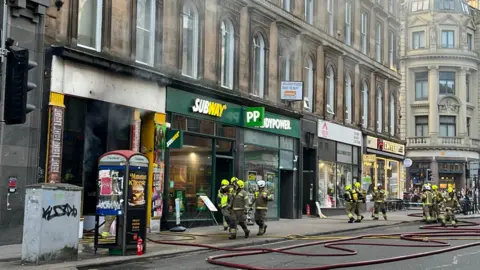
An investigation by the Ferret website also showed the tenants did not appear registered to sell vaping products.
The shop did not appear on the publicly accessible Scottish government's statutory national Register of Tobacco and Nicotine Vapour Product Retailers.
Businesses must register before they can legally sell tobacco or nicotine vapour products.
Failing to register can result in fines of up to £20,000 and six months in prison.
BBC Scotland News has attempted to contact the current director of Junaid Retail Limited, listed on Companies House, but he has not yet responded.
Who owns the building?
 Getty Images
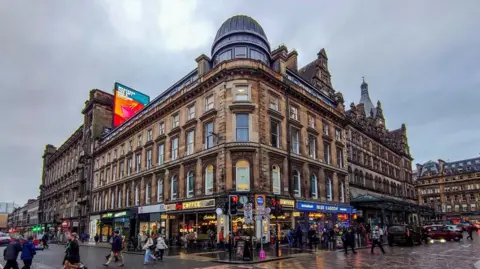
The building known as Union Corner, dates back to 1851, pre-dating Glasgow Central Station which opened in 1879.
No single person or business owned the whole building.
Title deeds for 105 Union Street show it is owned by Afton Estates Limited, an Edinburgh-based property company who bought the block for £540,000 in 2008.
BBC Scotland News asked the fire service when it last carried out fire safety inspections at the building but it asked us to submit a freedom of information request to obtain the information.
Afton Estates also owns two commercial buildings at 62 and 64 St Enoch Square near the St Enoch Centre in the city centre, as well as a residential building at 10 Mingarry Street in the city's west end.
Michael Tasker is listed as the director of the firm, which was incorporated in June 2001 and is registered at 61 Dublin Street.
BBC Scotland News has attempted to contact the current director, listed on Companies House, but he has not yet responded.
Who will pay for the damage?
Glasgow City Council took control of the site from the fire service on Thursday and is leading the clear-up operation.
Typically the main cost of the demolition would be passed to the building's owners and their insurers.
Speaking at his party's spring conference on Saturday, First Minister John Swinney announced a £10m recovery fund to support the council, businesses and agencies to "rebuild and renew that vital part of the city".
He also said the Scottish government would cover the cost of clearing the site.
 PA Media
More than £100,000 in public donations has been raised via GoFundMe to support various businesses affected by the fire, including tattoo shops, and hair and nail salons which operated from the building.
It is unknown how much the total cost of the damage will be or how much of the rebuild will be covered by insurance.
Will the council save the facade?
Glasgow City Council confirmed on Thursday the "highly dangerous" remains of the B-listed Victorian building would be demolished.
Raymond Barlow, from the council's building standards team, told the BBC the building had been "fatally compromised" and the remaining structure was "highly dangerous".
He pointed out that one of the most dangerous elements left behind was a "floating chimney stack", which would be the first part to be brought down.
The chimney stack on the southern gable has now been removed and work has now moved to the back wall of the collapsed building.
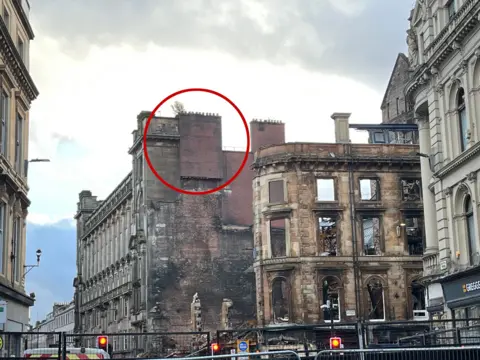
"We need to start work at one end of the site, take off the highest bits of danger and hopefully that will let us start to access parts of the station and get the station back up before coming to the facade," Barlow added.
The council said it did not know how long the demolition will take, nor was it possible to save the three-storey sandstone facade by propping it up. It said it was too early to say whether features could be preserved.
It added that crews are working around the clock, but timescales were weather-dependent as cranes cannot be used in high winds.
Will the building on Union corner be replaced?
There have been suggestions the building will be replaced but it remains unclear what will replace it or when work will begin.
Speaking on BBC Radio Scotland's The Sunday Show, council leader Susan Aitken said work would begin this week to plan what will happen to the now derelict site in the heart of the busy city centre.
She is set to discuss the regeneration of the wider area around Union Street and Gordon Street with a group of experts and council members.
Aitken said a compulsory purchase order could be a useful option to allow the redevelopment of the site due to the complex nature of the current ownership.
But there would be a legal process to work through before that was possible.
 Network Rail
She added that she would like the council to have "far stronger" powers to enforce the care of city buildings or "remove their ownership".
"We use compulsory purchase orders in Glasgow, more than all of the other local authorities in Scotland put together," she said.
"But they are legally challenging and they are expensive as well, so there is a lot that is beyond the reach of the council."

