Council leader calls for more powers to protect Glasgow's buildings

 PA Media
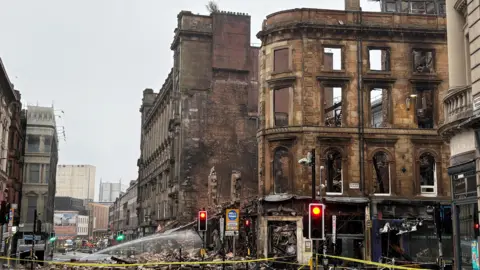
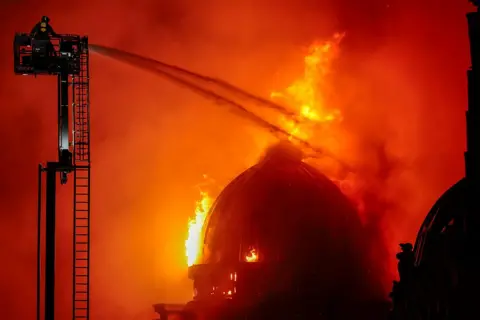
The leader of Glasgow City Council has said she would like more powers to protect the city's buildings in the wake of the Union Street fire.
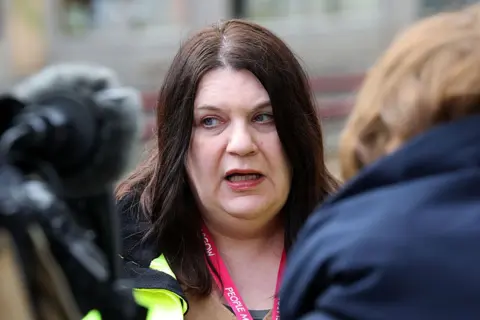
Speaking on BBC Scotland's The Sunday Show, Susan Aitken said councils currently had "very limited" powers and she would like to see them extended - in part, to crack down on neglectful private landlords.
She also said work would begin this week to plan what will happen to the now derelict site at the corner of Union Street and Gordon Street, which stands at the heart of the busy city centre.
Central Station remains closed until at least Wednesday as work continues to demolish the remains of the building destroyed in last Sunday's fire.
Glasgow City Council took control of the site from the Scottish Fire and Rescue Service (SFRS) on Thursday and is leading the clear-up operation.
Speaking at his party's spring conference on Saturday, First Minister John Swinney announced a £10m recovery fund to support the council, businesses and agencies to "rebuild and renew that vital part of the city."
He also said the Scottish government would cover the cost of clearing the site.
Aitken said the fire and questions about the condition of many of the city centre's buildings underlined the challenges Glasgow is facing.
"We do have a challenge. We've got perhaps one of the biggest concentrations of heritage buildings in any city in the UK, the vast majority of which are in private hands," she said.
She added that a lot of these private owners are not looking after buildings and she would like the council to have "far stronger" powers to enforce the care of them or "remove their ownership".
"We use compulsory purchase orders in Glasgow, more than all of the other local authorities in Scotland put together," she said.
"But they are legally challenging and they are expensive as well, so there is a lot that is beyond the reach of the council."
 Getty Images
Aitken said many of the steps needed to take ownership away from private landlords or enforce regulations are "beyond the power of the council".
"I would like us as a council to have more powers than we currently do. At the moment we have quite limited powers," she added.
The fire at Union Street is the latest of a number in Glasgow's over recent years.
Aitken defended the overall condition of the city centre and denied it is in a poor state.
"There's certainly a narrative that is pushed about Glasgow along those lines. But if you go into the city centre right now you will see unprecedented levels of investment taking place," she said.
"There is investment from the public sector though the city deal and from the council ourselves. There's investment by private sector partners. There is investment by owners in the city."
 Getty Images
Aitken said she has convened a meeting this week to discuss what to do next, and hoped it would be the start of a process to "use this huge loss for the city".
She said: "I think that's a conversation that needs to be had and that's why I've asked a number of prominent people who I'm very pleased to say have been really, really willing and keen to contribute to framing an approach to this over the coming months."
She said plans are underway for the compulsory purchase of the nearby Egyptian Halls and work was being done on the whole of Gordon Street, the site of Central Station's main entrance.
"What I've asked my officers to do on Glasgow City Council is actually to masterplan that wider area," she said.
"So there's a lot of work already planned for that area. I guess what's happened makes that job bigger but it also means that we want to involve a range of people, a range of expertise in making that plan and exploring the art of the possible."
