Glasgow Central Station closed until next week during demolition work

 Getty Images
The closure of Glasgow's Central Station will continue during demolition work until at least Wednesday next week, Network Rail says.
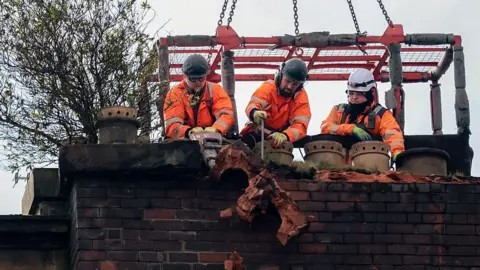
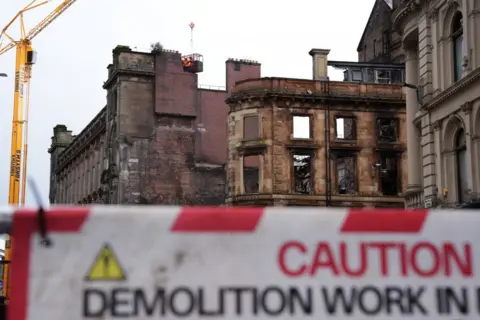
Glasgow City Council teams have started to dismantle the "highly dangerous" remains of the B-listed Union Corner building next door to the station.
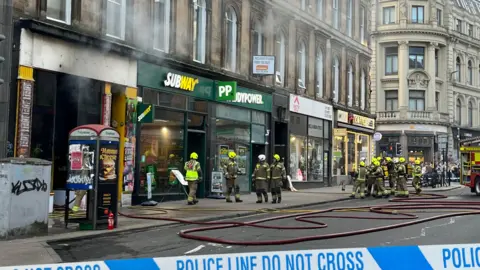
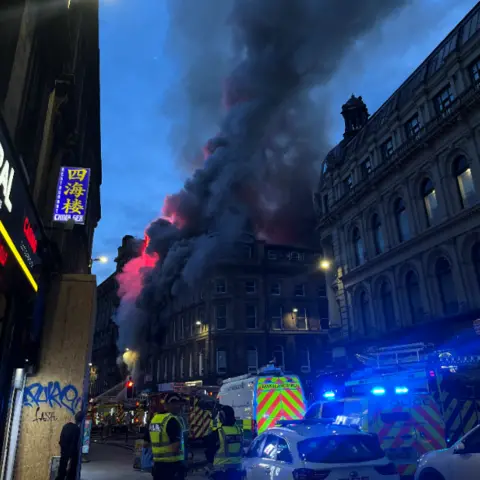
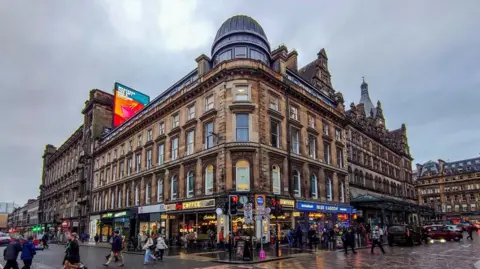
The historic building, at the junction of Union Street and Gordon Street, was destroyed in an overnight inferno on Sunday after a fire took hold in a vape shop.
Network Rail said Central Station's high‑level platforms would remain closed. Low-level platforms reopened to passengers earlier this week.
Ross Moran, route director at Network Rail Scotland, said: "We understand how disruptive this extended closure is for passengers and the wider city centre.
"The damage to the building beside the station is clearly significant and any phased reopening will depend on demolition work progressing to a stage that allows our engineers to safely return."
David Ross, ScotRail Chief Operating Officer, added: "Glasgow City Council and Network Rail must be given time to make sure the station is safe for the return of passenger services."
 PA Media
Glasgow City Council took control of the site from the Scottish Fire and Rescue Service (SFRS) on Thursday and carried out its own assessment of the damaged structure.
Among the first remnants of the building to be dismantled is a "floating" chimney stack still attached to the adjoining block, several storeys above ground.
Raymond Barlow, from the council's building standards team, said crews would work around the clock, but timescales were weather-dependent.
He said: "You are talking a good number of weeks before we see any change to aspects around here.
"We need to start work at one end of the site, take off the highest bits of danger and hopefully that will let us start to access parts of the station and get the station back up before coming to the facade."
Council leader Susan Aitken told the Herald that a compulsory purchase order (CPO) could be a useful option to allow redevelopment of the Union Corner site.
First Minister John Swinney said the Scottish government had held discussions with Glasgow City Council over supporting local businesses, with details of financial support to be announced soon.
He said ministers were also looking at potential tighter regulation of vape shops.
It is understood that the tenants of the vape shop where the fire started were being pursued by a debt recovery service for unpaid council business rates.
Junaid Retail Ltd had been the registered tenant since August 2024, but had not paid at any point during this period.
The registered address for the business was previously in Hamilton, but in recent days this changed to an address in Glasgow.
BBC Scotland News has attempted to contact the current director, listed on Companies House, who has not yet responded.
 PA Media
Carina McCreery, who operated a nail bar in the building, told BBC Radio Scotland Breakfast that the community had "rallied round" affected businesses.
She said: "People have been sending flowers and cards, kind messages - even my postman gave me a fiver yesterday.
"It was really, really sweet. Brands have reached out offering to send new pieces of kit replacing the stuff that we've lost."
She added: "I only opened in November and I put quite a few thousand pounds towards kitting it out. It's been a really big hit, in terms of what's been lost."
Scott McAnally, who owned a tattoo parlour in the building, said he had lost about £40,000 worth of equipment after the fire spread from the vape shop.
He said: "I think the unfortunate thing about the high street in Glasgow, and probably most cities, is that I don't think you have a choice if you want to open your shop above a vape shop.
"You just shut your eyes and throw a stone and you'll hit one."
What will happen to the Union Corner site?
 Getty Images
The fire is out but Union Corner remains a huge challenge for the council, writes BBC Scotland News correspondent David Henderson.
The privately-owned site needs to be made safe - that's why the council has taken it under its control.
Only then can the roads around the site be reopened, along with the main Gordon Street entrance of Central Station.
That would make it far easier to get the 70,000 rail passengers in and out of the station each day.
But Union Corner is in a built-up city centre, surrounded by valuable buildings.
So demolition work can't just mean taking a swing with a wrecking ball. Instead, contractors have started as they mean to go on - by hand.
Soon they'll have to turn their attention to the creaky sandstone facade on Gordon Street, but it's three stories high.
And I'm told the curve on the structure makes it especially hard to handle. If it twisted as it fell, it might damage Central Station.
Only once it's safe, and the site is cleared of hundreds of tonnes of rubble, another tough decision has to be made.
Should the council use a compulsory purchase order to buy the site from its numerous owners?
It's thought that doing so could make re-development easier, quicker and cheaper.
No-one wants a small-scale owner blocking this prime site's renovation for months or years.
But is the council the right body to manage a big commercial property development? And what should be built there?
Council leader Susan Aitken said a five star hotel is an appealing option for the site.
But that's only one of many options being considered.
