Fire-ravaged remains of Glasgow building to be demolished

 PA Media
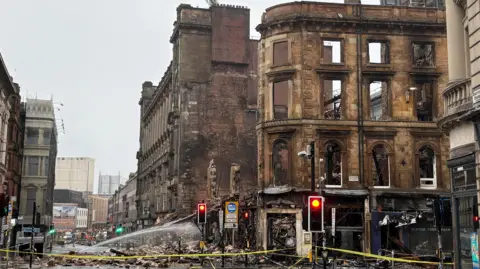
The remaining section of a historic Glasgow building wrecked by a fire is to be demolished.
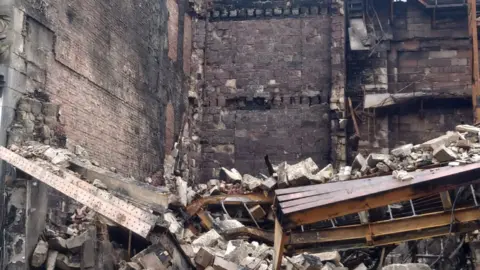
Glasgow City Council said the decision was made for safety reasons as parts of the Union Corner building, next to Glasgow Central Station, have continued to fall off.
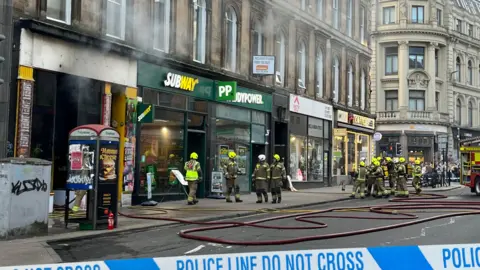
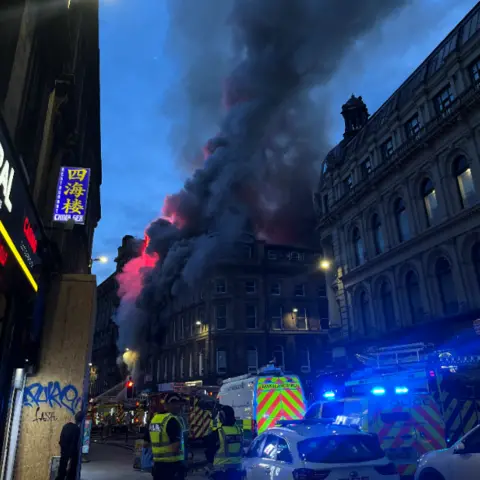
The fire started in a vape shop on Sunday afternoon and spread through the B-listed Victorian building. There were no casualties in the blaze.
Firefighters are still on site to continue to cool any remaining hot spots, with the station to remain closed for the rest of the week.
Glasgow City Council has taken control of the building from the Scottish Fire and Rescue Service and carried out its own assessment of the damaged structure.
In a statement, the local authority said: "We are now in control of the Union Street site.
"After a full and final assessment of the remaining structure, has decided that demolition must happen in the interests of public safety."
The council has not yet announced when the demolition will be carried out.
Security measures are in place around the building in a 'safe zone', which extends to Central Station.
 PA Media
Network Rail said "all available options" for safely reopening the station were being explored, including a partial or phased reopening of some platforms.
Services from the station's low level platforms resumed earlier this week.
The operator said engineers had not identified any significant structural issues and that damage, mainly due to water ingress, seemed to have been contained to a small area on the Union Street side of the station.
It said further updates, including timescales, would be shared "as soon as more detail becomes available".
Glasgow MSP Paul Sweeney was critical of the decision to demolish the building "within a matter of hours of the site being handed over".
He said he had asked both the first minister and the city council to bring in conservation-accredited engineers to assess the site, but had not received any responses.
He said: "Like at the Ayr Station Hotel, elements of this iconic listed building which could be preserved may now be destroyed unnecessarily.
"I hope that Glasgow City Council will at least laser scan the surviving elevation to enable a faithful reinstatement and undertake a careful hand demolition process that can 'flat pack' as much of the surviving structure as possible if a retaining scaffolding cannot be erected to all or part of the façade."
Vape shop regulation
At First Minister's Questions John Swinney told MSPs that the Scottish government had been in discussions with Glasgow City Council over supporting local businesses.
He said ministers were also looking at ways for tighter regulation of vape shops.
He said the local authority was gathering information from affected businesses, and details of financial support would be announced soon.
Scottish Conservative leader Russell Findlay said help for local firms should be the immediate focus, while Scottish Labour leader Anas Sarwar called for an investigation into the resourcing of the fire service.
Sarwar claimed high-reach appliances in the city had been cut from six to two, both of which were off for annual inspection on the night in question. This meant one had to be called through from Edinburgh.
Swinney said resources required to tackle the fire were available.
 Glasgow City Council
The Scottish government has also announced a ministerial board was being established to co-ordinate recovery efforts.
Justice Secretary Angela Constance will chair the board, which is tasked with supporting recovery efforts in the most effective way. Susan Aitken, the leader of Glasgow City Council, will join the group's meetings.
It will also oversee development of a support package to aid in the recovery process.
Some train services at Glasgow Central Station - beside the destroyed building - resumed on Wednesday after the weekend fire.
The station's low level platforms, which serve the Argyle line north of the River Clyde, reopened after a full site assessment, but the main high level station is to remain closed for the rest of the week due to the "high level of instability" of the fire-damaged facade.
What was the building that burned down?
 Getty Images
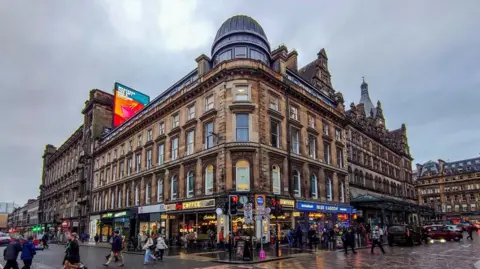
Known as Union Corner, at the junction of Union Street and Gordon Street, the B-listed building was constructed in 1851 and pre-dates Glasgow Central Station itself, which opened in 1879.
Designed by architect James Brown of the firm Brown & Carrick, it was built for Francis Orr & Sons - a well-known Glaswegian stationery and publishing company.
For years there was an Irn Bru advert on the rooftop and a red neon Bells sign on the dome itself, which made it a distinctive landmark in the city.
Among the businesses that until recently occupied the ground floor were the Blue Lagoon fish and chip shop and Sexy Coffee.

