Developer approved to bring Egyptian Halls 'back to life'

 Glasgow City Council
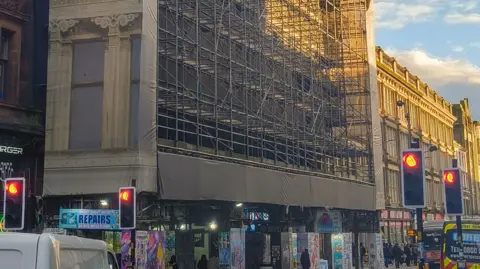
A developer has been confirmed to progress plans that would partly turn Glasgow's A-listed Egyptian Halls into a hotel.
Property firm Ediston say the proposal would involve minimal structural alterations to the building, designed by famed Scottish architect Alexander 'Greek' Thomson.
The site has been on the buildings-at-risk register since 1990 and Glasgow City Council say its condition has deteriorated in recent years.
The local authority last year launched a compulsory purchase order (CPO) process to take over the building from the current owners - two companies run by Dundee businessman Derek Souter and his partners.
The decision by the city council's contracts and property committee means it will now negotiate terms for a "back-to-back agreement" with Ediston - essentially tying contracts together - while working to ensure the CPO can be delivered.
Ediston will further develop its proposals and work towards securing full funding for the plans.
It hopes to convert the ground floor - currently home to shops - and the first floor into leisure uses, with the vacant upper floors becoming a hotel.
Egyptian Halls plan 'compelling'
Glasgow City Council say the bidding process for the Halls last summer saw about 20 notes of interest, with three bids then submitted.
The local authority stated Ediston's plans had scored significantly higher than the other proposals in all criteria, and boast a clear management and team structure with a defined timeline for development.
The submission includes in-principle commitments from potential new occupiers for the ground and first floor leisure uses and an international hotel operator for the upper floors.
Councillor Ruairi Kelly, the council's convener for built heritage and development, said the hotel plan was "compelling, detailed and well-progressed."
He added: "While there's much work yet to do, today's decision can be a significant milestone in securing a future for this architectural masterpiece while giving new life and new purposes to Glasgow's built heritage.
"By their very nature CPOs are lengthy and complex. But it's important for Glasgow's past - and its present and future - that we get this process right and bring this incredible building back to the heart of city life."
Decades long discussion
BBC Scotland News has seen correspondence between Souter, who owns the building through companies Union Street Properties Ltd and Union Street Investments Ltd, and the city council that suggests the businessman is intending to appeal the decision.
His companies were one of the two rejected bids. He has been in long-running discussions with Glasgow City Council over the building for decades, to the extent a previous CPO was attempted in 1996.
The council previously argued that having a deteriorating building in a prominent location opposite Glasgow Central Station was having a "significantly detrimental economic, social and environmental impact" on the city centre.
