STV journalists strike over plans to cut news show

 BBC
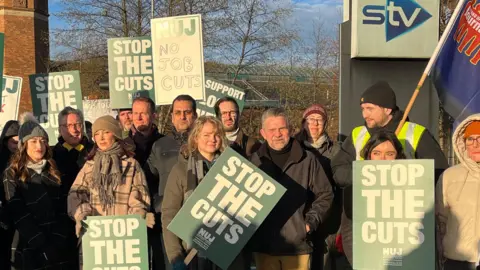
BBCAll Scottish news programmes on STV were cancelled on Wednesday as journalists staged a day of strike action.
The dispute is over compulsory redundancies and the end of a separate news service for the north of Scotland.
STV said the action was "ill-timed" as consultation with unions was ongoing.
Network programmes and advertising will not be affected by the strike.
But the company's new music radio station, which opened on Tuesday, remained on the air.
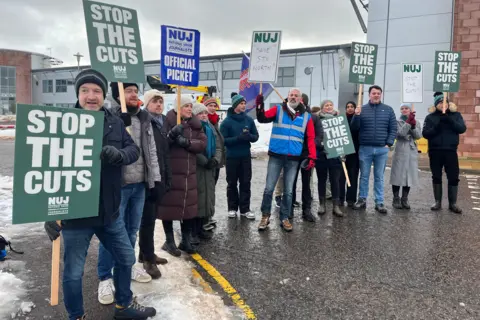
The National Union of Journalists (NUJ) is held protests outside STV's Glasgow headquarters and its Aberdeen offices.
Scottish organiser Nick McGowan-Lowe said members were striking in opposition to both compulsory redundancies and a management which he claimed "wanted to rip up" public service broadcasting obligations.
He said: "Viewers, staff, business leaders, politicians and unions all know STV's plans are desperate, shortsighted, damaging to Scottish journalism and in complete disregard of the viewers and communities in the north of Scotland who depend on local coverage from STV News."
STV currently provides two entirely separate news services - one for the central belt and the other for the northern half of Scotland.
The northern service is the last legacy of Grampian TV, which provided a range of local programmes for the area until the 2000s.
It was bought by STV's parent company in the late 1990s.
Later it was renamed and dedicated programmes for the north other than the news were dropped.
TV regulator Ofcom is currently consulting on proposed changes to the news service. The scheme would mean:
- All studio presentation coming from Glasgow.
- All news bulletins and most of the 18:00 programme being shown across both central and northern Scotland.
- Around 9 minutes' worth of separate material for the two regions during the 18:00 programme.
STV has emphasised that it will still have news teams in Aberdeen, Dundee and Inverness.
The bulletins and parts of the 18:00 programme, which would be shown across both central and northern Scotland, would include stories of national interest.
When the plans were first announced in September, they were condemned by the leaders of all the main political parties at Holyrood.
Aberdeen and Grampian Chamber of Commerce and some councils are also opposed.
Falling ratings and advertising
The company has argued in recent months that changes are needed because of falling ratings and advertising.
It insists it remains committed to providing a high quality news service and argues that the proposed set-up would ensure that service's sustainability.
Although the STV News at 6 is often the most-watched programme of the day in Scotland, little advertising is shown around it so it is of limited direct commercial benefit to the company.
BBC Scotland understands that five journalists remain at risk of compulsory redundancy although the changes will mean the loss of 28 roles within the news team.
Compulsory redundancies have been kept low as some staff have volunteered to leave and others affected by the changes have been redeployed.
Ofcom's consultation on whether to allow the changes runs until February. However it has no power over job numbers.
If Ofcom gives the go-ahead, the new format for news programmes is likely to be introduced by the spring.
'Changing media habits'
If the threat of compulsory redundancies is not withdrawn, more strikes are possible.
The law requires the NUJ to give two weeks' notice of any walkout.
Culture Secretary Angus Robertson spoke out against STV's plans at Holyood on Wednesday.
The former journalist said the Scottish government would continue to urge against any decisions that would result in further reductions in news reporting or redundancies.
Roberston's comments were prompted by a question from Labour MSP Richard Leonard who called on STV's board to withdraw the proposals altogether.
BBC Scotland News spoke to STV executive Bobby Hain, whose responsibilities include the news service and regulation.
Hain said the company was "incredibly proud" of its news service but changes were needed to safeguard its future.
He added: "We thought very carefully about the changes we wanted to make and what's really important is securing the future of regional journalism around the country.
"It's really important that we change and adapt to changing media habits.
"I recognise it is challenging but we can't do nothing."
Historically, STV and other channel 3 broadcasters had local commercial monopolies.
In return, the regulator of the day expected them to provide regional news and a range of other local programmes which may not have been profitable.
But growing competition - from broadcasters, streamers and websites - together with a fall in advertising revenue now make it harder to subsidise loss-making public service output.
