STV journalists to strike day after radio station launch

 Getty Images
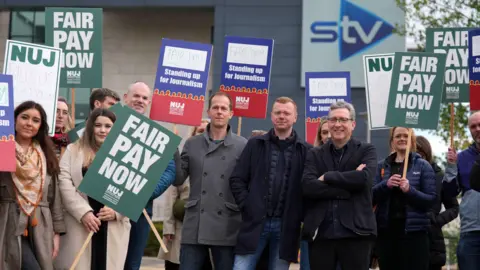
Journalists at STV are to strike over job cuts and major changes to news programmes.
The action by the NUJ union will take place on 7 January and is likely to mean that news programmes will be badly disrupted or cancelled.
The date was chosen to coincide with the launch of STV's digital radio station.
But shortly after the union announced the strike date, STV brought the station's launch forward by a day.
Nick McGowan-Lowe, the NUJ's Scottish organiser, said there was still time for STV to have a rethink but the union would not accept any compulsory redundancies among its members.
He said: "Our members are angry at the lack of leadership from the top of the company, angry at management's handling of the proposed changes and angry that their colleagues are facing compulsory redundancies because of the company's financial mismanagement.
"It is not too late for management to rethink their plans and avoid damaging strikes."
STV said: "The NUJ has notified us of their decision to take action on 7 January. This won't impact the launch of STV Radio, an exciting new growth venture for the business."
 PA Media
The broadcaster currently has two entirely separate news services - one for the central belt, the other for the north. This is the final legacy of Grampian Television, which used to provide a range of local programmes for northern viewers.
The company is proposing a merger of the two news services.
The main 18:00 news programme would still include around nine minutes' worth of material which would only be seen by viewers in the north. But most of the programme and the short news bulletins at other times would go out across both areas.
The TV regulator Ofcom is consulting on the plan until February but it has no power over jobs.
The changes also mean there will be fewer purely-local stories for viewers in the central belt although the overall changes to the service there will be less dramatic.
The NUJ had hoped the threat of action on the day the radio station had originally been expected to launch would have focused minds on avoiding compulsory redundancies completely.
The number of staff threatened with compulsory redundancy is already at a low level as volunteers have been found and some staff affected by the changes have been redeployed to other jobs.
STV has insisted that the launch of the new radio station and changes to news are entirely separate developments.
The changes to news follow falls in advertising revenue and declining viewing figures. The company argues the changes will ensure the service is sustainable for years to come.
Although the 18:00 news programme gets good ratings - and is often the most-watched programme of the day on any channel in Scotland - little advertising is shown around it, so the high audience is of little direct commercial benefit to the company.
The union fears the driving force for the cuts is STV's current financial challenges. Its share price has fallen badly since a profits warning in the summer and the company is only worth around £50m on the stock market.
The plan for the new radio station was announced months before the profits warning and the news cuts.
STV said its investment in radio "will drive profitable revenue for the company, helping to support our multi-million pound news operation which is not financially sustainable in its current form and for which we receive no public funding".
A spokesperson added: "Our request to Ofcom for changes to the news commitments in our licences, which they propose to accept, ensures the delivery of newsgathering and coverage right across Scotland on a sustainable basis for the company, and sees the expansion of our digital news service in response to changing news consumption.
"As a result of our cost savings plan, 28 roles are impacted across our newsrooms, the majority of which have been achieved through voluntary redundancy or redeployment."
STV is the only part of the Channel 3 network which is not run by ITV plc. Viewers in southern Scotland, who receive ITV1 and the local news programme Lookaround, are not affected by the plan.
The last time NUJ members at STV went on strike was in the spring of 2024.
This blacked-out news programmes but programmes taken from the ITV network and adverts were broadcast normally.
