'Ukraine will always be home - but Scotland is now home too'

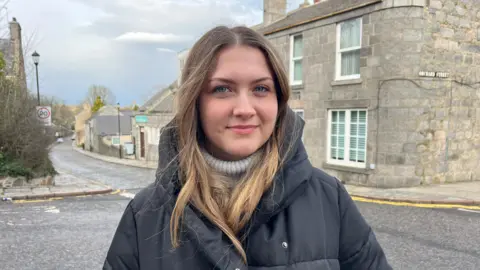 BBC
BBCWhen the Russian invasion of Ukraine began on 24 February 2022, Anastasiia and her family stayed in the city of Chernihiv for almost two weeks until it became "unbearable".
Russian forces laid siege to the city in the north of the country but failed to capture it.
With no electricity, no running water and no internet connection the residents felt "isolated from the whole world".
Anastasiia's family managed to relocate to the safer western part of Ukraine for a few weeks and when the Russians opted to bypass Chernihiv, they returned to what was left of the war-torn city.
Anastasiia says civilians had to be cautious not to step on explosives left by Russians during the siege.
This is when her family decided it was time for her to move to a safer place.
Anastasiia moved to the UK with a friend in July 2022 when they both were 18.
Her first home in Scotland was Inverurie in Aberdeenshire, where the pair lived with a sponsor.
In Ukraine, Anastasiia had been studying remotely and when she got to Scotland she was accepted into second year at Aberdeen University.
She told BBC Scotland News: "Everything was new but the hardest for me was probably being separated from family for the first time."
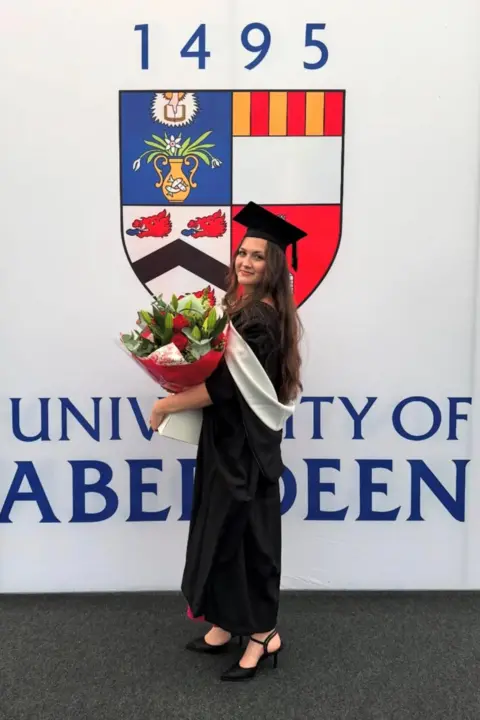 Viktoriia Sirenko
Anastasiia says she found support in other Ukrainian students and together they created a Ukrainian Society in the university.
"For me as a Ukrainian student, it was probably a different experience, not like for all other students," she says.
"Because during lectures you can get notifications about your part of Ukraine.
"You see that there was bombing and you straightaway text your family."
Since 2022, Anastasiia has seen her family just three times - most recently at Christmas when she returned for a week and a half.
"It was actually very scary time in Chernihiv," she says.
"There were a few bombings. One of them was only five minutes away from my house."
She says: "It was scary to hear the sound of upcoming rocket into your house.
"And you don't know where it hits, you just hope it's not your home."
Anastasiia, who graduated with an MA in Economics, says she wants to stay in the UK but the uncertain visa situation impacts her a lot.
She says it has been challenging to find the graduate job because her Homes for Ukraine visa does not guarantee long-term settlement.
'Grief never lets go'
Alisa Nartova also moved to Scotland on her own when she was 18.
She left the Ukrainian capital Kyiv to continue her university education as the war and regular interruptions of electricity, heat and water supply started to severely impact her mental health.
Before starting the university she worked for a year as a military linguist.
Having only herself to rely on, upon her arrival Alisa had to deal with paperwork, filling documentation, and dealing with university admissions on her own.
In her first months she faced a language and cultural barrier and stayed with a sponsor - a person she had never met before.
All the while, she battled what she describes as "survivor's guilt" - feeling guilty for being safe, while her family and friends are still in danger in Ukraine.
Alisa told BBC Scotland: "I have lost a lot of friends. People I knew for years, both guys and girls.
"Funerals is, really not nice, but often a place where you would find yourself if you are in your 20s and from Ukraine.
"The grief never lets go of you.
"You do not know where to put it and you just live with that."
Alisa says she find it difficult to answer the question "how are you?", especially after returning from her Christmas break in Ukraine
"It was minus 20C with no heating, no electricity, no water supply and a constant threat of a rocket, drone or missile," she says.
"You wake up from explosions nearby and in the morning you go to the places that were hit to help clean up the rubble."
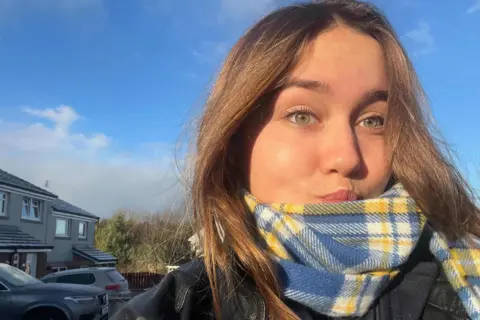 Alisa Nartova
But she says Ukraine remains her home.
"The depression, the anxiety, and it's all there," she says.
"But at the same time, it's the jokes, it's the festivals, it's the laughing on the streets, it's people showing love to each other.
"And that's what I miss."
Alisa says she wants to return to Ukraine after finishing her studies in Scotland to help rebuild her home country.
She is in the second year of MA Criminology and Sociology course and says: "Ukraine is home and always will be but I can say that I've found home here, too."
Education was my 'saving'
Anastasiia Korkina also came to Scotland when she was 18.
At the beginning she found it difficult to settle in a completely new environment.
She says she felt depressed because of the invasion and she didn't know what the future would hold for her.
After applying to universities, she got into the University of Aberdeen.
She told BBC Scotland News: "I found my saving in education here.
"Rather than being sad about the invasion I decided to invest my time in education."
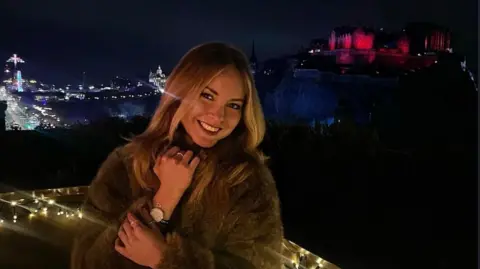 Mira Al Faradz
Some of her family lives in Odesa - a major seaport in the south-west of Ukraine.
Others live in a region currently occupied by Russia - and Anastasiia says she has no contact with them at the moment.
Anastasiia visits Odesa every six months and every time she says she experiences all the "harsh" conditions people in Ukraine are facing.
"I heard a lot of explosions, I heard bombings, drones, rockets, ballistic missiles at some point probably flying over our heads and it's been awful," she says.
"But my hometown Odesa is so beautiful so I keep coming back.
"My friends and family, they're so resistant but it's so sad to see their lives and youth been taken away.
"They seem so exhausted because genuinely they work every day so hard.
"And it's not life, I would say, it's more of a surviving."
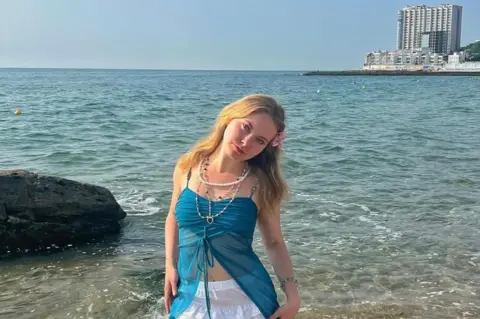 Alena Somova
Anastasiia says she doesn't have a feeling of home anymore.
She finds home in her family and friendships both in Scotland and Ukraine.
She is coming to the end of the studies and is facing uncertainties like other graduates about what will come next.
Anastasiia says she has learned to detach from the stress of uncertainty.
"There was so much pain and exhaustion regarding my beloved country," she says.
"I do not feel pain anymore really.
"I just feel numbness, I just detach myself from it."
Anastasiia says she would love to stay in the UK to build her career here.
"I've already built such a nice connection with people here so it would be a shame to just let it go and start again," she says.
