A hotel with rooms for students? People thought there would be chaos

 Social Hub
Blocks of student rooms are sprouting from many of the gap sites in Scotland's larger city centres, threatening to "hollow out" neighbourhoods according to critics.
Older buildings are being turned into hotels.
Both competitive sectors, both are at risk of levelling down to very similar offers. And with the risk of mono-cultures taking over where permanent residents used to be, both student and hotel accommodation have become ripe for disruption.
That's where Charlie MacGregor steps in - housing students at scale, and mixing them with business and leisure travellers as well as small businesses and lone desk-workers.

The key, he says, is to treat those student customers with trust and respect, and as "next generation talent".
The 50-year old Scot is the man behind The Social Hub - a chain of hybrid four-star hotels where lobbies gain from a buzz of business and leisure travellers, office workers in the creative sector, and students at work and play.
He has 21 locations already, with more than 10,000 rooms. When he brought in new investors in 2022, the deals valued the company at more than £2bn.
Eight Social Hubs are in the Netherlands, where MacGregor is based, and others are in those cities with at least one university, a tourist appeal and a lively business start-up culture. So that includes most of western Europe's capitals.
The only UK one is in Glasgow's Merchant City, offering nearly 500 rooms and work space for nearly 300.
He has plans for another in Edinburgh's Fountainbridge, on roughly the same scale.
Now going through the planning process, it is meeting opposition from those who want a stop to Purpose-Built Student Accommodation (PBSA) so that more scarce city space can be used for social housing.
Housing emergency
There's concern that students are getting priority during the housing emergency admitted by the Scottish and city governments, with high homelessness numbers and a dire shortage of affordable homes.
MacGregor does not classify The Social Hub as PBSA. More than half its rooms are a conventional hotel offering. Around 30% are for students, put into clusters within the building so that students can cook for themselves and so that high-jinks don't interrupt business travellers' sleep.
He was warned about the risk of mixing these client groups when he started opening up such Social Hubs, then known as The Student Hotel, in Holland.
Investors and planners thought hotel guests would not put up with students. In Amsterdam, there was an insistence that they should be separated into two entrances. Since it opened, only one has been used.
In the lobby, there are study spaces, some in secluded silence, but mostly a bustle of chat, pool, table-tennis and the cafe/pub/restaurant.
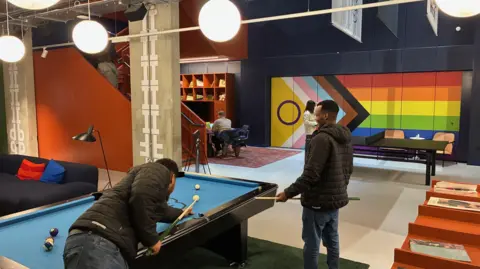
MacGregor began this disruption of the student market by offering space for parents to visit. Then he noticed bookings from business travellers, who enjoyed the ground floor vibe.
Although he missed out on the student experience 30 years ago, he's also found that students don't party all night and set off fire alarms if they're treated with that trust and respect.
It helps if you recognise that there are perhaps 30 different types of student, and if you go after the higher-spending and slightly older variety. That is where his prices are pitched. From £900 a month, it's roughly half as much again as a conventional student tenement flat.
"The old view of a student is that they'll destroy the place," he says. "But that's because they're only with students. Two hundred students by themselves are going to behave like students.
"When I started this, people were genuinely scared there would be chaos in our lobbies, But when you start mixing them with some adults and hotel customers, you see that everybody balances each other out.
"The hotel guests start to relax and start to have fun because there's a community vibe in our lobbies.
"What we have on our ground floor is more a reflection of our society, and therefore it's safer, more fun and better for everybody."
Renting out business space came next, with desks for sole desk-workers and space for small businesses. The social element of the Social Hub brings them together with students for drinks, debates and the gym, from which the two sides gain mentoring, internships, research projects and recruitment.
What was the business plan?
Deploying a new "green book valuation" of economic and social impact from a business, it's claimed that the Social Hub injects more than £10m annually into the Glasgow economy, more than five times greater than a conventional hotel of that size.
The business model is designed to flex, so that a downturn in one part of the clientele can be balanced out by an upturn in another. There's also a healthy mix of short and long-term customers.
If, for instance, tourism is down, there may be demand for more student space, and vice versa. Office space is flexible and can find other uses. A theatre for 200 people in the Glasgow Social Hub can be used for the city's Comedy Festival, for a student party or for sport.
Demand for gym space has grown since it was opened less than two years ago, so it's being expanded.
That flexibility worked well during the financial crisis, in a previous stage of MacGregor's business career. When businesses went to the wall because banks were calling in loans, Charlie MacGregor had to hand the keys back on some properties.
But when the economy began to open up, he was the one with a business plan for the upturn in demand for student accommodation.
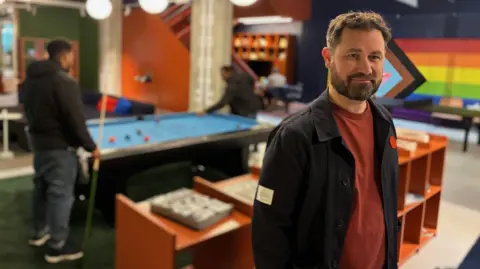
It worked in his favour again when Covid struck. Some students were stuck in his accommodation, and after a short while, others wanted to return to universities. When the hotel market began to open up again, he was the one with facilities which were already functioning.
Charlie MacGregor's story began in Edinburgh, attending a private boarding school, with undiagnosed dyslexia. He loved school but failed exams, and left at 16 to make his way in car sales and construction. Moving to London, he followed his father into student accommodation investment.
Once diagnosed with dyslexia, he came to see it as "a superpower". That's how he describes it to two of his four children who share that condition.
"Dyslexia I see as an advantage," he says. "It didn't help me pass exams. But it's a skillset I have that others don't have. It helps me think out the box, to be more creative about how I think of answers, find solutions or do presentations.
"It's not a disability or a hindrance. Given the right space and tools, what I tell my kids is that they have a superpower."
Breaking the model
When he moved to the Netherlands, MacGregor says: "There was a huge crisis in student accommodation. What I saw was lacking and what I really wanted was a diverse community. I wanted to bring parents into the student experience, to treat students like next-generation professionals.
"I wanted to add co-working and businesses, and locals as well. Hotels are these closed-door facilities in your neighbourhood or in your city, which is a shame, so we have a good relationship with the neighbours."
That appeal to the community includes a cafe and bar priced to bring in local people. The Social Hub is currently creating clubs of 500 people in each of its locations who have access to facilities, events and free coffee on a Sunday.
Even without being a member, locals keep the ping-pong tables busy, forming a competitive ladder with students residents, and joining the running club on Thursday lunchtime.
Charlie MacGregor is not the kind of businessman to stick to his lane. He set up a charity to help refugees, starting on the beaches of Greece 10 years ago, and applying the Social Hub thinking: what can you bring to the mix? The refugees themselves pitched in with the skills they brought.
And he is frustrated at the way in which housing shortages are being tackled across Europe and the UK. The private sector is expected to provide solutions, and the role of government is to put costs and restrictions on them, he says.
"At some point, you break the model with too many restrictions. There's too much expected of the private sector. It's like asking you to rent out your spare bedroom at half its value. Not many people are going to do that."
