'Each empty home shows there is a problem' - housing leaders call for action

 BBC
BBCA group of housing sector leaders has called for the government to launch a national strategy to bring empty homes back into use, amid record levels of people living in temporary accommodation and long waits for social housing.
Estimates suggest more than a million homes in England are currently unoccupied, with over 309,000 of those classed as long-term empty.
Organisations including the Big Issue, Women's Aid, Shelter and Resonance sent a letter to housing minister Matthew Pennycook MP calling for action to be taken to get them back in use.
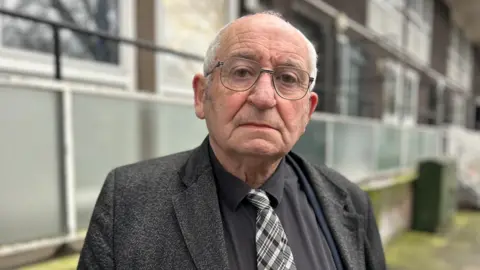
Lord John Bird, founder of the Big Issue magazine, said every empty home was "a sign that there is a problem" when it came to tackling the "housing emergency" efficiently.
The government said it was setting out "plans to make it easier for empty homes to be brought back into use".
More than 1.3 million households in England are currently stuck on waiting lists for a social home, a rise of 10% in the last two years. Over 300,000 of those are in London.
The open letter called on the government "to ensure that no property stands empty".
Lord Bird said the "housing crisis" required a "toolbox", and "one of the tools we need is to turn every house in the UK into a useful property that is being used because it is a limited, finite resource".
"I feel bad that there are parts of London, parts of the UK, where people can't live and yet round the corner there is a void property," he said.
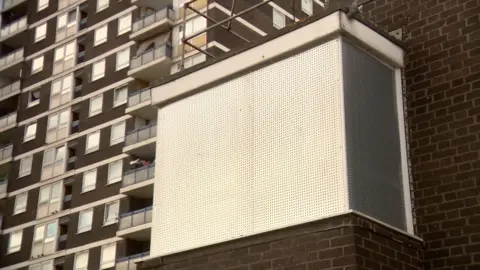
Families living in temporary accommodation recently told BBC London of their frustration at "living in limbo" on estates where dozens of family homes are boarded up.
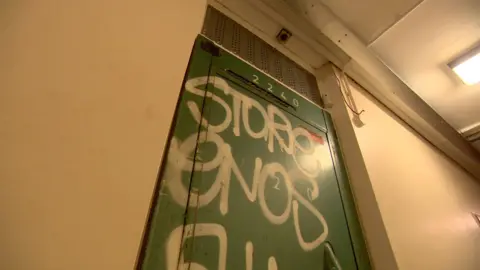
In Hackney's De Beauvoir Estate, 49 homes which were previously used for temporary accommodation have stood empty for at least two years, in three buildings which have collapsed or blocked drains and leaks.
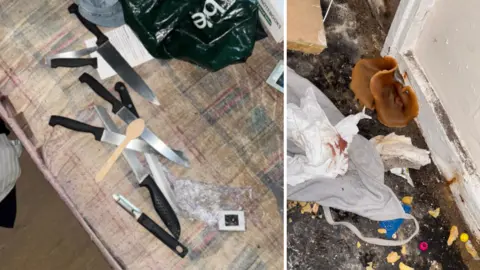
Before the council boarded them up last year, some of the flats were occupied by squatters, causing concern among residents who showed BBC London photos taken inside the homes of knives, drug paraphernalia and blood-stained napkins dumped on surfaces.
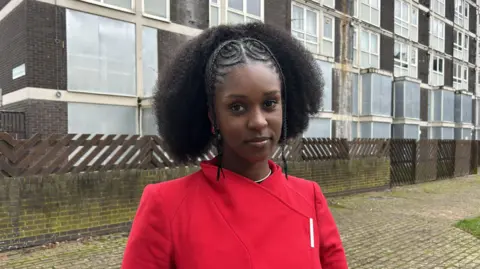
Sherri, who lives in a block where the entire ground and first floor remain empty, said she had "seen people who are not a part of the community drunk. I've seen rough sleepers underneath our fire exit stairs. Antisocial behaviour - dogs barking all hours of the day
"There are so many vulnerable people in this building - octogenarians, kids. It was strange being in our building and feeling we were so close to danger - this is supposed to be your sanctuary."
She said the state of the estate had become "a bit of a hot potato when you contact the council. They either pass it on to another department, tell you somebody is going to call you back, or they simply ignore you.
"This is zone two. They could be a shelter over good people's heads."
According to Hackney Council, some 7,800 people were on its housing register as of 31 January.
Guy Nicholson, deputy mayor and cabinet member for housing management and regeneration, said the empty homes on the De Beauvoir Estate "no longer meet today's standards" and finance was in place to convert them "into 70 modern temporary homes for homeless families".
"Hackney is no different from many other London boroughs in facing a chronic housing supply crisis," he added.
"Hackney Council is doing everything in its power to provide these much needed homes including delivering nearly 1,000 new council homes for social rent alongside bringing empty homes it is the landlord for back into use."
 De Beauvoir Estate residents
Zoe Garbett, chair of the London Assembly housing committee, said the situation was being "replicated across the city", with long waiting lists for council properties, and local authorities being placed under huge pressure "to make sure they are doing those repairs and bringing them back into use".
She said more government funding was needed to help the situation, while London boroughs also "need to pull together".
"There's not much movement in social housing in London," she said, pointing to how "lots of people are in under-occupied [homes] but aren't supported to downsize, lots of people are in overcrowded homes".
Garbett, who is standing in the May elections as a green candidate for mayor of Hackney, also acknowledged the "massive problem" with the number of empty private homes in the capital.
"We've pushed in Hackney for an empty homes officer to make sure they're pursuing that, with ways of bringing those homes into use," she said.
The recommendations made in the open letter calling for an empty homes national strategy, which has been seen by the BBC, include:
- A fully-funded local authority duty to investigate and act on long-term empty homes complaints
- National initiatives, such as a loan scheme, a national acquisition fund, and an enforcement fund
- Replacing the New Homes Bonus system with rewards for successful empty homes interventions
- Ringfencing Council Tax Premium revenue for local housing initiatives
- Developing empty homes-specific enforcement powers
- Reducing stamp duty for purchasers, where properties are used to meet local demand for social housing, and who provide homes for those on a pathway out of temporary accommodation
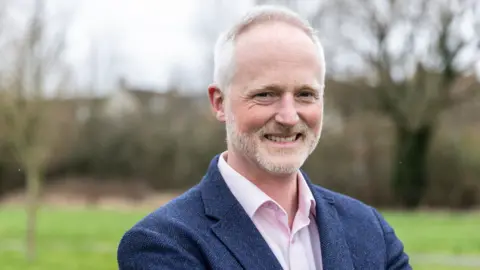
Resonance, a social impact property fund manager, was among the organisations that signed the letter to the government.
Chief executive Daniel Brewer, said there was "an urgent need for certain people facing the acute housing needs", with "132,000 families in temporary accommodation costing council tax payers £2.2bn last year".
"Two women a week are killed per week by a partner or ex-partner and the main reason they give for not leaving is there is nowhere to go. Two-thousand adults with learning disabilities are living in hospitality who have no need to live there.
"These are all things where existing empty homes could be part of the solution.
"We're not going to build our way out of this. This is an access to housing issue as well as a supply of housing," he said.
 Resonance
Some academics argue there are better ways of solving the housing crisis.
According to analysis from the Centre for Cities, filling long-term unoccupied properties would only make a small difference compared to the need to build more new homes.
Maurice Lange, who is from the think tank, accepted that while taking action on empty homes was a "good thing", he believed "planning reform and increasing funding for affordable housing would make a much more significant contribution to solving the housing crisis".
"Even if housing targets were lower, empty homes are always a small and finite resource," he said.
A Ministry of Housing, Communities and Local Government spokesperson acknowledged empty homes were "bad for communities".
"We've set out plans to make it easier for empty homes to be brought back into use and expect councils to use the powers we've already given them to ensure that this happens now.
"This is alongside investing £39bn to build the biggest boost to social and affordable housing in a generation," they said.
Listen to the best of BBC Radio London on Sounds and follow BBC London on Facebook, X and Instagram. Send your story ideas to hello.bbclondon@bbc.co.uk
