'There are dozens of empty homes but families like mine are living in limbo'

 BBC
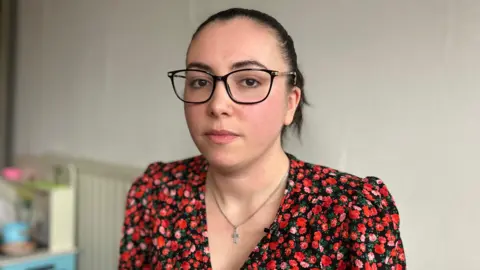
BBC"They say they don't have enough homes, but look at how many empty ones there are - [the council] just doesn't want to fix and repair them," says mother-of-one Vanessa.
She lives on Central Hill estate in Lambeth but only in temporary accommodation and says she's been left "in limbo".
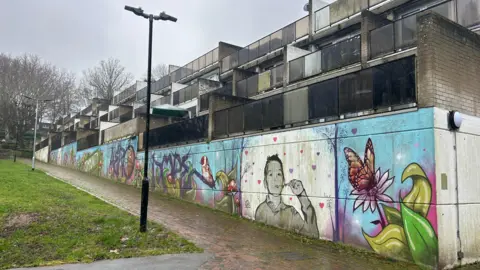
Dozens of properties on the south London estate are unoccupied, one for eight years, and yet the borough has the third-highest housing waiting lists in the capital - something that Vanessa, who has been waiting for a social home for three years, describes as "outrageous".
In 2014, the estate was marked for regeneration, which means Lambeth Council plans to provide new housing and local services by refurbishing, demolishing or rebuilding ageing blocks.
The council says "all options are being considered", but more than a decade on, residents say the estate has fallen into disrepair, with family homes boarded up at a time when so many families are desperate for more security.
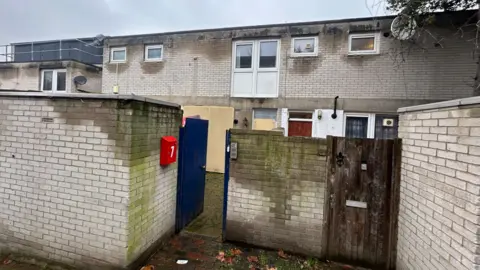
A Freedom of Information (FOI) request to Lambeth Council has revealed that in the past year, across six regeneration estates, the council is taking an average of 572 days to bring unoccupied homes, known as "voids", back into use.
In other words, the amount of time between a formal tenancy ending and a new tenancy beginning far exceeded the 30-day target set by the council for minor repairs, and 150 days for standard repairs.
One property has even remained empty for 33 years.
These homes often must undergo repairs so they are a "lettable standard" or are waiting to be re-let to a new tenant.
Lambeth Council says some of its homes have already been allocated to families who are due to move in, and there are far fewer "true voids" - referring to a property that cannot be easily brought back into use.
And yet there are almost 30,000 people on the council's social housing waiting list, with thousands of families living in temporary accommodation.
'Dehumanising uncertainty'
"If they do the proper works immediately after moving somebody out, they can immediately move a family in there," says Vanessa.
She claims one flat in her block has been empty for 10 months since her neighbour moved out, and isn't aware of any works or checks that have been conducted.
The one-bedroom flat she lives in with her two-year-old daughter is "overcrowded", she says, while they have also faced antisocial behaviour, issues with mould and a silverfish infestation.
"There's been talk about demolishing the building since I moved in, and way before that," she says.
"No-one knows what's going to happen - there's meetings about it but no decisions are made. We are living in dehumanising uncertainty."
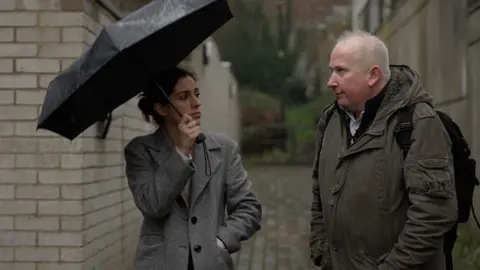
In regards to Vanessa's flat, Lambeth Council says it has carried out a number of repairs and according to its records there have only been two antisocial behaviour cases reported from Central Hill since January 2024.
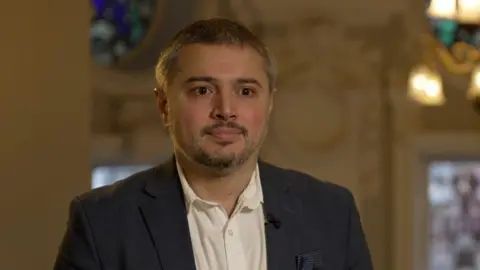
Nevertheless, Pete Elliott, a former resident and Gipsy Hill councillor for the Green Party from 2018-2022, describes the past 10 to 12 years as "psychological warfare" for the residents.
Mr Elliot, a prospective Green Party candidate for Gipsy Hill in the May local elections, says: "People are just left in limbo for so long.
"They can't do improvements and repairs because they don't know how long they're going to be in their homes.
"At the same time we've got people who are overcrowded who could be in larger houses. There are some three-bedroom houses that have sat empty for far too long.
"I want to see people who have been moved on to the estate in temporary accommodation to have secure housing."
A void property is a residential or commercial building that is untenanted, meaning it is empty, not generating rental income, and typically lies in the gap between one tenant moving out and a new one moving in.
Danny Adilypour, deputy leader of Lambeth Council with responsibility for housing, says there are only 181 true voids in the borough, which have long-term repair issues or squatters.
But he accepts more needs to be done and the council is always looking to "speed up the process".
He adds there are a number of complexities including squatters, waiting for the keys to be handed over, and legal issues involving families who have left.
"These properties have severe leak issues, drainage issues, structural issues that need to be addressed. So sometimes for older properties it can take a bit of time but we're not going to use a property unfit for use for a resident.
"Even if we had zero voids it wouldn't tackle the huge surge of homelessness we're seeing in Lambeth and across London," he says.
Huge rise in empty homes in London
Mr Adilypour also acknowledged the wider number of long-term empty properties in London - up 23% in the past year from 38,386 to 47,287 - making it the region with the largest increase, according to government figures.
These include dwellings considered to be "unoccupied and substantially unfurnished", as well as some unoccupied homes that are exempt from council tax, such as because the last owner or occupier has moved to a care home or hospital.
"We need to make sure we don't have large numbers of private properties lying empty for a long time," he explains.
"There are people who have second properties, investment properties, and Airbnb properties which aren't properly registered in a way the council can monitor.
"The homes we control as a council we turn around and bring back into use as soon as possible and I would hope the government would look at this and the wider picture."
According to analysis from the charity Action on Empty Homes, a total of at least 160,000 homes are currently empty in London.
Director of Policy and Campaigns, Chris Bailey, said the house-building industry in the UK has been "building the wrong housing for the wrong people", including "expensive flats with high service charges and unaffordable rents aimed at the so‑called luxury market".
He added: "We think there is a lot of unsold newbuild in the latest figures and a lot of homes with unrealistic price tags. We also think we've seen far too much property built for so-called investors and not for Londoners in need of housing."
A Ministry of Housing, Communities and Local Government spokesperson acknowledged "having empty homes is bad for communities" and said the government was "fixing this as part of our plans to restore the dream of homeownership in London and across the country".
"We've set out plans to make it easier for empty homes to be brought back into use and expect councils to use the powers we've already given them to ensure that this happens now.
"This is alongside investing £39bn to build the biggest boost to social and affordable housing in a generation."
London's social housing lists are at an all-time high.
The challenge is that there is no single reason for homes being empty - although figures continue to soar.
While not all of these are within the councils control, it begs the question - how do we better balance housing stock?
Additional reporting by Jonathan Fagg, England Data Unit
Listen to the best of BBC Radio London on Sounds and follow BBC London on Facebook, X and Instagram. Send your story ideas to hello.bbclondon@bbc.co.uk
