'Insane' six half-marathons run on New Year's Day

 Stuart Woodward/BBC
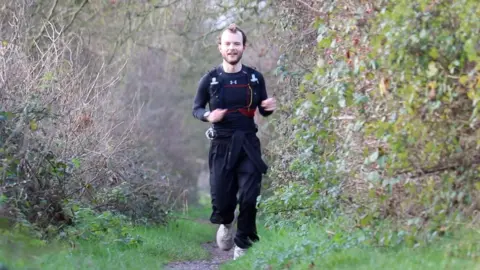
A man has run six consecutive half marathons on the first day of 2026 to fund research after his sister was diagnosed with a brain tumour.
Jack Syder-Mills began his epic feat in Norwich on the stroke of midnight on 1 January and completed all six runs in 19 hours and 52 minutes, ending on the Norfolk coast at Cromer.
Jack, 27, said it was "sufficiently insane to inspire others that you can push yourselves and go further than you think".
He said the start of the run was "memorable... very weird; you could see all the fireworks going off and a few people looking at me in a strange way thinking 'what are you doing?'."
 Family handout
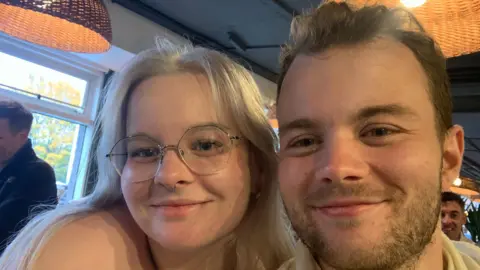
He said his sister Ella realised she had a brain tumour at the age of 22 when she was studying neuroscience at Keele University in Staffordshire.
"She was able to self-diagnose and get treatment early, but for a lot of people, that isn't possible," said the runner.
"I was so keen to raise money for a cause that's underfunded.
"Brain tumours kill more adults and young people under the age of 40 than any other cancer, but only receive 1% of national research funding."
 Stuart Woodward/BBC
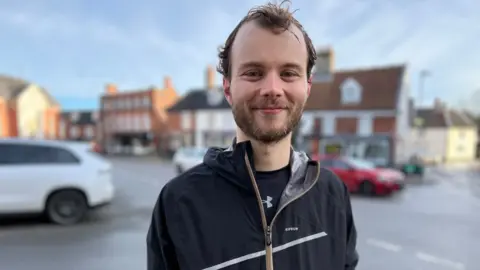
Jack said the challenge, in aid of the Brain Tumour Research charity, was one of the "toughest" things he had done.
"The pain I'm experiencing is very much temporary and lasts eight or nine hours and a couple of days afterwards," he told the BBC during one of his runs.
"But the pain for people with a brain tumour diagnosis, or their family, can last a lifetime. I feel like the thing I'm doing is very much a minor thing."
After finishing he said he was "relieved" after experiencing lots of "highs and lows" while running in the dark.
"It hasn't really settled in yet the scale of it, but I have been really heart-warmed by messages and donations," he said.
"I have no idea what is next, but I don't think it will be the last challenge."
 Stephen Huntley/BBC
Jack's route was made of six sections that are each roughly 20.26km (12.58 miles), just under the length of an official half marathon distance, which is 13.1 miles.
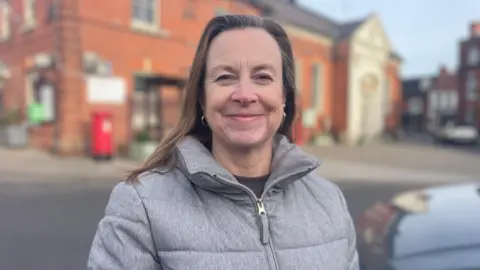
He took breaks between each run, fuelled by the help of his mum Jane Syder.
She said it was "the worst time" while they waited to hear what kind of tumour her daughter had - and there was great relief that it was benign.
"This is a disease that can happen to anybody's child at any time and it's devastating for the family," she said.
"So we wanted to raise awareness and valuable funds towards research, and to be able to save children's lives.
"Ella is very emotional and proud of Jack, but we are equally proud of her because her journey and her run in the last few years has been significantly harder."
Follow Norfolk news on BBC Sounds, Facebook, Instagram and X.
