Brain tumour during pregnancy a 'complete shock'

 Brain Tumour Research
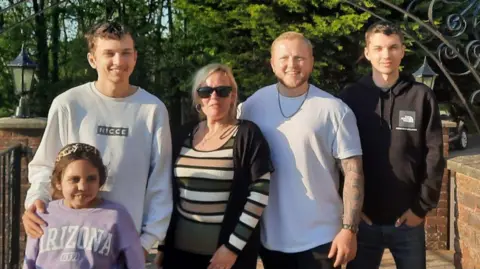
A mother who was diagnosed with a brain tumour during pregnancy says it was a "complete shock" and the most frightening time of her life.
Stephanie Hillard, 50 from Axbridge in Somerset, first experienced symptoms in 2012 with hearing loss, balance issues, and facial numbness. Initially diagnosed as tinnitus her condition continued to worsen.
She said: "When I was told I had a brain tumour I was in complete shock. I was terrified of what the diagnosis meant for my baby and whether I would be there for my children as they grew up."
Hillard is walking 10,000 steps every day throughout February to raise funding and awareness for the charity Brain Tumour Research.
While seven months pregnant in 2013, an MRI scan at Musgrove Park Hospital in Taunton revealed a benign, slow-growing meningioma.
"It was the most frightening time of my life," said Hillard.
Surgeons advised her to undergo surgery after the birth of her daughter, Lilly, now 12, in March 2013.
Due to the location of the tumour, surgeons were only able to remove 60% of it to avoid life-altering damage.
In 2017, routine scans revealed the tumour had begun to grow again, leading to further treatment with radiotherapy.
Hillard continues to live with balance issues, fatigue, and the long-term effects of what she describes as an "invisible disability".
 Brain Tumour Research
She has been unable to return to work and is now a full-time carer for her daughter, who has a genetic condition.
"Having to care for her while I'm going through what I'm going through comes with challenges," Hillard added.
After hers was misdiagnosed, she hopes her walking challenge will highlight the need for more funding into research for brain tumours.
According to Brain Tumour Research, the disease kills more children and adults under the age of 40 in the UK than any other cancer, yet just 1% of cancer research spending has been allocated to brain tumours since records began in 2002.
Hillard said walking also helps her stay positive.
"I walk not just for myself but other people as well. When you go out there it makes you feel like you're doing something good for people," she said.
"I tell people a bit about my story, just the fact of talking about it and what to look out for.
"It makes me feel better."
Follow BBC Somerset on Facebook and X. Send your story ideas to us on email or via WhatsApp on 0800 313 4630.
