Could river restorations be key to easing floods?

 BBC
BBCWith homes flooded, roads impassable and schools closed in the aftermath of Storm Chandra, the issue of how we come to terms with the greater likelihood of floods has surfaced once again.
Climate change is bringing warmer, wetter winters, which means more frequent disruption from flooding as rivers burst their banks.
Professor in physical geography at the University of Southampton David Sear said rivers would continue to be modified by "extremes of flooding, more extremes of drought".
"We've got to allow the water to go out onto its floodplain, flow more slowly, and make sure that the land surface around is able to store more water and release it more slowly," he said.
One such effort is the Wild Woodbury project over 170 hectares at Bere Regis in Dorset.
The so-called stage-0 river restoration is aimed at cleaning water, storing carbon and developing new wildlife habitats upstream on the River Sherford, and helping communities further down the river.
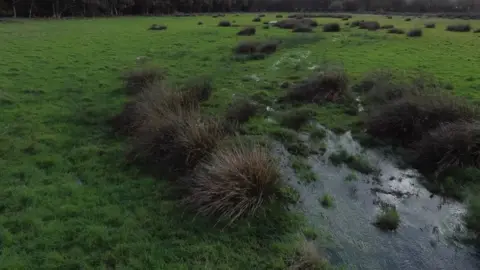
Preparation involved pushing the water out of the existing ditches on what was a typical farming landscape and and letting it flow over the land.
The unconstrained water was allowed to find its own pathways and naturally re-establish old routes across the fields.
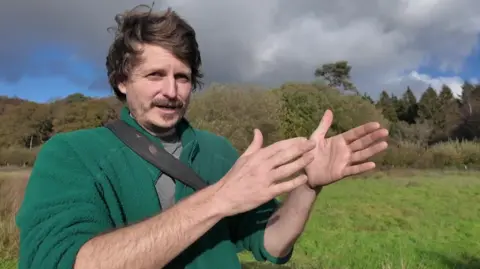
Project manager Rob Farrington said the benefits were seen almost immediately, with the water in various streams and pools so clear it "looked like gin".
"The water leaving our land before this restoration used to zoom down the drainage channels and the ditches incredibly quickly flooding the minor roads," he said.
"Slowing the water down and spreading it out not only creates this fantastic place for wildlife but those minor roads have not flooded since we've done this because the land acts like a sponge."
He said the work was helping alleviate both extremes of droughts and floods.
"So when there's plentiful rain, the water spreads out on our land and slowly and in a controlled manner goes on down," said Farrington.
"By slowing it down, it gives the land the ability to remove excess nutrients, so it's filtering it, it's cleaning it.
"And wetter soils can sequester and store more carbon."
The 270 hectares now has about 50 hectares of wetland, however, the trust admits such a solution would not work everywhere.
"That's a lot of space but then we're on a very flat open area here," Farrington said.
"In other areas, you're just not going to be able to get that benefit, so you need to be weighing up the cost of doing the activity and what you're going to win."
"In some instances, we may have built a road or houses on floodplains. It's obviously not feasible to do it," he added.
Nevertheless, he insists the scheme is a "massive benefit", cleaning rivers and coastlines further downstream towards Poole Harbour.
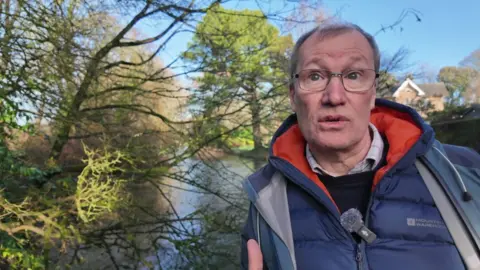
However, Prof Sear cautioned that with the bigger picture of climate change, such schemes were not enough.
"Just doing things at isolated locations seems like a great idea at that location but it's not necessarily treating the scale at which the challenge is being produced," he said.
"So we've got to join all these bits together, including, where necessary, some hard engineering but we can do it better now in order to be able to allow these rivers to adapt to this changing climate."
He said building on floodplains should be ended to "stop the risk", as well as providing protection for properties already built.
"When you look at an old map, you notice that all the villages and the old churches and structures like that, they are built outside the floodplain because they knew that was the winter riverbed," he said.
"Now, if you think of floodplains as the winter riverbed, why would you build in a riverbed?
"At the rate we're going, we're not going to be able to achieve the scales of change needed to address flooding, to address the nutrient problems and to address the biodiversity crisis unless we scale up.
"But we can't do it through diggers and lots of high-energy, high-cost things. We've got to do stuff working with natural processes."
You can follow BBC Dorset on Facebook, X (Twitter), or Instagram.
