Study to examine ways to slow short-sightedness

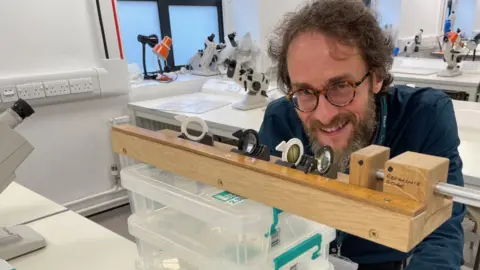 University of Bradford
Researchers at two West Yorkshire universities are leading a study examining ways to slow the progression of short-sightedness.
Staff at the University of Bradford and the University of Huddersfield are investigating how contact lenses worn by people in their 20s can delay myopia.
Findings are expected to inform future treatments, as myopia rates are predicted to reach 50% worldwide by 2050 - up from about 34% today.
Prof Edward Mallen, from Bradford university, said: "Myopic eyes are vulnerable to things like macular degeneration and other conditions, trying to control that is really important."
Myopia is a common eye condition where a person is unable to clearly see objects far away.
It is usually corrected with glasses or contact lenses.
"Alongside myopia comes other potential eye health problems - it is not just about the need for spectacles or contact lenses," Prof Mallen continued.
"It is about slowing down myopia progression.
"We can correct myopia with spectacles and contact lenses, we have done that for a long time.
"Now we have got great products that can correct the vision and can slow down the rate of progression."
The study is due to track participants using spectacles or contact lenses to assess changes in prescription strength and other physical eye factors over time.
Listen to highlights from West Yorkshire on BBC Sounds, catch up with the latest episode of Look North.
